Quick answer
In swimming, PB means personal best: your fastest time ever in a specific event across your entire swimming career. SB means season best: your fastest time in that same event during the current competitive season (September to August in North America). PBs measure career-long progress and qualifying status. SBs measure how you are performing right now.
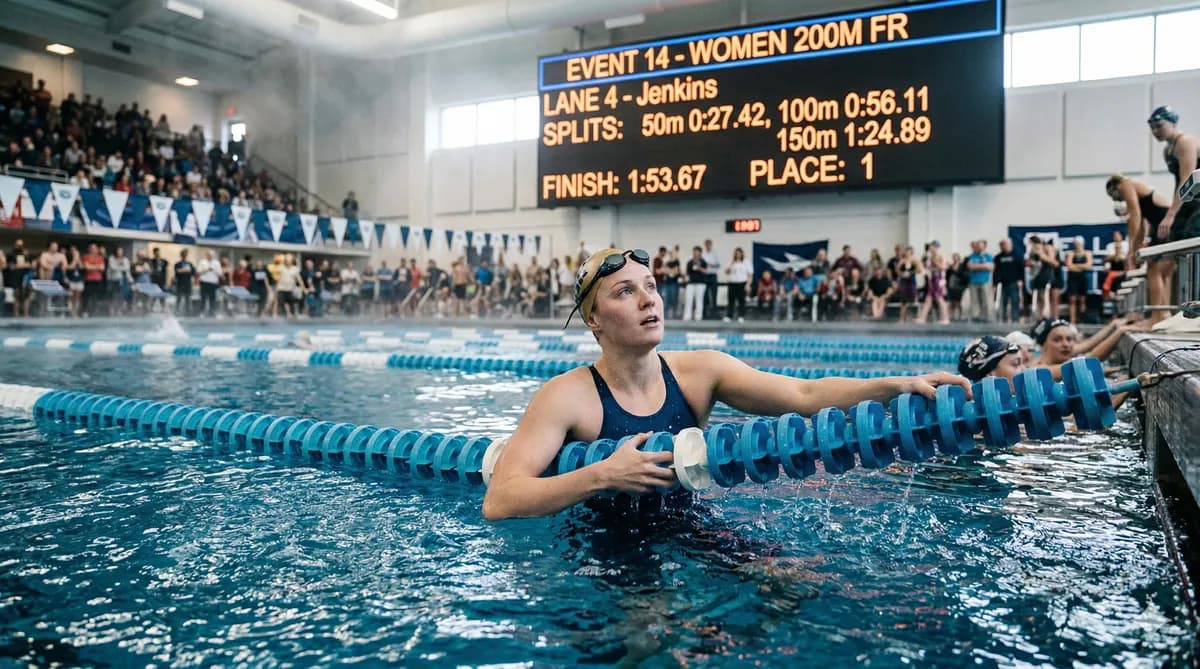
Rafa walked off the pool deck in Vancouver and asked me, half-confused, "Was that a PB or a SB?" She had just clocked a fast 200 IM but could not remember if it beat her best ever or just her best this year.
I did not know either. I had to look it up.
If you have ever stood at the scoreboard wondering which "best" you just broke, you are not alone. Season best and personal best sound similar, but they answer different questions, and they matter for different reasons.
Here is the plain version, why each one counts, and how to keep them straight without a spreadsheet.
The Plain-English Definitions
Personal Best (PB). Your fastest time ever in a specific event, across your entire swimming career. If you swam 100 free for the first time at age 9 and have raced it 200 times since, your PB is the single fastest one. It does not matter what year it happened. It is the all-time mark. You will also hear it called a PR (personal record) or a lifetime best. All three mean the same thing.
Season Best (SB). Your fastest time in that same event during the current competitive season. The season usually runs September through August in North America, with a short course block in winter and a long course block in summer. SB resets at the start of each new season.
Two numbers. Same event. Different time windows.
A 14-year-old might have a PB of 1:04.20 in the 100 free from a championship meet last March and an SB of 1:05.80 from this fall, since the new season just started. Both numbers are real. They just answer different questions.

Same event, two different best times. PB is the all-time mark; SB is the current season's mark.
When Personal Best Matters Most
PB is the long-arc number. It is the one that goes on college recruiting profiles, the one parents brag about, the one that lives in the swimmer's head at the start of every race.
PB matters most when you are:
- Setting a long-term goal. "I want to break 1:00 in the 100 free this year" is a PB-level target.
- Looking at motivational standards. Whether a swimmer "has" a B, A or AA time is usually judged by their best time in that event. Championship cuts are stricter: they only accept times from a set window (more on that below).
- Talking to college coaches or recruiters. They want your fastest verified time, period.
- Marking a milestone. Breaking 30 seconds in the 50 free or 1:00 in the 100 free. Those are PB moments. They only happen once.
The catch with PB: it can stay frozen for a long time without meaning you are not improving. A swimmer can be in great shape, training well, and still not touch a PB set during a tapered meet last year. That is where SB comes in.
When Season Best Matters Most
SB is the short-arc number. It tells you what is happening right now.
SB matters most when you are:
- Seeding a meet. Meets seed swimmers by their entry time, which has to come from the meet's qualifying period. Early in a new season, that is often a time from this season.
- Tracking in-season progress. Are you faster than you were in November? SB tells you. PB does not move that often.
- Setting a season goal. "I want to drop a second in 100 free this season" is an SB-level target. It is realistic and time-bound.
- Comparing fairness across competitors. SB shows current form. PB might be from two years ago when the field looked very different.
- Coaching conversations. Coaches plan around current form, not historical bests.
A swimmer with a strong SB but a stale PB is in good shape, climbing back toward an old peak. A swimmer with a recent PB and a slower SB is probably mid-season and not yet tapered. Both are normal.
Qualifying Times: Which One Counts?
This is where it gets important. Championship cuts are checked against your fastest official time inside the meet's qualifying period. If your PB falls inside that window, your PB counts. If it is older, it does not, and a more recent time has to do the job.
Two real examples from USA Swimming:
| Meet | Qualifying period starts | Source |
|---|---|---|
| 2026 Speedo Junior Nationals (summer) | June 1, 2025 | Official time standards PDF |
| 2026 Speedo Winter Juniors | November 1, 2025 | Official time standards PDF |
A great swim from spring 2025 would be your PB but would not qualify you for either meet. Swimming Canada and provincial sections also set a qualifying window for each championship, and local meets set their own.
Always check the meet info packet. The "qualifying period" line tells you exactly which times count.
The practical version: your PB qualifies you, but only if it is recent enough. If it is not, your SB has to do the job.
Why Both Numbers Matter for Motivation
This is the part that gets missed.
If you only chase PB, you will be disappointed often. PBs do not happen every meet. They cluster around taper and championship periods, maybe two or three times a year. Outside of those windows, every race feels like a near-miss, and that wears on swimmers.
If you only chase SB, you might feel great in-season but lose sight of the longer arc. A swimmer who keeps setting SBs at slower-than-PB speeds may need to ask whether they are actually improving year over year, or just starting each season at a slower pace.
Healthy goal-setting uses both:
- PB as the ceiling. The dream target. The "this would be a breakthrough" number.
- SB as the next step. The realistic in-season target. The "if I keep training and tapering well, I should hit this" number.
When SB starts approaching PB, you know taper is going to be exciting. That is the spot every swimmer wants to be in.

Healthy progress conversations use both numbers. PB sets the dream; SB sets the next realistic step.
How Gophin Tracks Both
Gophin pulls race results from official competition databases, so both numbers are there for every event your swimmer has raced.
Open the Best Times screen and you see the all-time PB for every event. Switch the season filter to the current season and the same screen shows the season bests. No manual entry, no spreadsheets, no asking the coach to text you a list.

Best Times: all seasons for the PB, one season for the SB. Updated from official results.
For the long view, Compare → Seasons puts two seasons side by side, event by event, with a progression chart. That is where the year-over-year story shows up clearly.
Everything in Gophin is free, with no paid tier. Open your swimmer's Best Times
Quick Decision Guide
Use this quick reference next time you are not sure which number to look at.
- "Did I just break my best ever?" Check PB.
- "Am I getting faster this year?" Check SB.
- "Do I qualify for this meet?" Check the qualifying window, then PB or SB.
- "What seed time goes on the entry?" Your fastest time inside the meet's qualifying period. Check meet info. Our guide to seed times, PB and NT explains the entry side.
- "Am I trending up across years?" Compare → Seasons, this season against last.
One Last Thing
PB is the highlight reel. SB is the trend. You need both to know whether you are actually improving, and you need both to know whether to celebrate.
Next time you stand at the scoreboard wondering which "best" you just broke, do not guess. Compare this season with the last one in Gophin and see both numbers in context. Free.
Sources
- USA Swimming. 2026 Speedo Junior National Championships time standards (PDF). Qualifying period.
- USA Swimming. 2026 Speedo Winter Junior Championships time standards (PDF). Qualifying period.
- USA Swimming. Time standards. Motivational standards and championship cuts.