Quick answer
Before a swimmer moves into a new age group, check the next meet's age-determination rule, compare their current official times with the appropriate future category and keep their previous results intact. A harder standard does not mean the swimmer has become slower. Use the comparison for planning; the meet package and coach confirm eligibility.
A birthday can make a familiar standards chart feel suddenly unfamiliar. The swimmer is still improving, but the next row asks for a faster time. A family can interpret that as losing progress, even though the stopwatch says otherwise.
The useful approach is to separate what changed in the athlete's performance from what changed in the comparison. A new age group changes the context. It does not rewrite the race that happened last month. Planning ahead gives the swimmer time to understand the next target without turning a birthday into a deadline.
Establish which age rule the meet uses
Do not begin with the app's current age display alone. Find the exact meet and edition, then read its age or birth-year rule. The relevant date may differ between competitions and standard sets.
For a specific example, Swimming Canada's 2027 preliminary information describes the Trials junior category using age as of 31 December 2027. That is a reason to check the package, not a rule to apply to every Canadian or US meet.
Record the chosen competition, its age date, the intended category and the source document. If the package is preliminary or unclear, ask the coach before treating a category as confirmed. Our Canadian qualification guide explains why different national meets must be checked separately.
Keep three questions separate
| Question | Useful reference |
|---|---|
| Has the swimmer improved? | Their own official times in the same event and course |
| How does the next category compare? | The selected standard's next applicable age row |
| Can the swimmer enter the meet? | The meet's complete eligibility and entry conditions |
Answering the middle question does not answer the last one. A hypothetical future-category comparison cannot establish that an older swim is valid for a future meet. The qualifying window and accepted courses still need checking.
It also cannot establish past eligibility. An app showing today's club or age is not a reconstruction of every historical entry rule. Use the actual meet documents when that historical question matters.
Preview the next target in Gophin
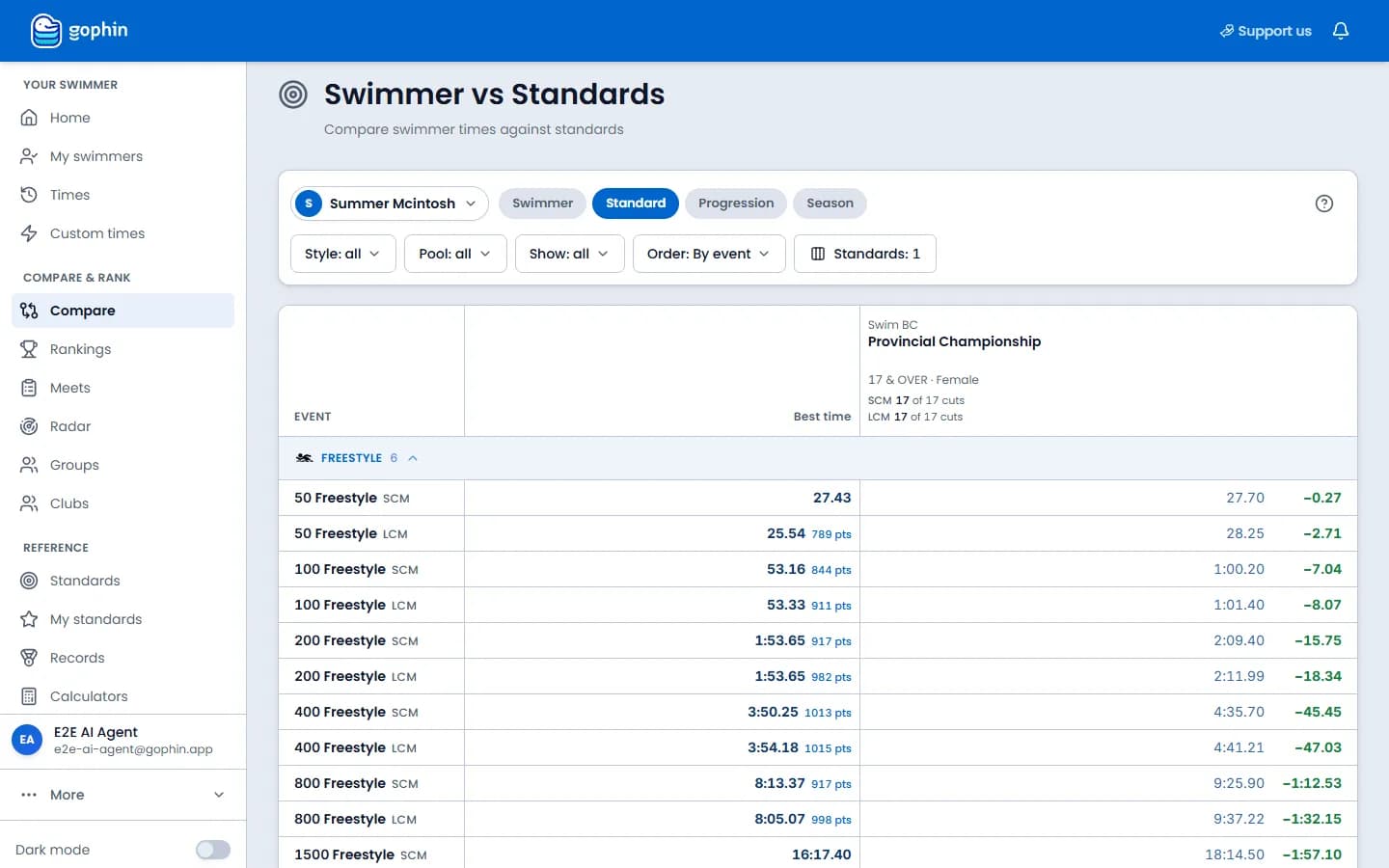
Open Compare → Standards, select the swimmer and choose the intended standard set. Check the season, course and competition category. Where the set provides the next age category, select it to explore the new reference.
Treat this as a planning comparison. It is not changing the swimmer's birth date, rewriting the result or declaring them eligible for a future championship. A deliberate filter change should stay visible in the family conversation: “This is next year's target row.”
Explore your swimmer's next age-category standards
The standards walkthrough explains the filters. If the future edition is not listed, use the official document rather than assuming the current edition will remain unchanged.
Explain a changing label with a concrete example
Consider a hypothetical girl who swims 2:11.00 in the 200 free SCY. In USA Swimming's 2024–2028 age-group PDF, the 13–14 A cut is 2:11.69 and the 15–16 A cut is 2:07.69.
Her swim is faster than the first target, but 3.31 seconds behind the second. The performance remains 2:11.00 in both comparisons. The difference comes from the selected age-group benchmark, not a decline in the swim.
Say that plainly: “You still swam your best. We are looking at a new target now.” The 200 free guide shows the full context, and the swimmer's own history shows the improvement that led to this point.
Choose a transition goal with the coach
Instead of trying to preserve every previous badge immediately, pick a goal that makes sense for the coming season. That might be approaching one cut, maintaining a more consistent race or gaining experience in another event.
Discuss the swimmer's interest as well as the numbers. A target they understand and want to pursue is easier to keep in perspective than a whole chart of standards that suddenly moved away.
Do not turn the gap into a required training prescription. The coach decides what work is appropriate. A parent's useful role is to keep the information accurate, provide encouragement and notice progress that the new category can obscure.
Review progress across the transition
Keep original dates and courses attached to the results. Use the same course when comparing before and after the birthday. A switch from yards season to long-course season can change the visible times independently of the age-group move.
Gophin's season comparison guide helps organise that review. If a converted result appears, keep the estimate label visible rather than counting it as a new official best in another course.
After a few relevant races, revisit the goal with the swimmer and coach. The aim is a workable direction for the season, not a constant test of whether the child has caught up with an older field.
Questions families ask
Does aging up erase a personal best?
No. A legal result remains part of the swimmer's history. The category used to interpret or enter it may change.
Can I use an old qualifying time in the new age group?
Check the exact meet's qualifying window and eligibility conditions with the coach. Reaching a standard in a preview comparison is not enough to decide that question.
Should I change the swimmer's profile to preview the next group?
No. Keep identity details accurate. Use the standard's category filter for planning and the official meet rule for eligibility.







Commentaires
Aucun commentaire pour l'instant. Les questions sur les temps, les compétitions ou l'app sont les bienvenues.