
Quick answer
Find your strongest events by comparing each legal best with the same kind of benchmark, then check the result against your own history and your coach's plan. Raw seconds cannot fairly compare a 50 free with a 200 IM. Age-group standards help with context; World Aquatics points offer another comparison for metres swims, with separate course tables and no official yards table.
The event a swimmer enjoys most, the event in which they win a heat and the event closest to a championship cut may be three different things. That is not a contradiction. Each answers a different question.
For families choosing season goals, the aim is not to discover one permanent “best stroke” and close every other door. It is to identify a current strength, an interesting opportunity and a manageable next step. Organised results make that conversation clearer.
Decide what “strongest” means today
Start with the decision you need to make. Are you selecting a meet target, reviewing a season or deciding which race to discuss with the coach? A comparison is useful only if it helps that decision.
For a near-term championship goal, the relevant question may be which event is closest to that meet's cut. For broader development, you might look for consistent improvement across several races. For confidence, it may be an event the swimmer enjoys and can execute well under pressure.
Write down the question before opening a ranking. Otherwise it is easy to let the largest badge or smallest raw time choose the goal for you.
Compare like with like first
Use legal official results, the correct event and the original course. Keep SCY, SCM and LCM separate. A converted time can help explore an idea, but it should not be treated as an actual performance in a different pool.
Within one event, compare the swimmer with their own earlier results. Notice whether an improvement is repeated or rests on one exceptional race. A single result can suggest an opportunity; several races provide more context.
For age-group tables, choose the same standard set and relevant category across events. Do not compare one event against a single-age A cut and another against a championship open-age cut, then interpret the labels as an equal scale.
Use standards to identify useful targets
In Gophin, open Compare → Standards and select the swimmer, set, category and course. Review which events meet the target and which remain close. The standards tutorial explains missing times and converted labels.
A small gap in seconds is useful for planning, but it does not always identify the swimmer's strongest event. One second is a different fraction of a 50 free from a 400 IM. Even a relative percentage is a comparison aid rather than a coaching verdict, because event demands differ.
Treat the view as a shortlist for discussion. A nearly achieved cut in a race the swimmer rarely swims may be worth exploring; an achieved cut in a favourite event may be worth consolidating. The coach can balance those opportunities with development and the meet schedule.
Add World Aquatics points for metres events
World Aquatics points put metres performances on a common scoring scale using a base time for each event, competition category and course. They can help compare a swimmer's different events without comparing raw seconds.
Use matching table editions and keep long course separate from short course metres. The official system does not publish a SCY table. A score calculated after converting yards to metres adds an estimate and should be labelled as such, not presented as official yards points.
The official World Aquatics base-times PDF is the source for the current tables discussed in our points guide. Base times can change between editions, so a change in score is not automatically a change in the swimmer's race time.
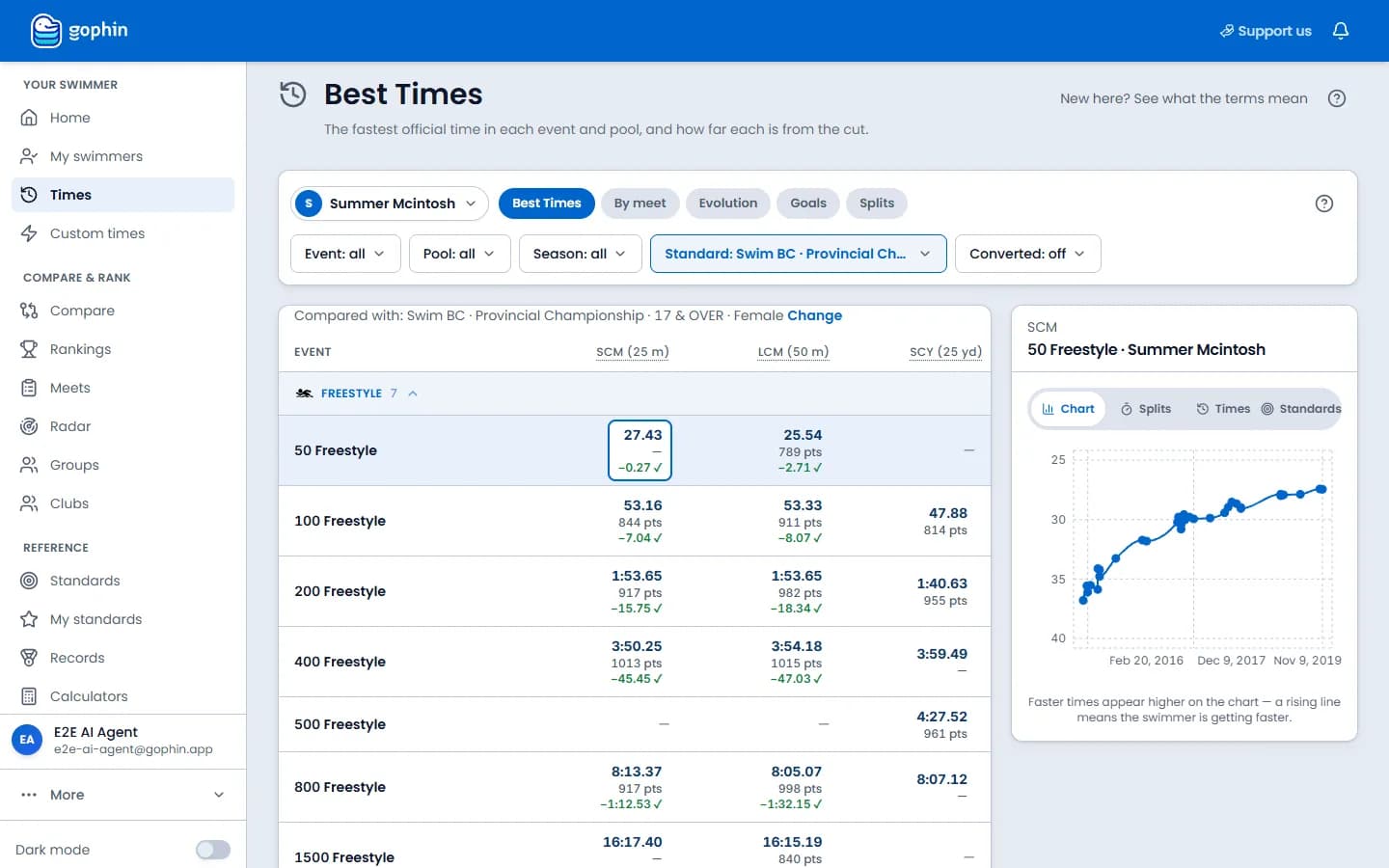
In Gophin, use Times → Best Times to review the selected swimmer's results and available points for metres swims. Start with the actual result, then add the score as another layer of context.
Review your swimmer's best times by event
Avoid three shortcuts that distort the answer
Winning a heat is not the same as the strongest event. Heat position depends on who was entered and how the meet was seeded. Use the official performance alongside the placing.
The smallest gap in seconds is not automatically the easiest cut. Skills, race opportunities and the swimmer's current training all matter. Ask the coach what is realistic rather than treating a spreadsheet order as a training plan.
Today's strongest event is not a permanent identity. Swimmers gain experience in new events and change over time. Keep opportunities open instead of labelling a child exclusively as a sprinter or a breaststroker after one meet.
Bring a small shortlist to the coach
Choose one established strength and one event worth exploring. For each, bring the official best, the appropriate benchmark, the recent trend and the swimmer's own interest. That is enough information for a useful conversation.
Agree on the next review point after a few relevant races rather than checking the order after every swim. Gophin keeps the history accessible; the family and coach decide how often reviewing it helps.
Questions swimmers ask
Can points tell me which event to enter?
They can inform the discussion, but entries also depend on goals, scheduling, eligibility and the coach's plan. A score alone cannot make that decision.
Is my highest-ranked event always my strongest?
Not necessarily. A ranking reflects a particular comparison group and filter. Standards, race history and enjoyment may highlight different opportunities.
What if one event has no recent time?
Treat it as missing evidence, not a weakness. Ask the coach whether racing it would be useful before predicting performance from another event.





Comentários
Ainda não há comentários. Dúvidas sobre tempos, competições ou o app são bem-vindas.