Quick answer
Let the coach coach. The car ride home is for the person, not a split autopsy. Cheer effort, not only the hundredths. Compare your child to their own past times, not the kid in the next lane. Look at official results after the file is up, not from the stands.
After one of Rafa's races last year, I started analyzing her splits before we even left the parking lot. Michelle gave me a look from the passenger seat. Rafa was silent in the back. I learned more about being a swim parent in that two-minute car ride than in any article I had ever read.
You know the one.
The parent who shouts split times from the bleachers. Who corners the coach after every practice. Who dissects every race in the car ride home before the seatbelt is even buckled.
Nobody sets out to become "that" parent. It happens slowly, fueled by love and a fierce desire to see your child succeed. But somewhere between support and pressure, there is a line -- and it is surprisingly easy to cross.
Here is how to stay on the right side of it.
Research backs this up. A 2024 systematic review published in Frontiers in Psychology found that parental pressure is consistently linked to adverse motivational outcomes in young athletes, while parental support is linked to greater enjoyment and persistence in sport [1]. The line between the two is real, and science has mapped it.
Let the Coach Coach
This is the golden rule of swim parenting, and it is harder than it sounds.
Your child's coach has a plan. They know which sets build endurance, which drills fix technique, and when to push versus when to pull back. When you second-guess training decisions or offer your own stroke corrections poolside, you create confusion. Your swimmer ends up trying to please two authorities instead of trusting one.
Your job is not to coach. Your job is to get them to the pool on time, fed, rested, and knowing that someone at home believes in them regardless of what happens in the water.
If you have concerns about training, schedule a private conversation with the coach. Never undermine them in front of your child.
The Car Ride Home Is Sacred
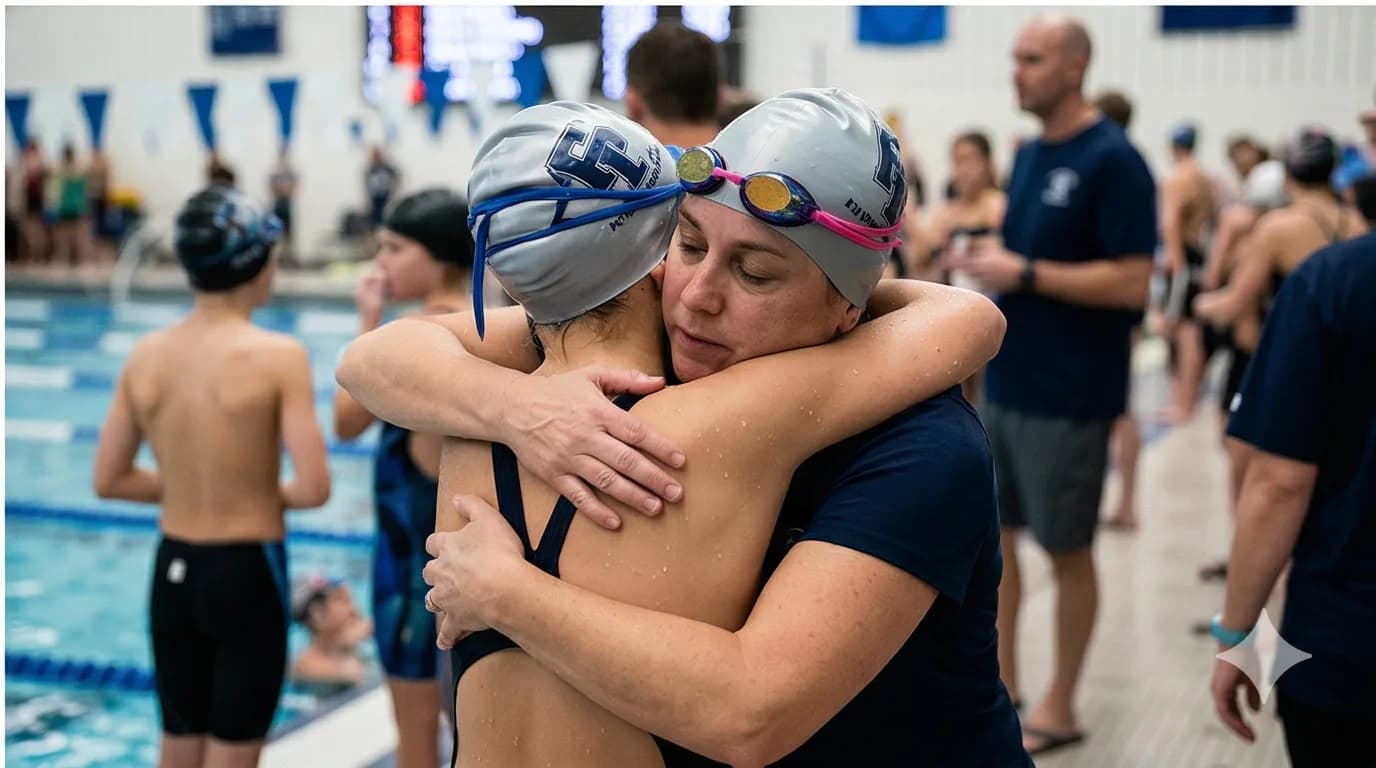
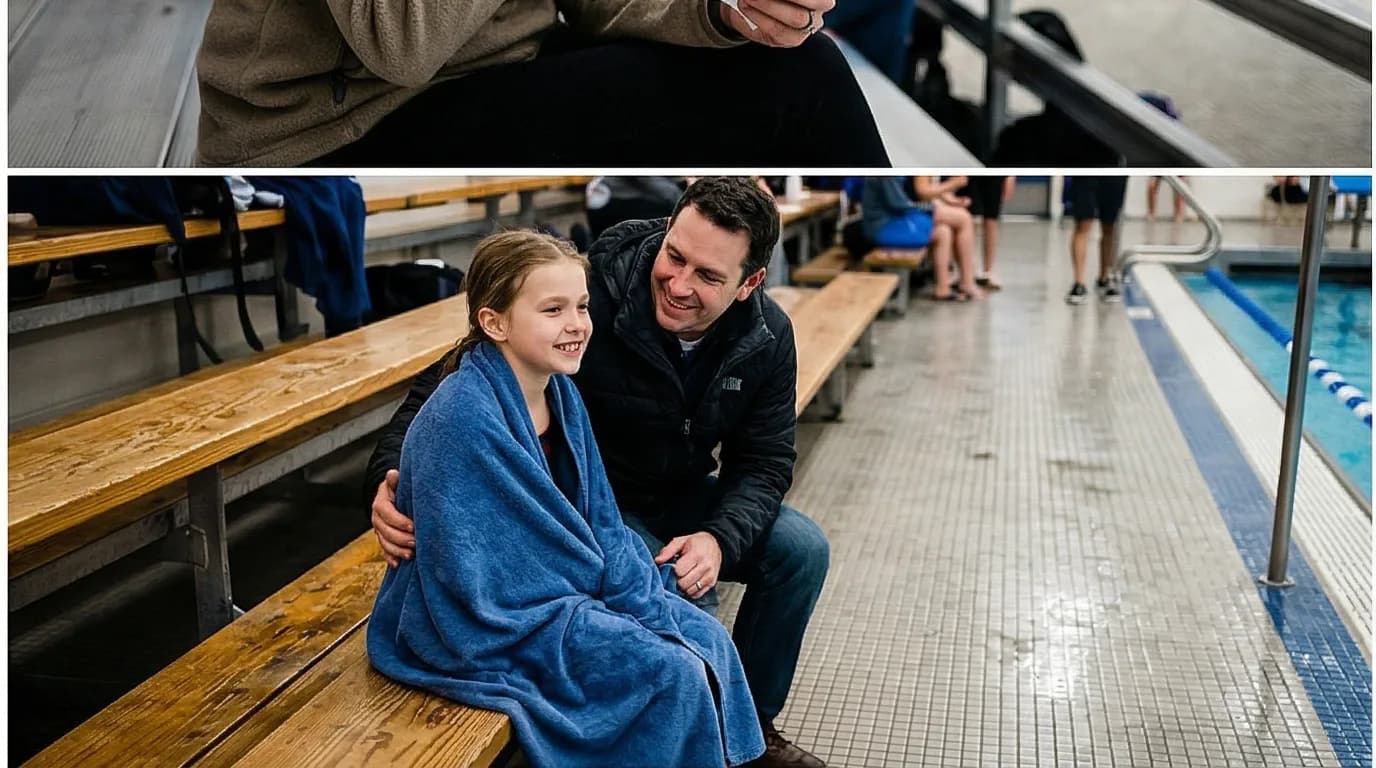
After a meet -- good or bad -- your swimmer does not need a performance review. They need a parent.
Resist the urge to ask about times before they have even dried off. Instead, try something like:
- "I love watching you swim."
- "Did you have fun today?"
- "I am proud of you for showing up and competing."
Sports psychologists consistently point to the car ride home as one of the most formative moments in a young athlete's experience. According to research by Knight and Holt (2014) published in Psychology of Sport and Exercise, positive parental involvement -- emotional support, logistical help, and unconditional acceptance -- is directly associated with greater enjoyment, self-esteem, and motivation in young athletes [2]. The parents who get this right create a safe space. The parents who get it wrong create anxiety that follows their child to every starting block.
A simple rule: if your swimmer wants to talk about the race, they will. Let them lead.
Celebrate Effort, Not Just Results
It is natural to get excited about a personal best. But if the only time you show enthusiasm is when the clock cooperates, your child learns that your pride is conditional.
Celebrate the early mornings. Celebrate finishing a brutal set. Celebrate the meet where nothing went right but they still got back on the block for the next event.
Swimming is a sport where improvement is measured in fractions of a second over months and years. If you only celebrate outcomes, you will have a lot of silent car rides. If you celebrate effort, you will raise a resilient athlete.
Stop Comparing Kids
Every swimmer develops differently. The twelve-year-old who dominates age group meets may plateau in high school. The late bloomer who finishes last at regionals may earn a college scholarship. A 2024 AAP Clinical Report by Dr. Joel Brenner notes that 70% of children drop out of organized sports by age 13, often because the pressure to perform outweighs the fun [3].
Comparing your child to their teammates -- out loud or even in your own head -- distorts your perspective. It turns teammates into rivals and makes your swimmer feel like they are falling short of an invisible standard.
The only comparison that matters is your child against their own past self.
What "That" Parent Actually Looks Like
Sometimes it helps to see the behavior plainly:
- Yelling instructions or corrections from the stands during a race
- Arguing with officials about calls or timing
- Publicly questioning the coach's lineup or training decisions
- Posting passive-aggressive comments in the team group chat
- Making your child feel like their value is tied to their times
If any of these hit close to home, that is not a reason for shame. It is a reason to recalibrate. Awareness is the first step.
Healthy Involvement vs. Unhealthy Involvement
Healthy: Volunteering at meets, learning how the sport works, showing up consistently, asking your child how they feel about their swimming.
Unhealthy: Hunting splits from the stands, setting goals your child did not ask for, living vicariously through their results, creating pressure they never asked you to create. Official times can wait until you are home.
The best swim parents are present, encouraging, and a little bit boring about results. They show up, they cheer, and they let their child own the experience.
The Bottom Line
Your swimmer will not remember their 200 IM time from when they were thirteen. But they will remember how you made them feel after it.
Be the parent who makes the pool a place of joy, not stress. Be the parent whose face in the stands means comfort, not pressure. Be the parent they actually want to tell about their races -- because they know the conversation will be safe.
That is the kind of swim parent every kid deserves.
If you want the official time and splits, sign in to Gophin after the meet file is published. Free, no card. Do it at home. The parking lot is still for "I love watching you swim."
Sources
- Frontiers in Psychology (2024). Systematic review: parental pressure linked to adverse motivational outcomes; parental support linked to enjoyment and persistence. Frontiers in Psychology. Link
- Knight, C.J. & Holt, N.L. (2014). Parental involvement in youth sport: positive involvement associated with greater enjoyment, self-esteem, and motivation. Psychology of Sport and Exercise.
- Brenner, J.S. & DiFiori, J.P. (2024). Overuse Injuries, Overtraining, and Burnout in Young Athletes. AAP Clinical Report. Pediatrics, 153(2). Link
Related guides for swim parent life
- Helping swim parents interpret progress without anxiety
- Your stress is contagious, how parent anxiety affects swimmers
- Clarity around swim performance reduces anxiety
- Swimmer's shoulder, a parent's prevention guide
- Growth spurts and swim performance, a parent's guide
- Club swimming vs recreational, when to make the switch
- Morning practice at 5 AM, how to make it work
- The real cost of competitive swimming
- 5 signs your young swimmer is burning out
- Why swimming is the best first sport for kids
- Hydration guide for competitive swimmers
- How much sleep does a young swimmer really need?
- How swimming builds discipline that lasts a lifetime
- The academic advantage, why swimmers do better in school
- 7 life skills kids learn from competitive swimming