Quick answer
A swim meet result sheet lists each event by code, heat, and lane, then shows seed time (entry), final time, place, and time drop. Look for your swimmer's name, compare final to seed (negative means dropped time), and check the "Q" or standard column for cuts achieved.
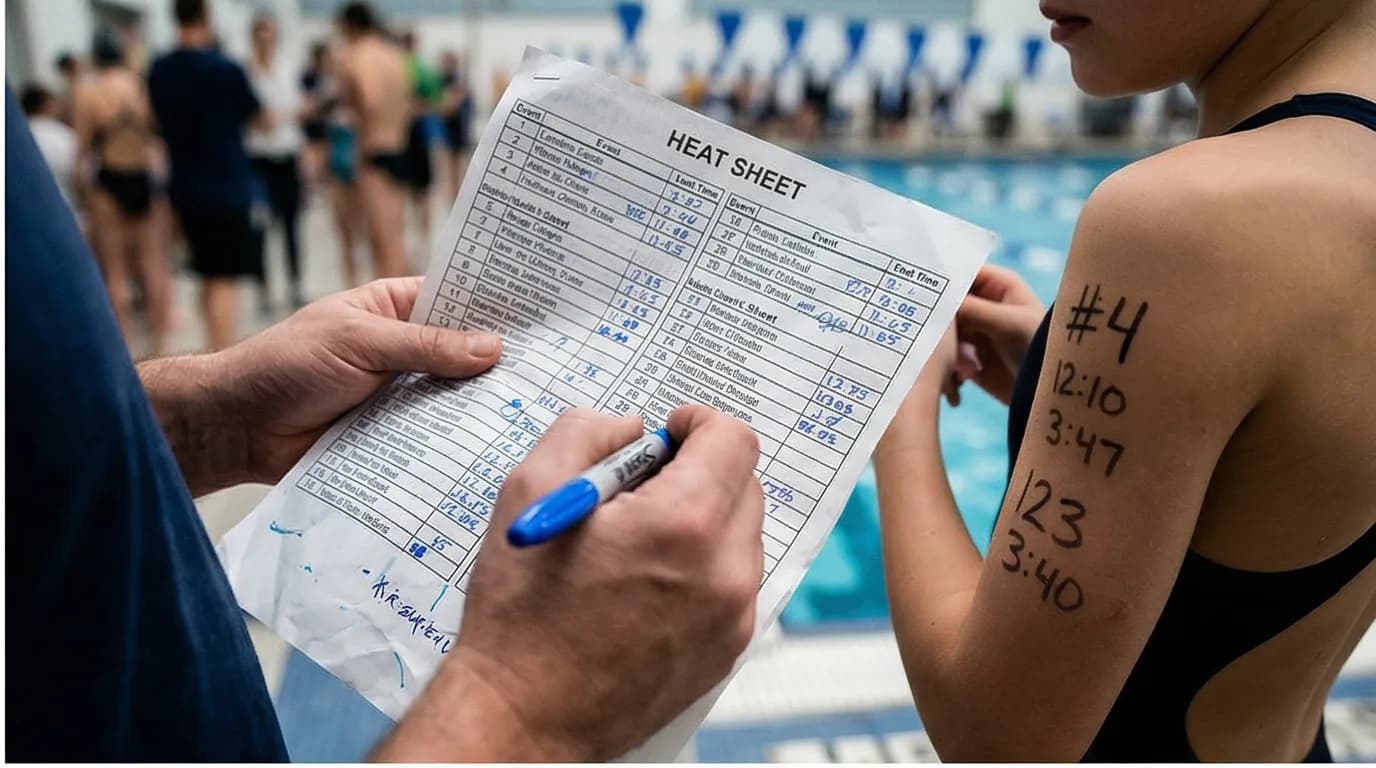
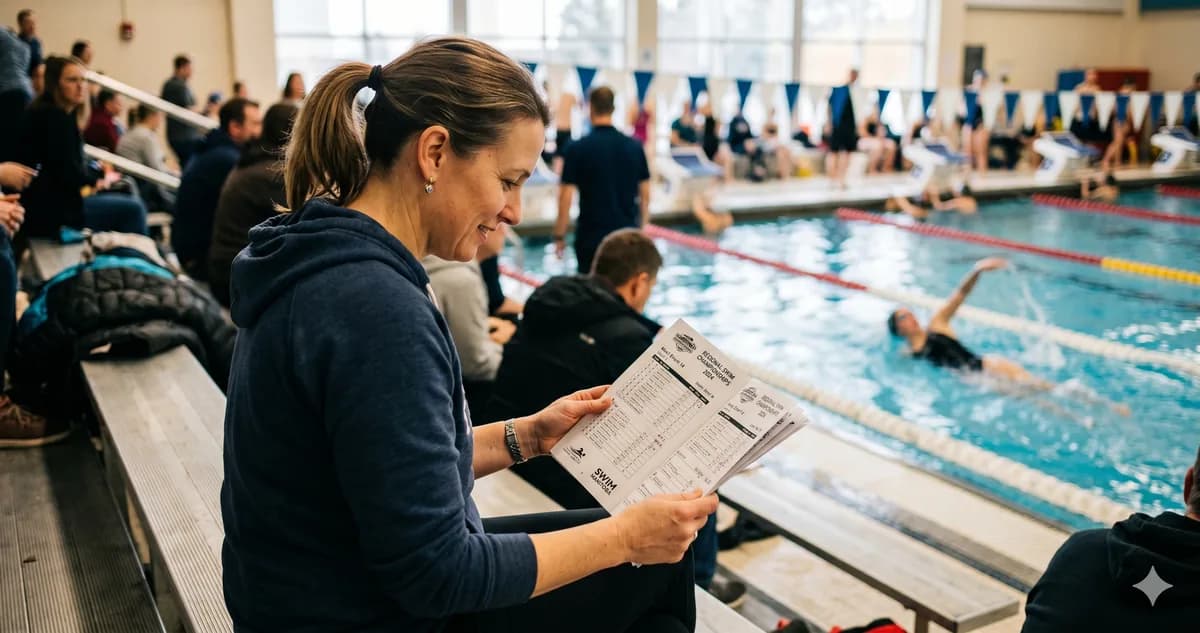
My first result sheet was a wall of numbers, event codes, heat numbers, seed times. I stared at it for a solid ten minutes before another parent took pity on me and walked me through it. If you've ever felt lost looking at swim meet results, I've been there.
Your child just finished their race. The scoreboard flashes numbers. Other parents seem to know what they mean. You smile and clap, but honestly, you're not sure what just happened.
Sound familiar? You're not alone.
Understanding swim meet results can feel like learning a new language. The abbreviations, the columns of numbers, the parents around you casually dropping terms like "splits" and "seed times", it's a lot to take in when you're new to competitive swimming.
But here's the thing: even experienced swim parents had to learn all of this at some point. Nobody is born knowing what a DQ means or why hundredths of a second matter.
This crash course will walk you through everything you need to know, in plain English, no swimming degree required.
The Basics: What a Swim Time Actually Tells You
How to Read a Swim Time
Swim times are written in the format minutes:seconds.hundredths:
- 1:05.32 means 1 minute, 5 seconds, and 32 hundredths
- 32.87 means 32 seconds and 87 hundredths
- 2:15.04 means 2 minutes, 15 seconds, and 4 hundredths
Why hundredths? Because swimming is decided by razor-thin margins. The difference between first and second place is often less than half a second.
Common Terms You'll See Right Away
NT (No Time): No official time on record for this event. Usually means it's their first time racing it.
Seed Time: The time your swimmer entered the meet with, based on a previous performance. Used to organize heats. Faster seed times go in later heats.
PB or PR (Personal Best / Personal Record): Your swimmer's fastest time ever in a particular event.
Understanding the Results Sheet
After a race, the results sheet shows: Place, Name, Age, Team, Seed Time, Final Time, Points.
The "+" and "-" Signs
A minus sign (-) means they swam faster than their seed time (good). A plus sign (+) means they swam slower (normal, bad days happen).
DQ, NS, and Other Abbreviations
DQ (Disqualification): Broke a technical rule. Common reasons: false start, illegal turn, incorrect stroke. Happens to everyone including Olympic swimmers. Not a crisis.
NS (No Show): Entered but didn't swim.
SCR (Scratch): Officially withdrew before the event.
| Abbreviation | Meaning |
|---|---|
| PB/PR | Personal Best |
| DQ | Disqualification |
| NT | No Time |
| NS | No Show |
| SCR | Scratch |
| SCY | Short Course Yards (25-yard pool) |
| SCM | Short Course Metres (25-metre pool) |
| LCM | Long Course Metres (50-metre pool) |
What Are Splits?
Splits are the times for each portion of the race. Example for 200m Freestyle:
- 1st 50m: 30.12
- 2nd 50m: 32.45
- 3rd 50m: 33.10
- 4th 50m: 31.89
- Total: 2:07.56
Coaches use splits to understand pacing. As a parent, just know they exist.
Prelims, Finals, and Time Trials
Dual Meets: Everyone races, results are final. One session.
Prelims and Finals: Morning races (prelims) to qualify for evening (finals). Top 8 or 16 from prelims make finals. Missing finals still means an official time.
Time Trials: Unofficial swims to post a time, often for future qualification.
For more on navigating meets, check out our guide on how parents can support young competitive swimmers .
How to Know If Your Child Is Improving
Don't just look at place. What actually tells you improvement:
- Personal bests (PBs): Did they beat their own fastest time?
- Time drops: Even small drops represent real progress. For understanding what specific time standards mean (like AA or AAA), see our article on understanding swimming standards by age .
- Consistency: Swimming similar times across multiple meets shows reliability.
A "bad" place can still be a great time. The best question isn't "What place did you get?" It's "Did you drop time?"
Where to Find Meet Results After the Meet
This is one of the biggest frustrations for swim parents. Results are scattered across various websites in hard-to-navigate formats.
This is exactly the problem that Gophin solves. Gophin automatically syncs your swimmer's results from official competition records. Every meet, every event, every time, all in one place. No manual entry. If you have ever lost track of a time you needed, read how to find lost swim meet results.
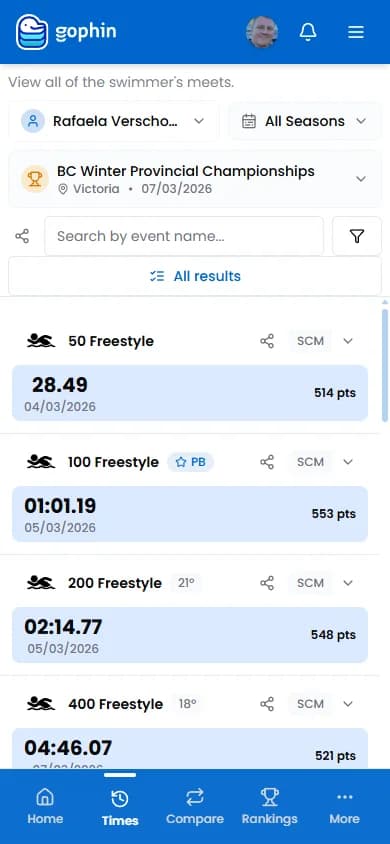
All meets in one place
Detailed meet results
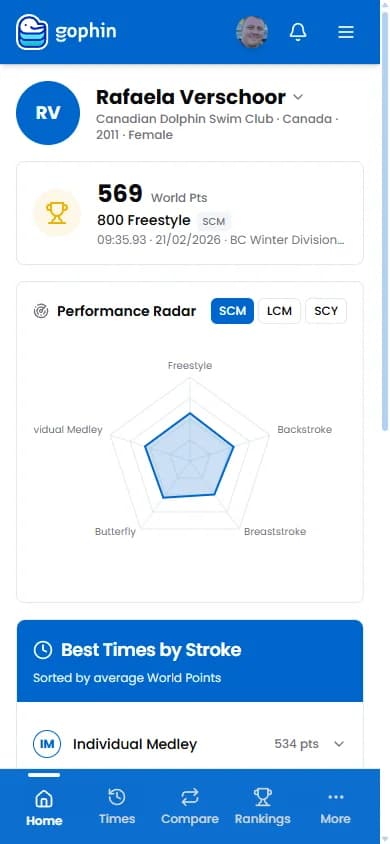
Dashboard recent meets
Meet results and history are completely free on Gophin. Set up in about two minutes. For a deeper look at automatic time tracking, read our guide on how to track swimming times automatically .
What NOT to Do After a Meet
Don't compare your child to other swimmers. Don't focus on place alone. Don't ask "Did you win?" Try instead:
- "How did it feel?"
- "Did you hit your goal time?"
- "What was your favorite race today?"
- "Are you happy with how you swam?"
Don't overreact to a DQ. Don't coach from the bleachers.
You've Got This
You don't need to be a swimming expert. Understanding the basics puts you miles ahead. Within a few meets, you'll be reading results without a second thought. For tips on staying calm through the season, check out our parent's guide to calm swim progress.
Follow Their Journey with Gophin