
Quick answer
Swimming standards by age are official time benchmarks published by governing bodies like Swimming Canada and USA Swimming. They organize performance into tiers (such as B, BB, A, AA, AAA, AAAA) and championship qualifying cuts. Each age group, gender, event, and pool length has its own complete set of standards.
"Is my time good?", Rafa asked me this after every single meet when she was eleven. I never had a clear answer until I sat down and figured out how swimming standards actually work. Once I did, everything clicked.
You just swam a 1:05 in the 100 freestyle. Is that good?
The honest answer: it depends. Your age, the pool length, your gender, and which standards you are measuring against all change what that time means. A 1:05 might be exceptional for a 12-year-old in a 50-metre pool. For a 17-year-old in a 25-metre pool, it might be solid but not yet at the provincial level.
This is why swimming standards exist. They give every swimmer, and every parent watching from the stands, a clear framework to answer the question: is my swim time good?
In this guide, we will break down how swimming standards by age work, what the different levels mean, which organizations set them, and how to quickly check where you stand.
What Are Swimming Standards?
Swimming standards are official time benchmarks published by governing bodies like Swimming Canada and USA Swimming. They define performance levels for every event, age group, gender, and pool length in competitive swimming.
Think of standards as a grading system for swim times. Instead of a letter grade on a test, you get a level, like A, AA, or AAA, that tells you where your performance sits relative to other competitive swimmers your age.
Standards serve three main purposes:
- Performance benchmarks. They answer the question "how fast is fast?" for any given age group and event.
- Qualification criteria. Most championship meets require swimmers to meet specific time standards before they can compete.
- Goal-setting tools. Instead of vague objectives like "swim faster," standards give swimmers concrete, measurable targets. "Drop 1.5 seconds to reach AA in the 200 free" is far more motivating than "improve this season."
How Swimming Standards Are Organized
Swimming standards are not one-size-fits-all. They are broken down across several dimensions.
By Age Group
Standards are set for specific age groups: 10 & Under, 11-12, 13-14, 15-16, 17-18, and Senior/Open. Each age group has its own set of standard times. As swimmers age up, the standard times get faster.
By Course (Pool Length)
Pool length affects times significantly. Three course types: SCY (25-yard pools), SCM (25-metre pools), LCM (50-metre pools, the Olympic standard). Short course times are typically faster because swimmers get more turns and wall push-offs.
By Gender and Event
Standards are published separately for male and female swimmers, and for every competitive event. This layered organization means there are hundreds of individual standard times across a single organization's system.
Major Standards Organizations
Swimming Canada
Swimming Canada publishes national time standards: AAA (Elite nationally), AA (Provincial level), A (Strong competitive), B (Developing). Provincial organizations also publish their own qualifying times.
USA Swimming
USA Swimming uses a more granular system: AAAA (National elite), AAA (Nationally competitive), AA (Strong regional), A (Solid age group), BB (Intermediate), B (Novice).
Other Organizations
Beyond the national bodies, there are 38+ organizations that publish official time standards across North America.
How to Know Where You Stand
The Manual Method
Go to your governing body's website, find the PDF, locate your age group, find the event and course type, compare, calculate the gap, repeat for every event. Tedious.
The App Method
Modern swimming tools do this comparison automatically. In Gophin, the Standards reference page (free for everyone) lets you look up official qualifying times by organization, age group, gender, season, pool length, and stroke.
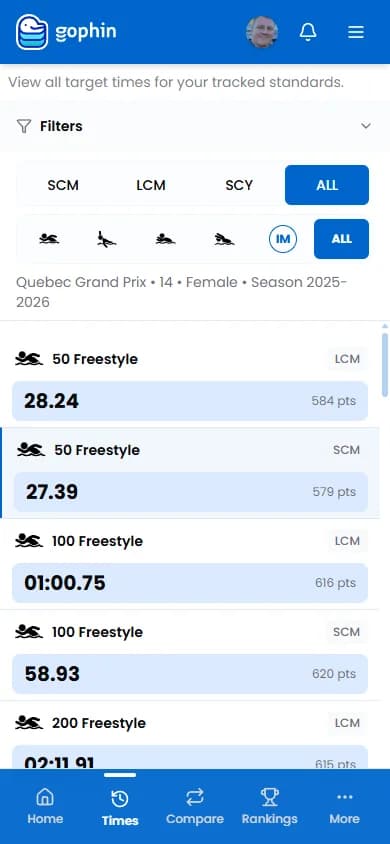
Standards reference page
For deeper analysis, the Compare Standards feature takes your actual PB times and compares them side-by-side against standards from any of the 38+ supported organizations. For each event, you see your time, the standard time, and the exact delta. Our Compare Standards tutorial walks you through every step.
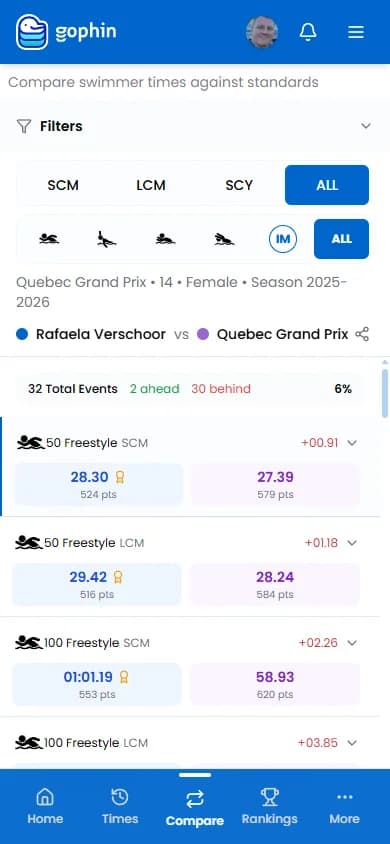
Compare Standards page
Understanding the Levels
| Level | What It Looks Like |
|---|---|
| B / BB | Actively competing, building skills. Local or developmental meets. |
| A | Solid regional competitor. Training seriously. |
| AA | Provincial or state level. Can qualify for provincial championships. |
| AAA | Top swimmers nationally for age group. National-level meets. |
| AAAA (USA Swimming) | Elite national level. Very few achieve this. |
Every level represents real progress. Moving from B to A might take a full season. Moving from AA to AAA might take two or three. Do not treat standards as pass/fail. They are markers on a long path. For a deeper dive into each country's system, see our guides to USA Swimming time standards and Swimming Canada standards.
Why Context Matters More Than the Label
Age within the age group matters. Training phase matters. Course type matters. First year vs. third year matters. Physical maturation matters. Never compare standards achievements across age groups. Your journey is your own.
How Gophin Helps You Track Standards
Standards Reference
Browse official qualifying times from a curated selection of organizations. Filter by organization, age group, gender, season, pool length, and stroke.
Standards organization dropdown
Compare Standards
Takes your actual swim times and compares them directly against standards from any of the 38+ supported organizations. You see your PB, the standard time, the exact delta, and color coding (green = met, red = not yet).
Compare Standards filters
For swimmers targeting specific championship meets, this feature answers: "Am I fast enough to qualify?"
Conclusion, Standards Are Guideposts, Not Verdicts
Every swimmer's journey is different. Standards do not define you, they guide you. What matters most is progression. Use them as tools, not as judgments.