Quick answer
SCM, SCY and LCM are the three pool sizes of competitive swimming. SCM = short course meters, a 25-meter pool. SCY = short course yards, a 25-yard pool (used in the US). LCM = long course meters, a 50-meter Olympic pool. "Short course" means a 25 pool, meters or yards; "long course" means a 50-meter pool. Times from different pools are not comparable: short course is faster because of the extra turns, and yards are a shorter distance.
SCY vs SCM vs LCM at a glance
| Code | Name | Pool | Where you see it | Usual season |
|---|---|---|---|---|
| SCY | Short course yards | 25 yards (22.86 m) | US club, high school, college (NCAA) | Fall and winter (US) |
| SCM | Short course meters | 25 meters | Canada, Europe, most of the world; World Short Course Championships | Fall and winter |
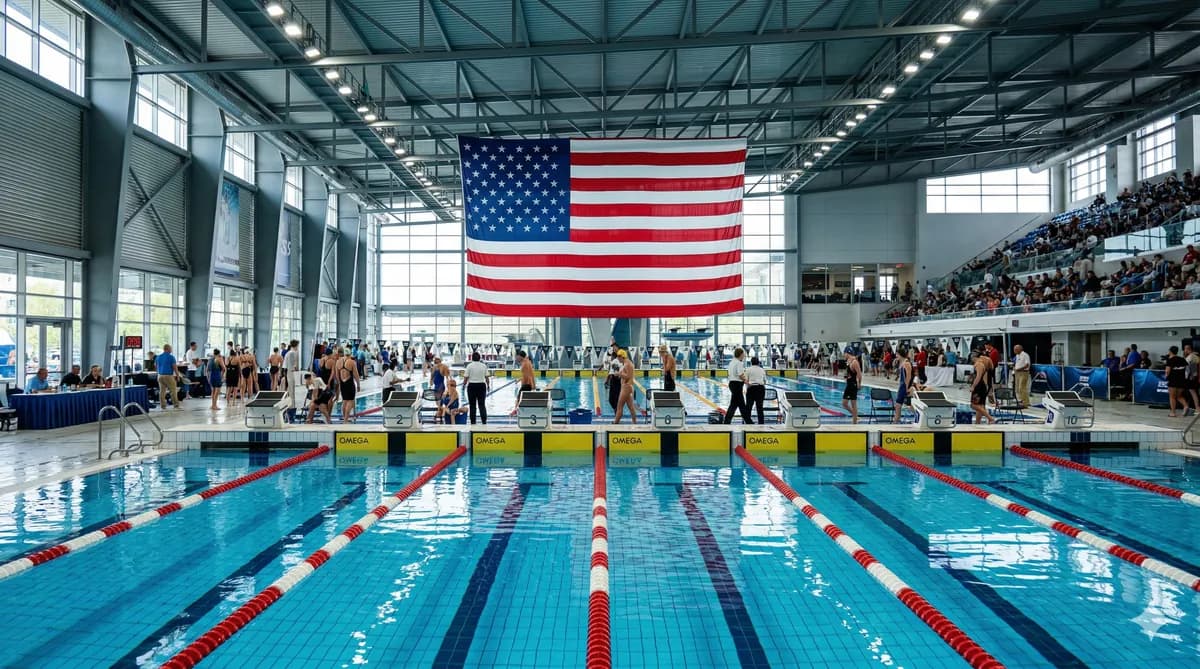
| LCM | Long course meters | 50 meters | Olympics, World Championships, summer national championships, summer meets | Spring and summer |
World Aquatics' competition regulations define the two metric pools (50 m and 25 m). Yards are an American format run by USA Swimming and high school and college leagues.
Is short course meters or yards? Both. "Short course" only says the pool is 25 long. In the US, short course almost always means yards (SCY); in Canada and the rest of the world it means meters (SCM). Always check the letter at the end.
What does SCM mean in swimming?
SCM is short course meters: a 25-meter pool. A 100 in SCM is four lengths with three turns. It is the fall and winter format in Canada and most countries, and the format of the World Aquatics Short Course World Championships.
What does SCY mean in swimming?
SCY is short course yards: a 25-yard pool, 22.86 meters long. A "100 free" in SCY is 100 yards (91.44 m), not 100 meters. That is why SCY times look so much faster than meter times. It is the standard for US club swimming from fall to spring, high school and NCAA college swimming.
What does LCM mean in swimming?
LCM is long course meters: a 50-meter pool, the Olympic pool. A 100 in LCM is two lengths with one turn. Summer club seasons, summer national championships, Olympic Trials, the Olympics and the World Championships are all long course. Winter championships are not: the 2026 Winter Junior Championships, for example, swim in short course yards.
Short course vs long course: why the times are different
Turns. Every wall is a push-off, and a push-off is faster than swimming. The shorter the pool, the more walls:
| Race | Turns in a 25 pool | Turns in a 50 pool |
|---|---|---|
| 100 | 3 | 1 |
| 200 | 7 | 3 |
| 400 | 15 | 7 |
More walls also mean more time underwater, where good swimmers are fastest, and shorter stretches of stroke between rests. So the same swimmer is faster in short course. The gap grows with distance: with the factors Gophin uses, an LCM time is about 1.5% slower than SCM in a 50, 2% in a 100 and 4% in a 1500.
Distance (yards only). 100 yards is shorter than 100 meters. Converting SCY to SCM means multiplying by about 1.11 for the 50, 100 and 200. The freestyle distance events are not even the same race: the yards version of the 400 m free is the 500 yd, of the 800 m is the 1000 yd, and of the 1500 m is the 1650 yd (the "mile").
That is why the first question an experienced swim parent asks about any time is: which pool?
How to convert between SCM, SCY and LCM
Use the free swim time converter: type the time, pick the pool and event, and it shows the other two pools. If you prefer to scan, the LCM to SCY conversion chart has ready-made tables in both directions.
Free tool
Convert a swim time between pools
Same conversion factors the Gophin app uses. Conversions are estimates: turns and underwater skill change the real gap for each swimmer.
Remember that a conversion is an average. A swimmer with great turns gets more out of short course than the formula expects; a swimmer with a strong stroke and weaker turns loses less in long course.
Which season uses which pool?
- United States: SCY from roughly September to March (club and high school), then LCM in the summer. Some meets run SCM, but it is less common.
- Canada: SCM from September to the spring, then LCM for provincial and national summer championships.
- Most other countries: SCM in the winter, LCM for the main championships.
So a swimmer has separate personal bests for each pool. A new short course best does not replace the long course best in the same event; they are different records.
Time standards are written per pool
USA Swimming and Swimming Canada publish qualifying times separately for each pool (SCY, SCM, LCM). A swimmer can have the "A" cut in SCY and not yet in LCM, and that is completely normal. Always compare a short course time with a short course standard and a long course time with a long course standard. The USA Swimming time standards guide shows the current cuts.
The most common mistake: comparing across pools
"She swam 1:05 last month and 1:10 today. Did she get slower?" If last month was SCY and today is LCM, no. A 1:05.00 in the 100 SCY converts to about 1:13.62 LCM, so a 1:10 in long course is actually a much better swim. Without the pool, a time is half the information.
How Gophin keeps the pools apart
Gophin tags every official time with its pool, shows best times separately for SCY, SCM and LCM, and draws progress charts within each pool. When you do want to compare, you can pick a pool and see every best time converted to it, marked with "≈" so a converted time never passes for a real swim. Standards comparisons use the right pool, or the converted time when you ask for it.
See your swimmer's best times by pool (free)
Bottom line
SCY and SCM are 25 pools (yards and meters); LCM is the 50-meter pool. Short course is faster, yards are shorter, and each pool has its own best times and its own standards. When you need to translate a time, use the converter; when you track a season, keep the pools apart and let the app do the bookkeeping.