Quick answer
SCY, SCM, and LCM times are not interchangeable. Short course is faster because of extra turns. Use Gophin's free Course Converter to translate a time between pools. Sign in with a free account, convert, and save the result to your swimmer's profile.
Open the free converter (sign in)
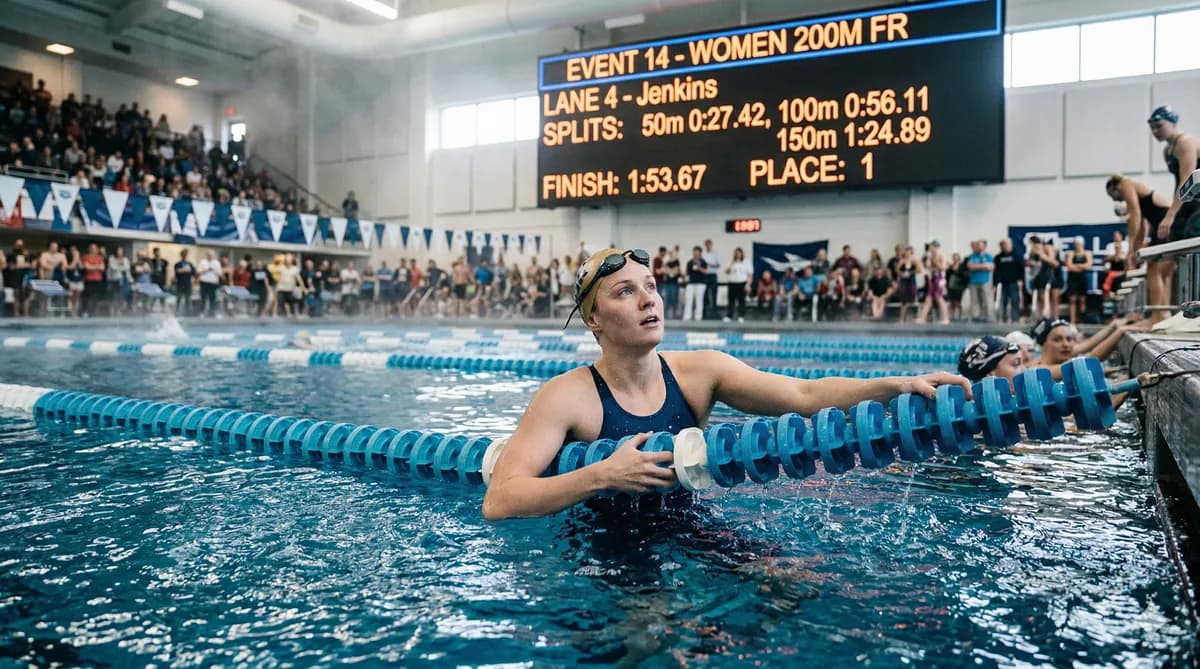
Rafa swam a 4:40 in the 400 Free short course. When she moved to long course, her time was 4:51. "Am I getting slower?" she asked, genuinely worried. I had to sit her down and explain how course conversion works, and why her long course time was actually right on track.
You just posted a 1:02 in the 100 Freestyle at a short course meet. Your friend swam a 1:05 in long course. Who is actually faster?
If you have ever asked yourself "what would my 25m pool time be in a 50m pool?" you already know why a swimming time converter matters. Times in a 25-meter pool, a 50-meter pool, and a 25-yard pool are not directly comparable. The pool length changes everything: the number of turns, the push-offs, and the total distance all shift the clock.
The good news is you do not need to do the math yourself. Gophin's free Course Converter lets you convert times between SCM, LCM, and SCY in seconds. Gophin is free for everyone. Sign in, convert a time, and save it to your swimmer's profile.
This guide explains how course conversion works, when you need it, and how to use the tool step by step.
Understanding Pool Courses: SCM, LCM, and SCY
Before you convert a single time, you need to understand the three pool formats used in competitive swimming worldwide.
SCM, Short Course Meters (25m Pool)
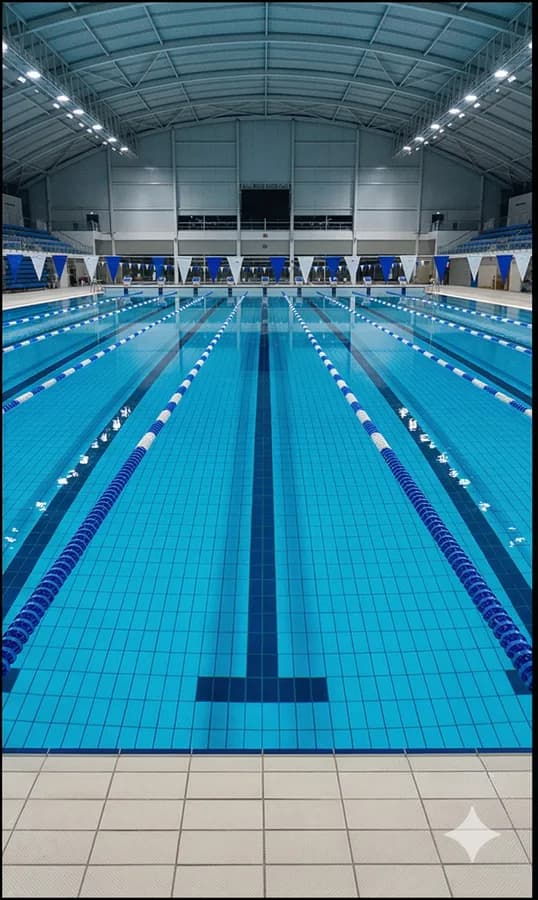
This is the standard pool length for winter competitions in Canada, Europe, and many other countries. The pool is 25 meters long, which means a 100-meter race requires four lengths and three turns.
SCM is the format you swim in at most indoor facilities during the September-to-March season. World Aquatics (formerly FINA) World Short Course Championships and many national championship events use this format.
LCM, Long Course Meters (50m Pool)
The Olympic format. A 50-meter pool means a 100-meter race is just two lengths with one turn. This is the standard for summer competitions, Olympic Trials, World Championships, and most outdoor championship meets.
Because there are fewer turns in a 50-meter pool, LCM times are typically slower than SCM times for the same event and distance. You push off the wall less often, which means less free speed from each turn.
SCY, Short Course Yards (25yd Pool)
The dominant format in American college and high school swimming. A 25-yard pool means a 100-yard race covers four lengths (100 yards total, not 100 meters). NCAA championships, high school state meets, and most US club practices use 25-yard pools.
SCY times look faster than meter times partly because 100 yards is a shorter distance than 100 meters (91.44 meters). The extra turns in a short pool also help.
Why Different Pools Produce Different Times
The key variable is turns. Every time a swimmer reaches the wall, they push off with their legs, essentially getting a burst of speed that is faster than swimming. In a 25-meter pool, you get three push-offs per 100 meters. In a 50-meter pool, you only get one.
More turns means more push-offs. More push-offs means faster times. That is why short course times are almost always faster than long course times for the same swimmer in the same event.
The difference is real and measurable: roughly 2% per 100 meters when comparing SCM to LCM. For yards-to-meters conversion, the pool length ratio (25 yards vs. 25 meters) adds another factor of approximately 1.11.
Free Swimming Time Converter, Try It Now
Gophin offers a free swim time conversion calculator that handles all the math instantly. Create a free account, sign in, and convert any time in seconds.
How to Use the Course Converter
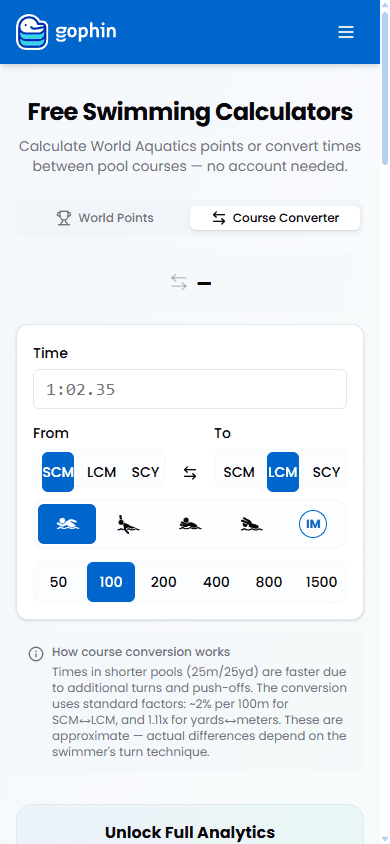
- Go to the tool. Open Gophin's Course Converter in your browser or the Gophin app.
- Enter your time. Type the time you want to convert (for example, 1:02.35).
- Select the "From" course. Choose the pool type you swam in: SCM (25m), LCM (50m), or SCY (25yd).
- Select the "To" course. Choose the pool type you want to convert to. Use the swap button to quickly reverse the direction.
- Choose your stroke. Select Freestyle, Backstroke, Breaststroke, Butterfly, or IM. The stroke matters because conversion factors vary slightly by stroke.
- Choose the distance. Select the event distance (50, 100, 200, 400, etc.).
- Read your converted time. The result appears instantly.
That is it. Six inputs, one answer. The tool is completely free and works on any device.
Convert Your Time Now, Free, No Login
How Swimming Course Conversion Works
A swimming time converter is not just multiplying by a fixed number. The math accounts for the specific differences between pool lengths, including turn frequency and distance ratios.
SCM to LCM (Short Course to Long Course Meters)
The standard approximation adds roughly 2% per 100 meters to account for fewer turns and push-offs. In a 200-meter race, for example, you lose six push-offs going from SCM (seven turns) to LCM (three turns). That difference adds up.
Example: A swimmer posts 1:02.35 in the 100 Freestyle SCM. To estimate their LCM time:
- 1:02.35 = 62.35 seconds
- Add ~2% for 100 meters: 62.35 × 1.02 = approximately 63.60 seconds
- Converted time: approximately 1:03.60 LCM
The actual conversion factor varies slightly by stroke and distance. Backstroke and butterfly swimmers, who benefit more from extended underwater phases off the wall (dolphin kicks, streamlines), tend to see a larger gap between short course and long course times.
SCY to SCM (Yards to Short Course Meters)
The primary factor here is the pool length ratio. A 25-yard pool is shorter than a 25-meter pool, so each length covers less distance. The conversion multiplier is approximately 1.11 (since 1 meter = 1.0936 yards).
This factor accounts for the distance difference. Both pool types have the same number of turns per race (same number of lengths), so turn advantage is roughly equal.
SCY to LCM (Yards to Long Course Meters)
This is the biggest conversion gap because it combines both factors: the yards-to-meters distance adjustment AND the reduction in turns.
- First, multiply by ~1.11 to convert yards to meters.
- Then, add the ~2% per 100 meters for the short-to-long course adjustment.
The result: a 100 SCY time will look significantly "faster" than the equivalent LCM time. A swimmer who goes 50.00 in 100 Free SCY might convert to roughly 56-57 seconds in LCM, depending on stroke technique and turn ability.
Why Stroke Matters
Not all strokes convert equally. Backstroke and butterfly swimmers typically gain more from turns because of extended underwater phases (backstroke flags, butterfly dolphin kicks). Freestyle and breaststroke conversions tend to be tighter.
This is why Gophin's converter asks for your stroke, it applies stroke-specific adjustments rather than a one-size-fits-all multiplier.
When You Need to Convert Swim Times
Course conversion is not just an academic exercise. There are real, practical situations where swimmers, parents, and coaches need accurate short course to long course conversion, and vice versa.
Transitioning Between Seasons
In Canada, most swimmers race SCM from September through March and LCM from April through August. Every spring, swimmers and coaches need to set LCM goals based on their SCM performance from the winter season.
A swimming time converter bridges that gap. It tells you what your winter times might look like in a summer pool so you can set realistic targets.
College Recruiting (Canada to USA)
Canadian swimmers who compete in SCM need their times converted to SCY for American college coaches and NCAA recruiting. This is one of the most common reasons for SCY to LCM conversion searches, swimmers and parents trying to understand how Canadian times translate to the US college system.
If a Canadian swimmer posts a 55.00 SCM 100 Free, what does that look like in SCY for an NCAA coach? The converter gives you that answer instantly.
Comparing Swimmers from Different Countries
A swimmer from Australia competing in LCM and a swimmer from the US competing in SCY cannot be compared on raw times alone. Course conversion levels the playing field by adjusting for pool length differences.
This is especially useful when researching competitors before international meets or when scouting talent across borders.
Meet Qualification Standards
Many championships publish qualifying times in a specific course format. If your recent times are in a different format, you need to convert them to confirm whether you meet the standard.
For example, if Provincial Championships require a 1:05.00 LCM in the 100 Free, and your best time is 1:02.50 SCM, the converter tells you whether your SCM time meets the LCM standard after adjustment.
Club or Program Transfers
Swimmers who move between countries or switch from a club that trains in a 25-meter pool to one that trains in a 50-meter facility need their times translated. Coaches at the new program want to understand where the swimmer fits on the team roster.
Conversion Tips, What Every Swimmer Should Know
Converted times are useful estimates, but they come with important caveats. Understanding these nuances makes you a smarter swimmer and a more informed parent.
Not All Swimmers Convert Equally
Two swimmers with identical 100 Free SCM times might produce very different LCM times. Why? Turns.
A swimmer with powerful underwater dolphin kicks and tight streamlines gets more speed from every wall. That swimmer's short course times benefit more from turns, which means their long course times will be relatively slower compared to short course.
Conversely, a swimmer with a strong open-water stroke and weaker turns will lose less going from short course to long course. Their conversion will be tighter than average.
Backstroke and Butterfly Show Bigger Gaps
Strokes with extended underwater phases (backstroke and butterfly) tend to have larger SCM-to-LCM gaps. Swimmers in these strokes spend more time underwater off each wall, which means the loss of turns hits harder in long course.
Freestyle and breaststroke typically show smaller gaps, though individual variation still matters.
Use Conversions as Estimates, Not Predictions
A converted time tells you what is approximately equivalent. It does not predict your exact race result. Race-day performance depends on taper, rest, adrenaline, competition, and countless other factors that no formula can capture.
Think of converted times as a reference point, not a guarantee. They answer "what is roughly equivalent?" rather than "what will I swim?"
Course Conversion Is Not the Same as Race Prediction
If the converter says your SCM time equals 1:03.60 LCM, that does not mean you will swim 1:03.60 at your next long course meet. You might go faster because you are well-rested. You might go slower because you are mid-season. The conversion gives you a baseline for goal-setting, not a crystal ball.
Beyond Conversion, Track All Your Times Automatically
Converting a single time is useful. But what if you could see every time you have ever swum , across all courses, all events, all seasons, organized automatically?
That is what Gophin does. The Course Converter is one free tool in a larger platform built for competitive swimmers.
Auto-Import from Official Competition Records
Gophin automatically imports meet results from official competition databases across Canada and the United States. You swim a meet, the results get published, and Gophin syncs them to your profile. No manual entry. No spreadsheets.
Your best times, meet history, and time evolution charts update themselves after every competition.
Free Account Features
With a free Gophin account (no credit card, no trial period), you get:
- Best Times, Every personal best organized by event, filterable by course type
- Meets, Complete chronological history of every competition
- Evolution Charts, Visual graphs showing how your times improve over months and years
- Standards Reference, Browse official qualifying times from organizations across Canada
- World Points Calculator, Calculate World Aquatics points for any time to compare across events and strokes
- Course Converter, The tool described in this article, free forever
Cross-Event Comparison with World Points
If you want to go beyond course conversion and compare performance across completely different events (Is my 100 Free better than my 200 IM?), the World Points Calculator provides a universal scoring system based on current world records. This tool is also free and is free with a Gophin account.
Conclusion
Understanding how swimming times translate across pool types is a fundamental skill for any competitive swimmer, parent, or coach. Whether you are converting SCM winter times to LCM for the summer season, translating Canadian times to SCY for US college recruiting, or checking qualification standards in a different course format, a reliable swimming time converter saves time and eliminates confusion.
Gophin's Course Converter is free (sign in with a free account) and works for every stroke and distance combination. Enter your time, select your courses, and get an accurate conversion in seconds.
And when you are ready to go beyond single conversions, create a free Gophin account to automatically track every time you have ever swum, organized, visual, and always up to date.