Quick answer
The USA Swimming 13–14 age-group A cut for 100 breaststroke is 1:15.99 for girls and 1:08.99 for boys in SCY. Use the B, BB, A and AA tables below to find the matching age group and course. These are published competitive benchmarks, not average times for all children.
Breaststroke progress is not always obvious from the poolside seats. Two races may look equally controlled, yet a change in timing can produce a different result. Parents can help most by keeping an accurate history and asking a clear question, rather than prescribing a faster stroke rate from the stands.
An official age-group table gives you a starting point. It answers “Which benchmark does this time reach?” The swimmer's own race history answers a different question: “Are things moving in the right direction?” Both matter when setting the next goal.
Before comparing a breaststroke time
Read the event and course on the official result. A 100 breaststroke in a 25-yard pool is SCY; in a 50-metre pool it is LCM. The same event in a 25-metre pool is SCM, with separate standards in the source document.
The tables here come from USA Swimming's 2024–2028 motivational age-group standards, revised 10 October 2025. B, BB, A and AA are four steps in the published scale, which continues through AAA and AAAA. They are goals, not official descriptions of a child's potential.
Use the complete age-group row, not a neighbouring age or a remembered single-age cut. A 13-year-old and a 14-year-old share the 13–14 reference on this page.
100 breaststroke SCY times by age
Girls, 100 breast SCY
| Age group | B | BB | A | AA |
|---|---|---|---|---|
| 10 & under | 2:00.29 | 1:46.89 | 1:33.59 | 1:29.09 |
| 11-12 | 1:36.49 | 1:29.29 | 1:22.19 | 1:18.59 |
| 13-14 | 1:28.69 | 1:22.29 | 1:15.99 | 1:12.89 |
| 15-16 | 1:25.89 | 1:19.79 | 1:13.69 | 1:10.59 |
| 17-18 | 1:24.79 | 1:18.79 | 1:12.69 | 1:09.69 |
Boys, 100 breast SCY
| Age group | B | BB | A | AA |
|---|---|---|---|---|
| 10 & under | 1:54.09 | 1:42.29 | 1:30.59 | 1:26.59 |
| 11-12 | 1:32.59 | 1:25.49 | 1:18.39 | 1:14.89 |
| 13-14 | 1:20.49 | 1:14.79 | 1:08.99 | 1:06.19 |
| 15-16 | 1:16.89 | 1:11.39 | 1:05.89 | 1:03.19 |
| 17-18 | 1:14.69 | 1:09.39 | 1:03.99 | 1:01.39 |
If your swimmer is below B, start with their own earlier legal swims. The first competitive benchmark is not a minimum requirement for enjoying the event or contributing to a team. A new swimmer's immediate goal might simply be a legal, more controlled second race.
100 breaststroke LCM times by age
Girls, 100 breast LCM
| Age group | B | BB | A | AA |
|---|---|---|---|---|
| 10 & under | 2:19.39 | 2:03.89 | 1:48.39 | 1:43.29 |
| 11-12 | 1:50.39 | 1:42.19 | 1:33.99 | 1:29.99 |
| 13-14 | 1:42.39 | 1:34.99 | 1:27.69 | 1:24.09 |
| 15-16 | 1:38.59 | 1:31.59 | 1:24.49 | 1:20.99 |
| 17-18 | 1:37.49 | 1:30.49 | 1:23.59 | 1:20.09 |
Boys, 100 breast LCM
| Age group | B | BB | A | AA |
|---|---|---|---|---|
| 10 & under | 2:12.89 | 1:59.19 | 1:45.49 | 1:40.89 |
| 11-12 | 1:47.79 | 1:39.59 | 1:31.29 | 1:27.19 |
| 13-14 | 1:33.79 | 1:27.09 | 1:20.39 | 1:16.99 |
| 15-16 | 1:29.49 | 1:23.09 | 1:16.69 | 1:13.49 |
| 17-18 | 1:26.69 | 1:20.59 | 1:14.39 | 1:11.29 |
Canadian swimmers should use their provincial or national meet standards for entry. These US motivational rows provide context only. Our Swimming Canada guide explains why the Canadian system does not map directly to B, A or AA.
Breaststroke timing makes the story different
The total result combines swimming, the start, turns and pullouts. A faster opening does not necessarily lead to a faster finish. Equally, a swimmer can improve technique before a personal best makes that change visible in the final time.
Use the available race splits to describe what happened, then let the coach interpret why. For example, was the first 50 substantially faster than usual while the second slowed? Was a more controlled opening followed by a stronger finish? Compare several races in the same course before deciding there is a pattern.
Avoid turning this into a technique correction at the car door. “What did your coach want you to focus on?” gives the swimmer room to explain. It also keeps one message from the deck instead of two competing sets of instructions.
Check legality before celebrating a cut
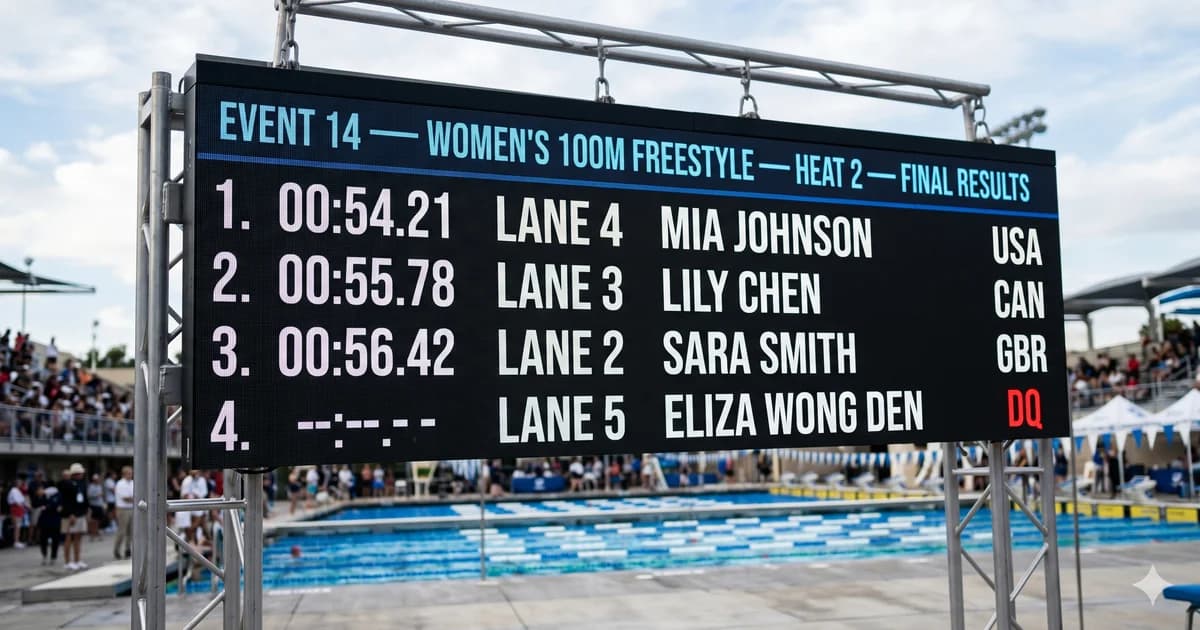
An official qualifying time must come from a valid result. A DQ can be disappointing even when the clock shows a personal best, but it is important not to record that clock time as an achieved standard.
Ask the coach to explain the official reason and the next learning step. Our guide to common swim disqualifications is a parent introduction, not a replacement for the current rulebook or the referee's decision.
Keep a training note separate from the official best-time history. That way the swimmer can recognise an encouraging race while the qualification record stays accurate.
Calculate the gap without guessing
Consider a hypothetical 13–14 girl with a legal 1:17.00 SCY. The A standard is 1:15.99, so the gap is 1.01 seconds. Compare hundredths as well as whole seconds: rounding a result before comparing it can hide a near miss.
The next question is whether that is a sensible target for the season. The coach can weigh it against event experience, race schedule and the swimmer's own goals. You do not need to chase every letter level at once.
In Gophin, find the swimmer and open Compare → Standards. Choose the USA Swimming motivational age-group set, the correct category and the course of the actual swim. Read any converted-time label before counting a cut. The step-by-step guide shows the filters and the event list.
See the gap to your swimmer's next breaststroke standard
Questions parents ask
Is breaststroke slower than freestyle?
Raw times across strokes answer different questions. Use each stroke's own event standard rather than judging the breaststroke result against a freestyle personal best. For a wider view, see how to find your strongest events.
Can I estimate 100 breast from a 50 breast best?
Doubling the 50 is not a dependable personal prediction. The start contributes once in each race, and the swimmer must manage a different distance. Use actual 100 results to establish the baseline.
Does a new age group mean the old result no longer matters?
No. The result remains part of the swimmer's history even when a different target applies. Planning for an age-group change helps keep the new benchmark separate from the progress already made.






Comments
No comments yet. Questions about times, meets or the app are welcome.