Quick answer
The most common swim DQs by stroke: false starts (all events), one-hand touches and illegal kicks in breaststroke, single-hand touches and dolphin kicks in butterfly, missed flip-turn touches in backstroke, and walking on the bottom in freestyle. Most are fixable in practice with deliberate technique work and clear race rehearsal.
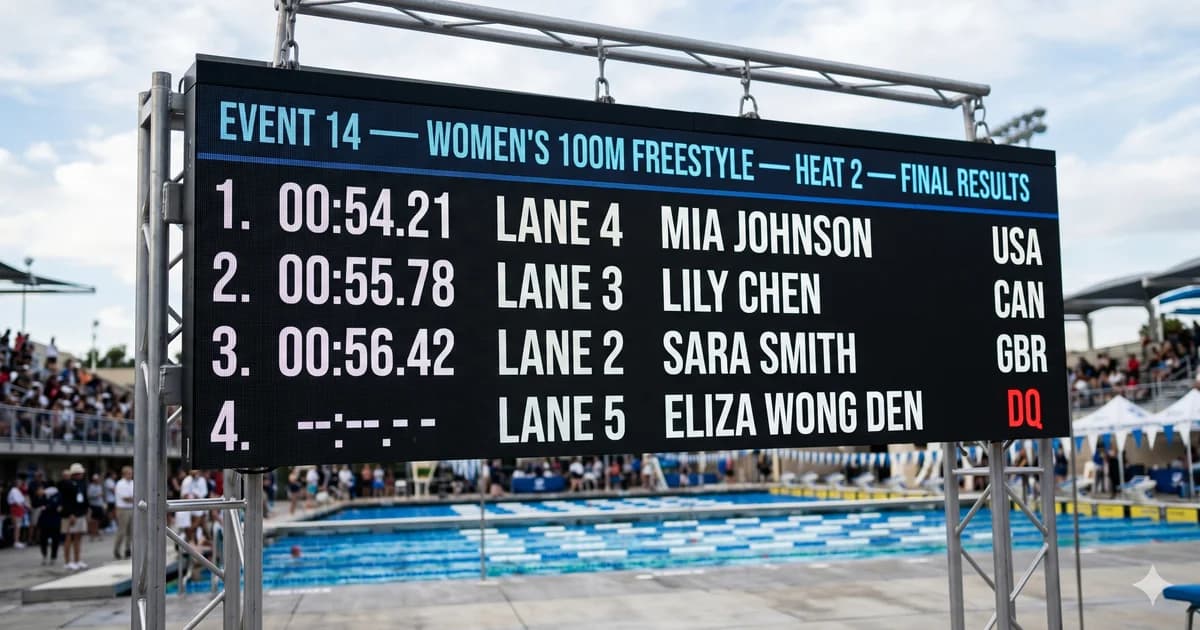
The first time I saw "DQ" next to Rafa's name on a Vancouver scoreboard, I had to ask another parent what it meant. They told me. Disqualified. I asked why. They said something about a touch on the breaststroke turn and shrugged. We never really got the full explanation that day.
Most swim parents have a version of that story. The DQ shows up, nobody on the deck has time to walk you through what happened, and your swimmer comes out of the water either confused or upset, depending on whether they know yet.
DQs are a normal part of swimming. They happen to beginners and to elite swimmers. Knowing the most common reasons by stroke helps swimmers avoid them and helps parents understand what they are looking at when they happen.
Here are the rules that trip up most swimmers, by stroke, with what to do about each one.
What a DQ Actually Means

A DQ (disqualification) means a stroke and turn official judged that the swimmer broke a rule during the race. The time still gets recorded for reference, but it does not count for results, rankings, or qualifying.
DQs are decided by trained officials walking the deck. They watch for specific rule violations defined by World Aquatics (the international governing body) and adapted by USA Swimming and Swimming Canada. The 2026 rulebook reflects updates published in February 2026.
A DQ is not a punishment. It is a call. Officials are trained to be consistent and impartial. If a rule was broken, even by a fraction of a second, the call gets made.
Freestyle: The Hardest Stroke to Get DQ'd
Freestyle has the loosest rules. You can swim it in any style you want (most swimmers swim front crawl), as long as you:
- Touch the wall at every turn
- Surface within 15 meters of every push-off
- Touch the wall at the finish
The most common freestyle DQs:
- Failing to touch the wall at a turn. This usually happens when a swimmer flips early or pushes off without making contact. Easy to miss in a fast race.
- Going past 15 meters underwater. Underwater dolphin kicks are legal off the start and walls, up to 15 meters. Past that mark, you have to surface. Most pools have a marker line on the lane rope at 15 meters.
- Standing on the bottom of the pool to push off. Walking is not allowed. You can stand to recover after a problem, but you cannot use the bottom to gain speed.
In a 200, 500, or 1500 freestyle, missed wall touches cause more DQs than anything else. Tired swimmers cut corners. Practice clean touches at the wall in training, even when fatigued.
Backstroke: The Turn Catches People
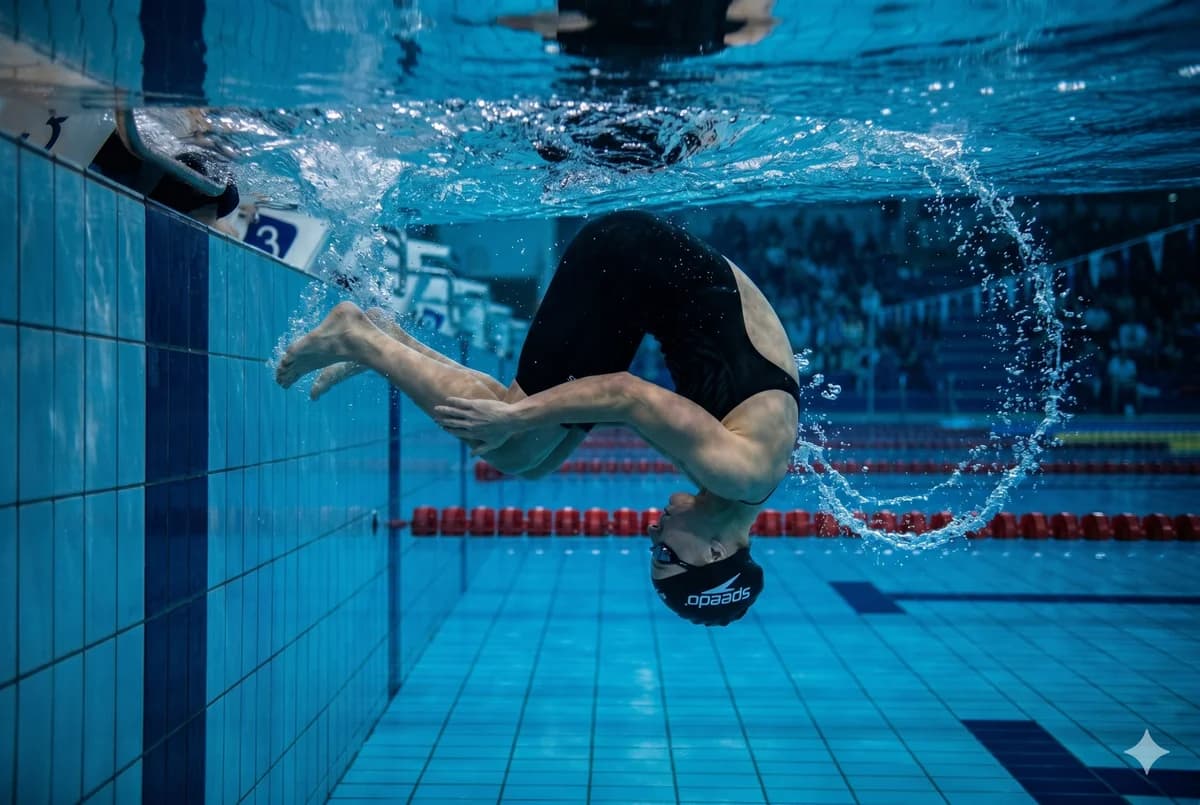
Backstroke looks simple but has the most technical turn in the sport. Most backstroke DQs happen at the turn, not during the swim.
The 2026 rules require:
- Stay on your back the entire race, except during the turn
- During the turn, you may rotate to the front, but only as part of a continuous turning action that starts an immediate pull or pull-and-kick into the wall
- One single arm pull is allowed during the turning action, after the body passes vertical
- You must leave the wall on your back
- Touch the wall at the finish while on your back
The most common backstroke DQs:
- Turning past vertical without an immediate continuous turn. Rotating to the stomach and gliding, hesitating, or taking multiple pulls is a DQ. The turn must be one continuous motion.
- Multiple arm pulls during the turn. Only one arm pull is allowed after the rotation to the front.
- Submerging past 15 meters off the start or turn. Same as freestyle, the underwater dolphin kicks must end by the 15-meter mark.
- Turning onto the stomach at the finish. The hand must touch the wall while the swimmer is still on the back.
Backstroke turn rules get updated more often than other strokes. Coaches and officials track the changes carefully. If your swimmer is racing backstroke for the first time in a new season, ask the coach to walk through the current rules at practice.
Breaststroke: Two Hands, Symmetric Kick, One Dolphin
Breaststroke has the most stroke-related DQs in age group swimming. The rules are strict and the stroke is technical.
Key rules:
- Both hands must touch the wall simultaneously at every turn and at the finish
- The kick must be symmetric (both feet turning out together)
- One downward dolphin kick is allowed during the underwater pullout, after the start and after each turn, and only before the breaststroke kick
- The pullout cannot extend past the hipline before the breaststroke kick begins
- Head must break the surface during each stroke cycle (after the first pullout)
The most common breaststroke DQs:
- One-hand touches at the wall. Even a fingertip difference between hands counts. This is the most common breaststroke DQ in age group swimming.
- Scissor kicks or alternating kicks. Both feet must turn out together. If one foot turns out and the other does not (a scissor kick), it is a DQ. So is a flutter kick.
- Two dolphin kicks in the pullout. Only one is allowed, and it must come after the arm pull and before the breaststroke kick.
- Head not surfacing during the stroke cycle. After the initial pullout, the head must break the surface every cycle.
Most breaststroke DQs at the younger ages come from the wall touch. Drill it. Both hands, every time, even in practice.
Butterfly: Symmetry and the Dolphin Kick
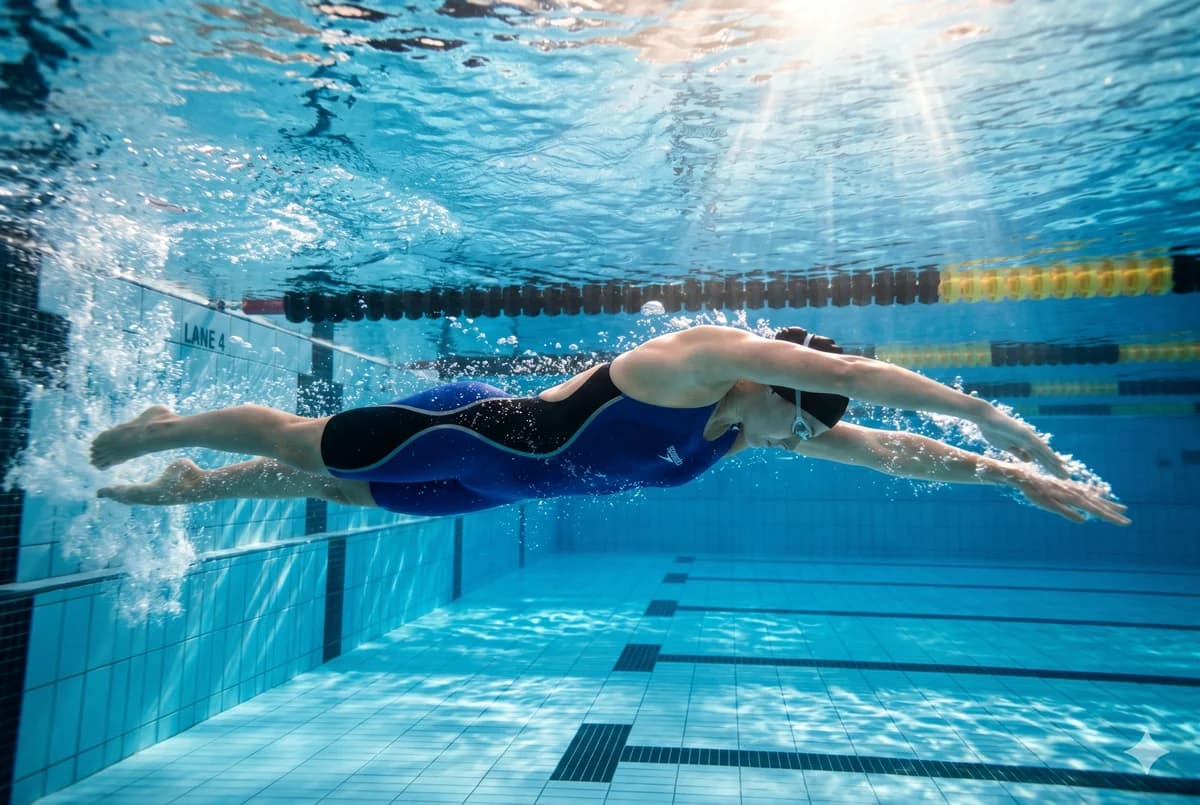
Butterfly has the fewest unique technical rules but the highest physical demand. Tired butterfly swimmers make mistakes that turn into DQs.
Key rules:
- Both arms must move together in front of the body and behind the body
- Recovery (the over-water portion of the arm stroke) must be over the surface, with both arms entering at the same time
- Only dolphin kicks are allowed (no flutter kicks)
- Both hands must touch the wall simultaneously at turns and finishes
- The head must break the surface by 15 meters off the start and turns
The most common butterfly DQs:
- Alternating kicks. Tired swimmers sometimes flutter-kick to keep moving. Even one flutter kick can cause a DQ.
- Arms not moving together. One arm reaching ahead while the other lags is a DQ. This often happens late in the race when symmetry breaks down.
- One-hand wall touches. Same as breaststroke, both hands have to land at the same time.
- Underwater past 15 meters. Same rule as the other strokes. The 15-meter mark applies off every wall.
Butterfly DQs are mostly fatigue-related. Build the stroke endurance to keep symmetry through the back half of the race, especially in 100s and 200s.
IM (Individual Medley): Stroke Order and Transitions
In an IM, every stroke must be performed in the right order: butterfly, backstroke, breaststroke, freestyle. Each stroke must follow its own rules.
Common IM DQs:
- Wrong stroke order. Rare but it happens, usually with younger swimmers in their first IM.
- Illegal transitions. The transition between strokes has its own rules. Backstroke to breaststroke must touch on the back. Breaststroke to freestyle must touch with both hands.
- Stroke-specific DQs. Any DQ that applies to the individual stroke also applies in an IM.
IM DQs are most common at the breaststroke-to-freestyle transition, where swimmers sometimes touch with one hand instead of two.
What to Do After a DQ
A DQ feels worse than a slow swim. The time existed, the work happened, and then it gets erased.
Here is the practical sequence for swimmers and parents.
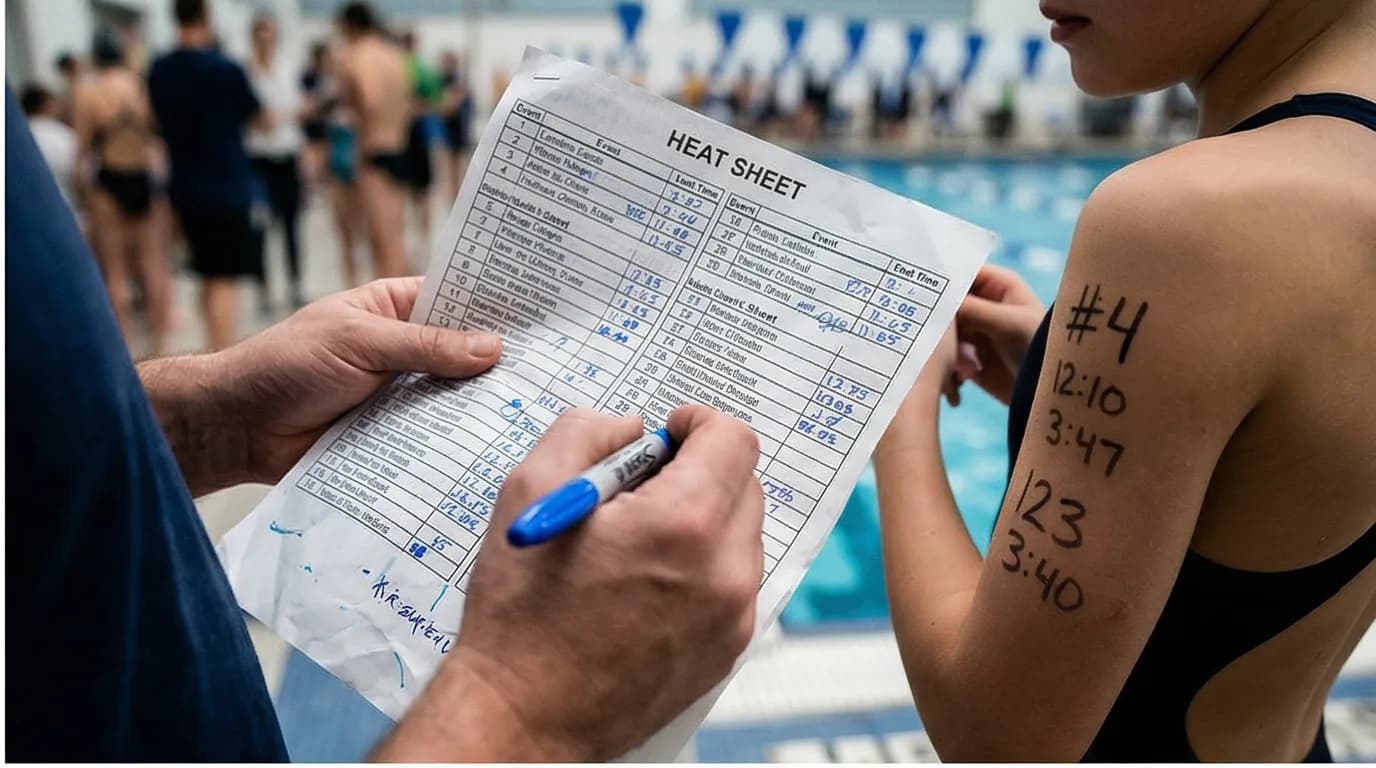
1. Find out exactly what the DQ was for. The coach should be able to get the call from the official within 5 to 10 minutes. The DQ code also shows up next to the swimmer's name on the posted heat sheet once the heat closes. Knowing the specific reason matters more than the DQ itself.
2. Acknowledge the swim happened. Even if it does not count for ranking, the time is real. The swimmer trained, raced, and finished. That counts for confidence and for next time.
3. Drill the specific issue at the next practice. A breaststroke wall-touch DQ becomes a wall-touch drill. A backstroke turn DQ becomes a turn-rotation drill. The fix is usually small and specific.
4. Move on. A DQ at one meet does not change a swimmer's career. Most swimmers have several over the course of their swimming. Holding onto one for weeks is more damaging than the DQ itself.
5. Track the trend, not the single result. If DQs are stacking up in one stroke, that is a coaching conversation. If it is one DQ in a season, it is just part of swimming. For the bigger picture across seasons, build a stroke-by-stroke DQ history inside Gophin so the trend is visible without digging through multiple sites.
How Officials Make the Call
Officials work in pairs at most meets. One walks each side of the pool. They watch for specific violations defined in the rulebook. If both officials see the same violation, the DQ is confirmed. If only one sees it, the DQ usually still stands, but the official has to be confident.
DQs cannot be appealed at most age group meets. The official's call is final. At higher-level competitions, a formal protest process exists, but it is rarely used.
This is why DQs feel sudden and final. They are.
One Last Thing
DQs are part of swimming. Every swimmer gets one eventually. The ones who recover fastest are the ones who treat it as information, not as a verdict.
Find out what the call was for, fix it in practice, and move on to the next race.
And once the meet is over and the official times post, you can use Gophin to spot which strokes are still drawing DQs, free, no card needed.
Sources
- World Aquatics. Competition Regulations, February 2026 update. Stroke and turn rules for freestyle, backstroke, breaststroke, butterfly, and individual medley. worldaquatics.com
- USA Swimming. 2026 Rulebook. Stroke and turn enforcement and disqualification procedures. usaswimming.org
- U.S. Masters Swimming. "How Swimmers Can Avoid the Most Common Disqualifications." usms.org
- Swimming Canada. Officials training resources and rule adoption. swimming.ca