Quick answer
Short course pools are 25m (or 25y), long course pools are 50m (Olympic size). Short course times are typically 2 to 4 percent faster because of more walls and push-offs per race. Both are valid Personal Bests, just tracked separately. Long course is the international standard used at the Olympics and World Championships.
Rafa's 400 Free: 4:40 in short course, 4:51 in long course. "Why am I slower, Dad?" she asked after the meet, genuinely confused. I had to explain that it is basically a different race -- more walls, more push-offs, different pacing. That conversation happens in every swim family sooner or later.
Sooner or later, every swim parent encounters a confusing moment: their child posts a faster time than usual, and a more experienced parent leans over and says, "well, that was short course." As if it explains everything. And suddenly you realize that not all swim times are created equal.
The difference between short course and long course is one of the most fundamental concepts in competitive swimming, and it trips up new parents more than almost anything else. This guide breaks it all down.
The Basics: Pool Length Matters
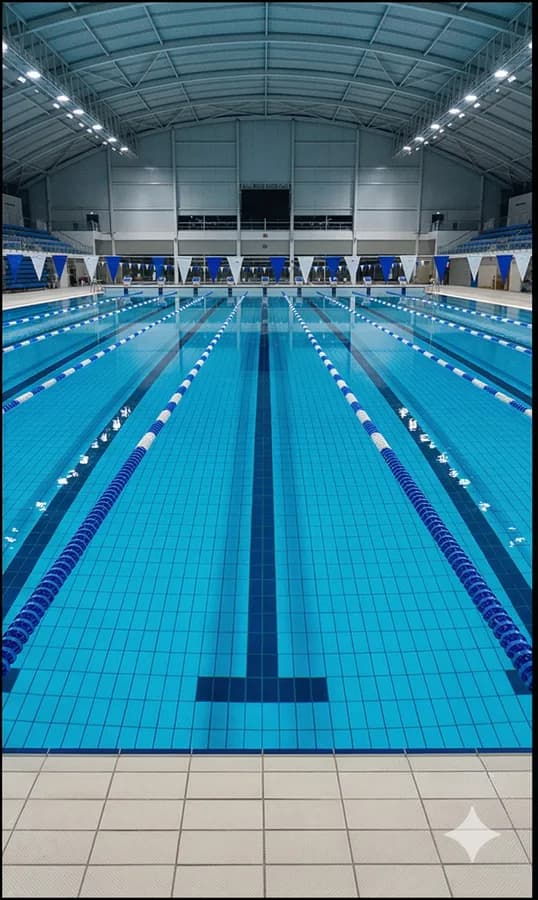
Competitive swimming takes place in three pool configurations:
- SCM (Short Course Metres): 25-metre pool. Used worldwide and the standard for most winter seasons in Canada, Europe, and many other countries.
- LCM (Long Course Metres): 50-metre pool. The Olympic standard, as defined by World Aquatics (formerly FINA) facility rules [1]. Used for major championships and typically the summer season format.
- SCY (Short Course Yards): 25-yard pool (approximately 22.86 metres). Standard in the United States for high school, college (NCAA), and most club swimming during the winter season.
| Code | Pool | Where you see it | Typical season |
|---|---|---|---|
| SCY | 25 yards | US club, high school, NCAA | Fall and winter |
| SCM | 25 metres | Canada, Europe, World Short Course | Fall and winter |
| LCM | 50 metres | Olympics, Worlds, summer champs | Spring and summer |
When someone says "short course," they usually mean a 25-metre or 25-yard pool. "Long course" means a 50-metre pool. The distinction matters because it directly affects how fast a swimmer can go.
Need to translate a time? Sign in and open the free Course Converter .
Why Times Are Different Across Courses
If your child swims a 200 freestyle in a 25-metre pool and then swims the same event in a 50-metre pool, the long course time will almost always be slower. This is not because they swam worse. It is physics.
Turns and walls. In a 200-metre freestyle in a short course pool, the swimmer makes seven turns. In long course, they make three. Each turn involves a push off the wall, and that underwater phase is significantly faster than swimming on the surface. A strong underwater push-off can cover five or more metres in less time than it takes to swim those same metres at the surface. More turns mean more of these speed boosts.
Stroke rhythm. In a longer pool, swimmers must sustain their stroke for twice the distance before reaching a wall. This demands more endurance per length and can expose technique weaknesses that walls help mask in short course.
Breathing patterns. With longer distances between walls, swimmers may need to breathe more frequently, which can slow their stroke rate.
The cumulative effect is significant. A swimmer's short course time for the same event can be anywhere from two to eight seconds faster than their long course time, depending on the event, the distance, and the swimmer's individual strengths.
Conversion Factors: Useful but Imperfect
Because times differ by course, there are mathematical conversion factors that estimate what a short course time would translate to in long course, and vice versa. National federations like Swimming Canada and USA Swimming, as well as World Aquatics, publish these conversion factors [2], and many coaches use them to gauge an athlete's potential across courses.
For example, a rough conversion might suggest that a 1:00.00 in the 100 freestyle SCM is approximately equivalent to a 1:02.50 in LCM. But these are estimates, not guarantees. Swimmers who are exceptional at turns and underwaters may gain more advantage in short course than the conversion predicts. Swimmers with great open-water endurance may lose less in long course than expected.
Conversions are a useful reference point, but they should never be treated as exact translations. They are approximations, and individual variation is significant.
SCY: The American Factor
If your child competes in the United States, they will encounter SCY (Short Course Yards). This adds another layer of complexity because a yard is shorter than a metre, making times in SCY look faster than SCM times for the same event name.
A "100 free" in SCY is 100 yards (approximately 91.4 metres), while a "100 free" in SCM is 100 metres. They are literally different distances raced at different pool lengths. Comparing the two directly makes no sense, even though the event name looks the same.
If your child competes in both Canada and the US, or if you are looking at university recruitment in the NCAA, understanding this distinction is critical. The events share a name, but the numbers are not interchangeable.
Which Season Uses Which Course?
The swimming calendar generally follows a pattern, though it varies by country:
- Fall and Winter (October through March): Short course season. Most competitions are held in 25-metre (or 25-yard in the US) pools.
- Spring and Summer (April through August): Long course season. Championships and major meets shift to 50-metre pools.
This seasonal split means your child maintains separate sets of personal bests: one for short course and one for long course. A PB in short course does not replace a long course PB for the same event. They are tracked independently.
How Standards Differ by Course
Swimming federations set qualifying standards -- time benchmarks that swimmers must achieve to qualify for provincial, national, or international competitions. Both Swimming Canada and USA Swimming publish separate standard tables for SCM, LCM, and (in the US) SCY, updated regularly to reflect evolving competitive levels [3]. These standards are set separately for each course.
A swimmer might meet the "AA" standard in short course for the 100 butterfly but not yet in long course, because their long course time is naturally slower. This is completely normal. Different standards exist precisely because the courses produce different times.
When evaluating your child's progress against standards, always make sure you are comparing apples to apples. A short course time against a short course standard. A long course time against a long course standard.
Why You Cannot Directly Compare
The most common mistake new swim parents make is comparing a time from one course to a time from another as if they are the same thing. "My child went 1:05 in their 100 free last month and now they went 1:10 -- did they get slower?"
Not necessarily. If last month's time was short course and this month's was long course, that five-second difference is expected, maybe even an improvement. Without knowing the course, a time by itself is incomplete information.
This is why experienced swim parents always ask: "Was that short course or long course?" It is not a trivial question. It is the context that makes the number meaningful.
How Gophin Keeps It Straight
Gophin separates short course and long course times automatically. When you view your swimmer's profile, personal bests are displayed by course type. Evolution charts show improvement trends within each course, not across them. This means you are always comparing equivalent performances.
When results are pulled from official databases, Gophin tags each time with the correct course designation so there is never ambiguity. You can view your child's short course history and long course history side by side, each telling its own clear story of progress.
For parents who compete across seasons or in multiple countries, this separation eliminates the confusion that comes from mixing course types in a single list. Every number has its context, and that context is visible at a glance.
The Bottom Line
Short course and long course are not better or worse than each other. They are different playing fields with different characteristics. Understanding this distinction is one of the most important steps in becoming a confident, informed swim parent.
When you hear a time, ask which course it was swum in. When you track progress, keep the courses separate. And when your child posts a new personal best, celebrate it for what it is -- regardless of pool length.
** Keep short course and long course apart. Sign in and open the Course Converter
if you need an estimate across pools. Free, no card. **
Sources
- World Aquatics (formerly FINA). Official facility rules defining pool dimensions for international competition: 50m (long course) and 25m (short course). worldaquatics.com
- World Aquatics, Swimming Canada, and USA Swimming. Published course conversion factors used to estimate equivalent times between SCM, LCM, and SCY.
- Swimming Canada and USA Swimming. Separate qualifying standards published for each course type (SCM, LCM, SCY), updated regularly.