Quick answer
World Aquatics points are a universal scoring system that compares swimming performances across different events, distances, and courses. The system uses the current world record as a 1000-point benchmark and scales every other time relative to it using a cubic formula. Higher points mean a faster relative performance. A score of 700 to 800 is national level, 900+ is world-class. Sign in to Gophin (free) to run the calculator.
Open the free calculator (sign in)
Another swim parent asked me "what are World Aquatics points?" at a meet last year. I'd heard the term dozens of times but couldn't actually explain it. I went home that night and researched until I could. Here's what I learned.
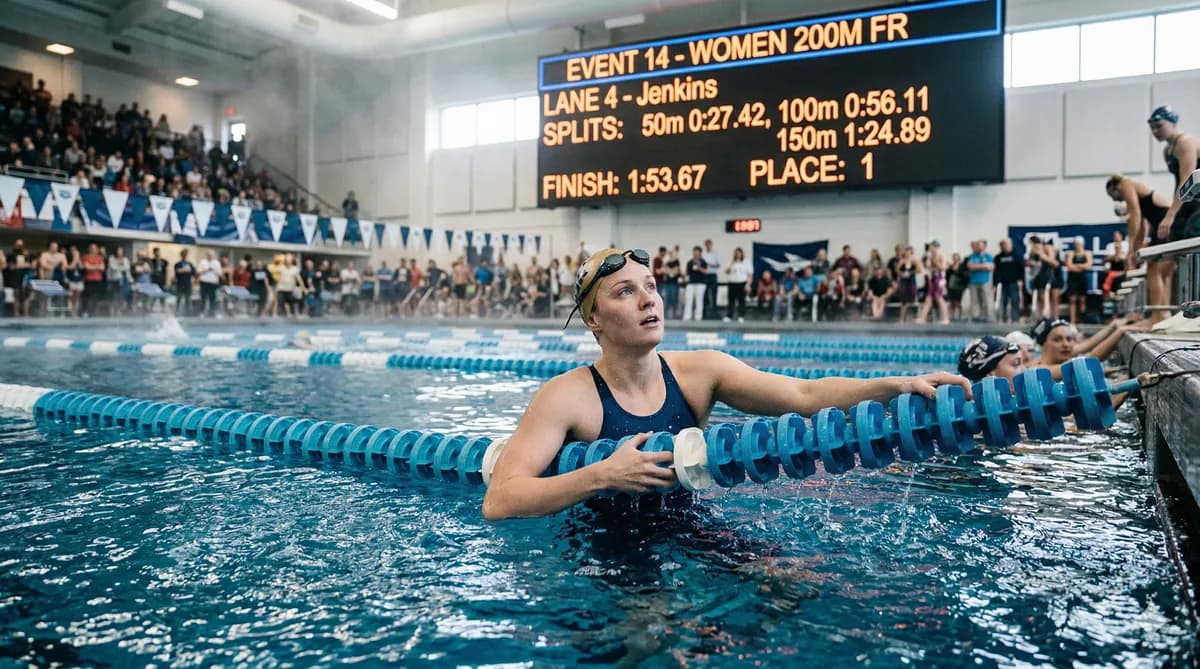
You finish a race and your coach says: "569 points." You nod, towel off, and pretend you know what that means.
You are not alone. World Aquatics Points are one of the most useful metrics in competitive swimming, but most swimmers never learn how they actually work. Whether you just heard the term for the first time or you have been checking your points for years, this guide will give you a clear understanding of what World Points are, how they are calculated, and why they matter for your swimming career.
Even better, you can calculate your World Aquatics Points for free using Gophin's World Points Calculator . It works for every stroke, distance, course type, and gender. Sign in with a free account to use it.
Let's break it all down.
What Are World Aquatics Points?
World Aquatics Points are a universal scoring system that converts any swim time into a single number between 0 and 1,000. The higher your score, the closer your time is to the current world record for that event.
The system was created by the international governing body of swimming, formerly known as FINA (Federation Internationale de Natation). In 2022, FINA officially rebranded to World Aquatics, and the scoring system followed suit. If you have ever searched for a "FINA points calculator," you were looking for the same thing , the name changed, but the formula did not.
The core idea is simple: World Points let you compare performances across completely different events. A 50 freestyle and a 400 individual medley produce very different times. But if both swims earn 650 World Points, they represent the same relative level of performance.
This makes World Points one of the few truly objective measures of how fast a swim is, regardless of event, stroke, or distance. It is the closest thing competitive swimming has to a universal language of performance.
A Brief History
FINA introduced the points system to standardize international rankings and create a fair method of comparing swimmers across different disciplines. The system gained broad adoption among national federations, coaches, and recruiting programs because it solved a real problem: raw times are meaningless without context.
When FINA rebranded to World Aquatics in December 2022, the underlying formula stayed the same. Only the name changed. So if you see "FINA Points" on an older document or website, it is the same calculation you would run today under the World Aquatics name.
How World Aquatics Points Are Calculated
The formula behind World Points is straightforward once you see it.
Formula:
World Points = 1000 × (Base Time / Your Time)³
Here is what each part means:
- 1000, the maximum score. A swim that exactly matches the world record earns 1,000 points.
- Base Time, the world record for that specific event, gender, and course type, set at the start of each season. This is the benchmark everything is measured against.
- Your Time, the time you swam, in seconds.
- ³, the cubing exponent. This is critical. It means that small differences in time produce larger differences in points as you get closer to the world record. The gap between 900 and 950 points is much harder to close than the gap between 500 and 550.
A Worked Example
Let's say you are a male swimmer and you just swam a 53.50 in the 100m Freestyle (LCM). The current world record (base time) for that event is 46.80.
Step 1: Divide the base time by your time.
46.80 / 53.50 = 0.8748
Step 2: Cube the result.
0.8748³ = 0.6690
Step 3: Multiply by 1,000.
0.6690 × 1,000 = 669 World Points
That score of 669 tells you your 100 free performance sits at roughly 67% of world record pace when adjusted by the cubing formula. You can now compare that 669 directly against your 200 backstroke score, your 50 butterfly score, or any other event.
Why the cubing matters: The ³ exponent means the points scale is not linear. Dropping from 60 seconds to 55 seconds earns you far more points than dropping from 70 to 65. This reflects the reality of competitive swimming, the closer you get to the world record, the harder every tenth of a second becomes.
Free World Aquatics Points Calculator, Try It Now
You do not need to do the math by hand. Gophin offers a free World Points Calculator that does the calculation instantly.
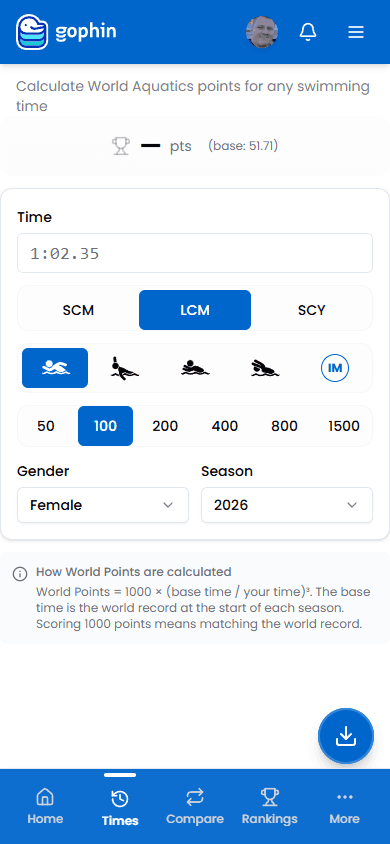
Here is how to use it:
- Go to the calculator. Open the World Points Calculator , it is free. Sign in with a Gophin account to use it.
- Enter your time. Type in your swim time (minutes, seconds, hundredths).
- Select your course type. Choose SCM (Short Course Metres), LCM (Long Course Metres), or SCY (Short Course Yards).
- Pick your stroke. The calculator supports all five competitive strokes , freestyle, backstroke, breaststroke, butterfly, and individual medley.
- Choose the distance. Options range from 50m to 1500m, depending on the stroke.
- Select gender and season. The base times update each season, so selecting the correct season ensures accurate results.
- Get your points. Your World Aquatics Points appear instantly.
The calculator uses the official base times published by World Aquatics for each season. That means your result matches what you would see on official rankings and meet results.
Why use a calculator instead of manual math? Beyond convenience, the base times change every season as new world records are set. A calculator that stays updated with the latest base times ensures your score is always accurate. Using last season's base time would give you a wrong result.
Why World Points Matter
World Points are not just a curiosity. They serve real, practical purposes for swimmers, coaches, and families involved in competitive swimming.
Compare Across Events
Raw times are event-specific. You cannot compare a 24.5 in the 50 free to a 2:05 in the 200 fly just by looking at the numbers. World Points give you a single score per swim, so you can instantly see which of your events is your strongest, and which has the most room for improvement.
For coaches managing a full roster, this is invaluable. Instead of mentally translating between strokes and distances, you can rank every swimmer's every event on the same scale.
Track Improvement Over Time
Because base times only change once per season, your World Points score for the same event is a stable measure of progress throughout a season. If your 200 backstroke was 580 points in October and 620 points in March, you know you made meaningful progress, even without memorizing the exact time drops.
Points also let you compare across seasons. Even when the base time changes (because a new world record was set), the relative meaning of a score stays consistent. A 700-point swim is elite in any season.
College Recruiting Context
For swimmers in North America pursuing collegiate swimming, World Points provide a standardized way to evaluate ability. Coaches at NCAA programs recruit from both yards (SCY) and meters (SCM/LCM) backgrounds. World Points give them a common reference point to compare a Canadian swimmer's SCM times against an American swimmer's SCY times.
If you are putting together a recruiting profile, including your World Points alongside your best times adds immediate context that a college coach can interpret without conversion tables.
Team Evaluation for Coaches
Coaches use World Points to make relay selections, identify underperforming events, and set realistic season targets. Because points normalize across events, a coach can quickly spot which swimmers are closest to their potential across their entire event range.
Points also help with meet strategy. If you know your team's 200 medley relay legs each score above 650 points but the butterfly leg is at 520, you have identified exactly where to focus training effort.
World Points Ranges, What Is a Good Score?
One of the most common questions swimmers ask is: "Is my World Points score good?" Here is a general framework. Keep in mind that these ranges are approximate and vary slightly by age, event, and context.
| Points Range | Level | What It Means |
|---|---|---|
| 300-400 | Recreational competitive | You are actively competing and building your base. Consistent training and technical improvement will move the needle. |
| 500-600 | Strong club swimmer | You are competitive at regional and age group championship meets. This is a solid level for dedicated age group and senior club swimmers. |
| 700-800 | Elite / National level | You are competing at national championships or high-performance programs. Times in this range attract attention from college programs and national team selectors. |
| 900+ | World class | You are approaching or at world record pace. This is Olympic Trials and international championship territory. Only a small number of swimmers globally reach this level. |
Important context: A 14-year-old scoring 500 points is in a very different position than a 22-year-old scoring 500 points. Age and development stage matter. Use these ranges as general guideposts, not absolute judgments.
Also note that the cubing formula means point differences at the top of the scale represent much smaller time differences. The gap between 800 and 900 points might be only a second or two in a 100m event. The gap between 400 and 500 might be several seconds.
SCM vs LCM vs SCY, Do World Points Change by Course?
Yes. World Points use different base times for each course type. This is important to understand because it means the same swimmer can have different point scores for the same event, depending on whether the race was in a 25-meter, 50-meter, or 25-yard pool.
Why? Each course type has its own world records. Short course pools produce faster times because swimmers get more turns and more wall push-offs. A 100m freestyle world record in SCM (25-meter pool) is faster than the LCM (50-meter pool) record for the same event. The base times reflect this.
What this means for you: If you swim in multiple course types during a season, calculate your points for each one separately. Your SCM points and LCM points for the same event will usually be close but not identical.
SCY (Short Course Yards) is worth a special note. Yards is primarily used in the United States, and World Aquatics does maintain base times for SCY events. Gophin's calculator supports SCY, which is particularly useful for American college swimmers and anyone competing in NCAA meets.
If you want to convert a time from one course to another before calculating points, Gophin also has a free Course Converter tool that handles the math for you.
Conclusion
World Aquatics Points give every competitive swimmer a universal way to measure performance. Whether you are comparing your 50 fly to your 200 free, tracking progress across a season, or putting together a college recruiting profile, points tell the story that raw times cannot.
The formula is simple, 1000 × (Base Time / Your Time)³, but doing the math by hand for every event and course type is tedious. That is why we built a free calculator that handles it all. And once you create a Gophin account, every time in your profile automatically displays its World Points score, so you can compare across events at a glance without calculating anything.
Calculate Your World Points Free, No Login Needed
Enter your time, pick your event, and see where you stand. It takes five seconds and works for SCM, LCM, and SCY.
Swim smarter, not harder.