Quick answer
Age-group swimmers generally need 9–12 hours a night (ages 6–12) or 8–10 hours (teens), and competitive kids should aim at the high end. A Stanford sleep-extension study found faster 15-metre sprints, better reaction, and better turns when swimmers slept about 10 hours. Morning practice makes 10 hours hard; protect bedtime first.
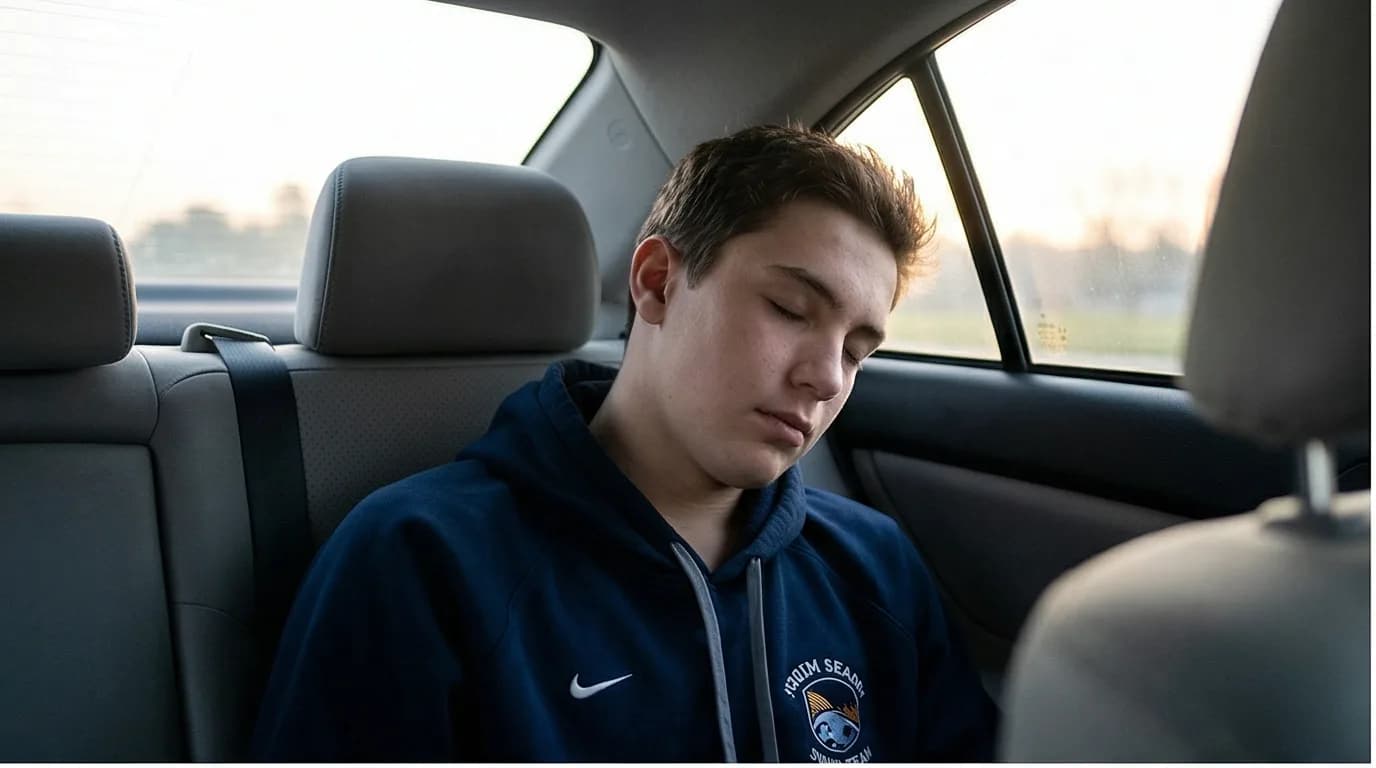
Most evenings after practice, Rafa falls asleep in the back seat before we even make it home. Head against the window, still in her parka, out cold. That image -- my fourteen-year-old daughter too exhausted to stay awake for a fifteen-minute drive -- is what made Michelle and me restructure our entire family schedule. Dinner earlier, screens off by eight, everything built around making sure she gets nine-plus hours.
If you are juggling training, school, and bedtime in your house, I get it. Here is what we learned, backed by what the science says.
Your child swims five or six days a week. They wake up early for morning practice, go to school, do homework, and somehow still have enough energy to argue about screen time before bed. But here is a question that gets overlooked in all that chaos: are they sleeping enough?
For young athletes, sleep is not just rest. It is where the real training happens.
The Numbers
The American Academy of Sleep Medicine (AASM) recommends that children ages 6 to 12 get 9 to 12 hours of sleep per night. For teenagers (13 to 18), the recommendation drops to 8 to 10 hours. As Dr. Christopher Asplund noted in a 2024 article in Current Sports Medicine Reports on the importance of sleep for athletic performance, athletes benefit from extra sleep for recovery. For young athletes training at competitive levels, most experts recommend aiming for the upper end of that range -- closer to 10 hours.
Why so much? Because sleep is when the body repairs muscle tissue, consolidates motor skills, and releases growth hormone. A swimmer can do the perfect flip turn in practice all week, but it is during deep sleep that the brain locks that movement into long-term memory. Cut sleep short, and those reps are partially wasted.
The Stanford Study Every Swim Parent Should Know
A landmark study led by Dr. Cheri Mah at Stanford University, first presented at the SLEEP 2008 conference and later expanded in a 2011 publication in the journal Sleep, tracked swimmers who extended their sleep to 10 hours per night for six to seven weeks. The results were hard to argue with:
- 15-meter sprint times improved by an average of 0.51 seconds
- Reaction times off the blocks got faster
- Turn times improved
- Swimmers reported better mood and less fatigue during practice
Half a second might not sound like much. But in swimming, where races are decided by hundredths, it is enormous. And the swimmers did not change anything about their training. They just slept more.
The Morning Practice Problem
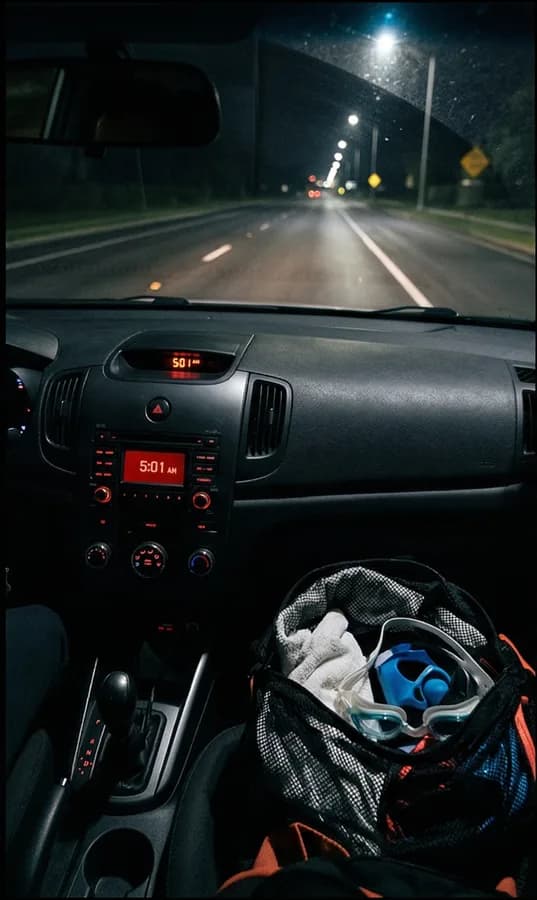
Here is the tension that every swim family knows: morning practice often starts at 5:00 or 5:30 AM. That means your child is waking up at 4:30 -- maybe earlier. If they need 10 hours of sleep, that means they would need to be asleep by 6:30 PM the night before.
That is obviously not realistic. No teenager is going to bed at 6:30 PM.
So what can you do? A few practical approaches:
- Prioritize bedtime on school nights. Even if 10 hours is not possible, pushing bedtime 30 minutes earlier makes a measurable difference.
- Use weekends to catch up partially. While you cannot fully "bank" sleep, a longer night on Friday or Saturday helps reduce the accumulated deficit.
- Naps count. A 20 to 30 minute nap after school -- before afternoon practice -- can boost alertness and performance without disrupting nighttime sleep.
- Talk to the coach about schedule balance. Many clubs are starting to rethink early morning practices for younger age groups, recognizing that sleep deprivation undermines the training itself.
Sleep vs. Screen Time
You already know this, but it bears repeating: screens before bed are the enemy of good sleep. The blue light emitted by phones, tablets, and laptops suppresses melatonin production, which is the hormone that tells the brain it is time to sleep.
Studies show that adolescents who use screens in the hour before bed take significantly longer to fall asleep and get lower quality rest when they do.
The practical rule: no screens for at least 30 minutes before bed, ideally 60. This is easier to enforce if you create a charging station outside the bedroom. When the phone charges in the kitchen, the temptation disappears.
Building a Better Sleep Routine
Good sleep does not happen by accident, especially for busy athletes. Here are habits that help:
- Consistent bedtime and wake time, even on weekends when possible
- Cool, dark bedroom (around 18 to 20°C / 65 to 68°F)
- A wind-down routine -- reading, stretching, or a warm shower. Something that signals to the body that the day is over.
- Avoid heavy meals within two hours of bedtime. A light snack is fine, but a full dinner at 9 PM makes it harder to fall asleep.
- Limit caffeine after noon. This applies to energy drinks too, which some older swimmers start reaching for to compensate for the sleep they are not getting.
The Conversation Worth Having
If your child is consistently tired, moody, struggling in school, or plateauing in the pool, sleep is the first thing to look at -- before training volume, before nutrition, before anything else. It is the lowest-effort, highest-impact change a young athlete can make.
You do not need a sleep lab or a specialist. You just need an honest look at what time your child is actually falling asleep and what time they are waking up. If the gap is less than nine hours on most nights, there is room to improve.
Sleep is not the opposite of training. It is part of it.
Gophin does not track sleep. It tracks official race times. If a stretch of short nights lines up with a stall on the clock, you will see it in Compare Seasons. Sign in free, no card. Fix the nights first.
Sources
- Mah, C.D. et al. (2008, 2011). Stanford University sleep extension study. Swimmers improved 15m sprint by 0.51s, plus faster reaction and turn times. Presented at SLEEP 2008; basketball version published in Sleep (2011).
- American Academy of Sleep Medicine (AASM). Recommends 9-12 hrs for ages 6-12, 8-10 hrs for teens.
- Asplund, C.A. (2024). "The Importance of Sleep for Health and Athletic Performance." Current Sports Medicine Reports / SAGE Journals.