Quick answer
Club swimming teaches showing up, packing a bag, handling a clock that does not negotiate, and bouncing back after a DQ. Those transfer to school and work more than a medal does. They only stick if the kid still wants to be there. A national cut is not required.
Last year, I walked past Rafaela's room at 9 PM and found her packing her school bag for the next day -- lunch, homework, everything organized and ready to go. She was twelve. Morning practice starts at 6 AM, and she had figured out on her own that there is no time to scramble in the morning. I stood there thinking: I do not know many adults who plan ahead like that.
That moment made me realize the pool was teaching my daughter things no classroom ever could.
Competitive swimming gives your child more than faster times and a collection of ribbons. It quietly teaches them skills that will shape who they become long after they hang up their goggles.
Parents often focus on the physical benefits of swimming, and those are significant. But according to a 2006 review by Dr. Richard Bailey published in the Journal of School Health, sports participation is linked not just to physical health but also to academic, social, and emotional development. The real return on investment shows up in classrooms, job interviews, relationships, and the quiet moments when your child has to make hard decisions on their own.
Here are seven life skills that competitive swimming builds, one lap at a time.
1. Goal Setting
Every personal best is a milestone. Every qualifying time is a target. Swimmers learn early that improvement does not happen by accident. It happens when you identify what you want, break it down into achievable steps, and work toward it consistently.
A ten-year-old who learns to set a goal of dropping two seconds in the 100 freestyle by the end of the season is practicing the same skill that will help them plan a career, manage a project, or train for a marathon twenty years later. The pool teaches goal setting in its purest form: clear, measurable, and entirely dependent on your own effort.
2. Time Management
School, practice, homework, social life, sleep. Competitive swimmers learn to juggle these competing demands earlier than most kids. When practice runs from 5:30 to 7:00 AM and school starts at 8:15, there is no room for wasted time.
This forced structure teaches swimmers to prioritize, plan ahead, and use their hours efficiently. Data from the National Federation of State High School Associations is about US high-school student-athletes across sports, not swimmers alone: average GPA 3.01 versus 2.59 for non-athletes, and lower dropout rates. The packed schedule does not automatically hurt academics. For many kids it sharpens time management. For some, it is too much. Watch the person, not the average.
3. Resilience
Bad races happen. Disqualifications happen. Months of training sometimes end in a time that is slower than where you started. Swimming does not shelter children from disappointment. It teaches them to face it, process it, and get back in the water.
The swimmer who touches the wall, looks at the scoreboard, sees a result they did not want, and still shows up for warm-up the next morning is building emotional resilience that no textbook can teach. They are learning that setbacks are not endings. They are data points on a longer journey.
4. Work Ethic
There are no shortcuts in swimming. You cannot fake fitness. You cannot coast on talent alone past a certain point. Results come from consistent, unglamorous effort: thousands of meters, day after day, week after week.
Kids who grow up in this environment develop an understanding that meaningful achievement requires sustained work. They learn to trust the process even when progress feels invisible. That lesson transfers directly into academics, careers, and every other arena where showing up and doing the work matters more than raw ability.
5. Sportsmanship
Competitive swimming has a beautiful culture of mutual respect. Swimmers congratulate the person in the next lane, even when that person just beat them. They cheer for teammates. They shake hands with competitors from rival clubs.
This is not just politeness. It is a deep lesson about competing with integrity, celebrating the success of others, and understanding that someone else's victory does not diminish your own value. In a world that often frames success as a zero-sum game, swimming teaches kids otherwise.
6. Self-Discipline
Nobody stands over your child during a race telling them to kick harder. Nobody can do the hard set for them. Swimming develops internal motivation and self-discipline in a way that few other environments can match.
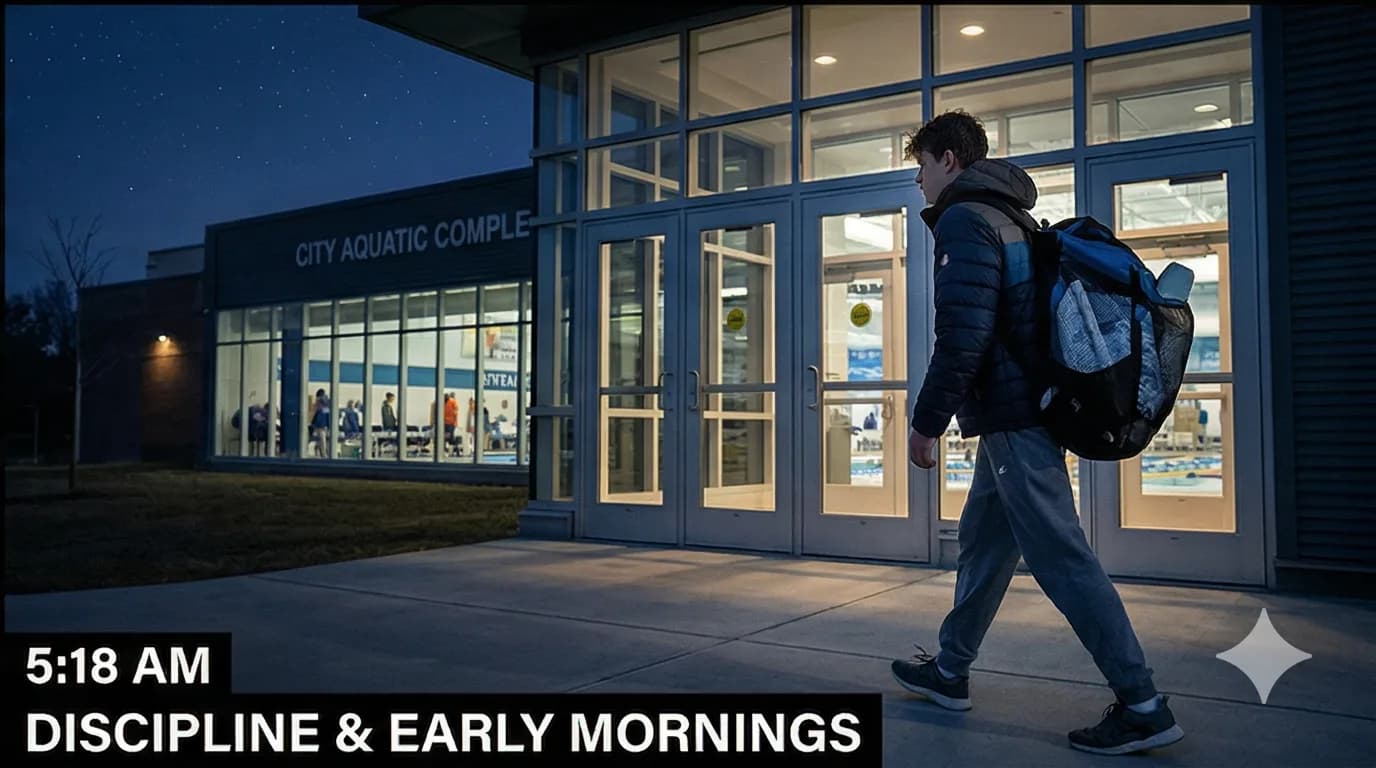
Showing up at 5 AM when it is dark and cold outside. Finishing a set when every muscle is screaming to stop. Choosing sleep over a late-night movie because morning practice is non-negotiable. These small daily choices build a foundation of self-discipline that becomes second nature.
7. Handling Pressure
Standing on the blocks before a championship final, knowing that months of preparation come down to the next sixty seconds, is a profound test of composure. Competitive swimmers learn to perform when it counts, to manage nerves, and to channel anxiety into focus.
This ability to function under pressure, to breathe, trust your preparation, and execute, translates into every high-stakes moment life will throw at them. Exams, presentations, job interviews, critical conversations. The swimmer who has stood on the blocks knows how to show up when the moment matters.
The Bigger Picture
Research by Fraser-Thomas, Cote, and Deakin (2005) in Physical Education & Sport Pedagogy identified five key outcomes of positive youth development through sport: competence, confidence, connection, character, and caring. Competitive swimming, with its blend of individual accountability and team culture, touches all five.
Not every competitive swimmer will earn a scholarship or stand on a national podium. But every competitive swimmer who stays with the sport long enough will carry these seven skills into adulthood. They are woven into the daily fabric of training and competition, absorbed gradually and permanently.
Of course, these benefits only materialize if children stay in the sport long enough. A 2024 clinical report by Drs. Joel Brenner and John DiFiori in Pediatrics warns that 70% of kids drop out of organized sports by age 13, often due to burnout from overtraining and early specialization. Keeping swimming fun, age-appropriate, and balanced is what allows these life skills to take root.
The next time you are in the stands at 6 AM, watching your child push through a tough set, remember: you are not just watching them become a better swimmer. You are watching them become a more capable, resilient, and disciplined human being.
That is worth every early alarm.
The skills show up in how they handle a stall on the clock. Sign in to Gophin (free, no card) and look at the same event across months. Do not turn that picture into a lecture in the car.
Sources
- Bailey, R. (2006). "Physical education and sport in schools: a review of benefits and outcomes." Journal of School Health.
- Fraser-Thomas, J., Cote, J., & Deakin, J. (2005). "Youth sport programs: an avenue to foster positive youth development." Physical Education & Sport Pedagogy.
- Brenner, J.S. & DiFiori, J.P. (2024). "Overuse Injuries, Overtraining, and Burnout in Young Athletes." Pediatrics, 153(2).
- National Federation of State High School Associations. Student-athlete GPA and dropout rate data (all sports).