Quick answer
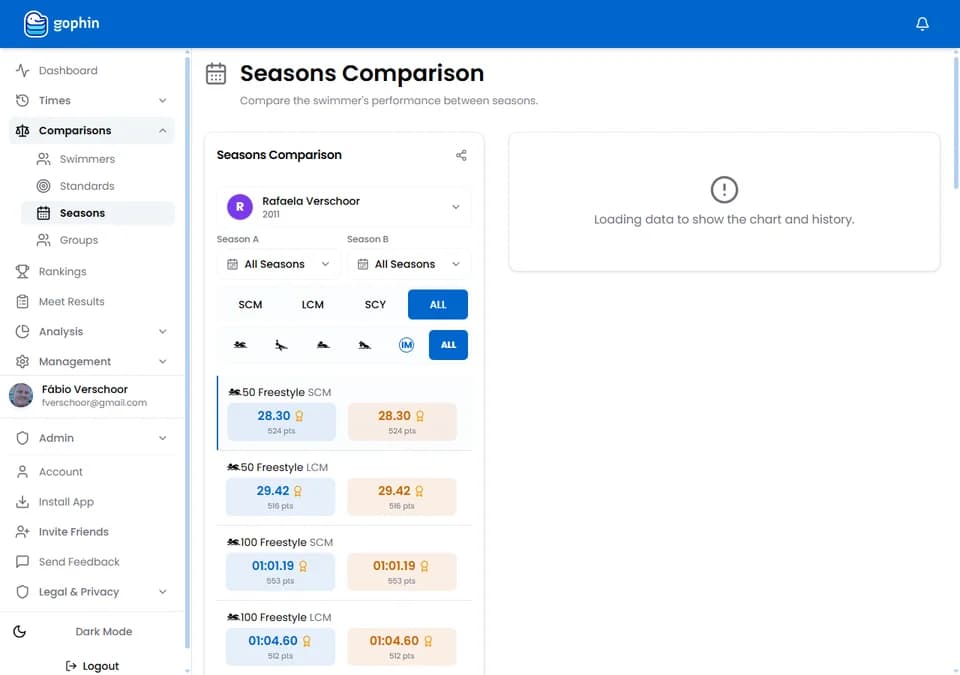
Set short course goals from last short course season, not from a long course time. Pick one or two events, aim at the next official cut, and check the gap after each meet. Sign in to Gophin (free) and use Compare Seasons plus Compare Standards so the goal stays visible.
Short course season is the long haul of the year. In Canada that means SCM. In the United States it means SCY. Either way, September is when families ask the same question: what should we actually aim at before championships in the winter?
A useful goal is specific, in one course, and checkable. "Get faster" is not a goal. "Drop the 100 Free SCY from 1:05.89 to the A cut" is.
Start from last short course season
Pull last winter's best times in the same course. A long course 100 Free from July is a different race. Keep SCM, SCY, and LCM in their own columns. Gophin already splits personal bests by course, so you are not mixing them in a spreadsheet.
If you need a refresher on the three pool codes, see what SCY, SCM, and LCM mean .
Aim at a cut, not a round number
Official standards (B, BB, A, AA, plus championship cuts) give you a mark the whole team already understands. A 12-year-old girl chasing A in the 100 Free SCY is chasing 1:04.09, not "break 1:05." Good swim times by age has the B through AA tables. Then check the live gap in Gophin.
Sign in free and open Compare Standards . Pick USA Swimming or Swimming Canada, then read how many events sit ahead of the cut.
One or two events, not eight
Championship meets still have a program. Most age groupers swim four to six events. The season goal should sit on the one or two that matter for the target meet. Everything else is supporting work. Coaches already know this. Parents get calmer when the family is not tracking eight different "must hit" times.
- Write last season's best in the goal event, same course.
- Write the next cut (BB, A, a provincial time, a Junior cut).
- Write the gap in seconds. That is the season project.
- After each meet, check whether the gap shrank. Ignore one noisy prelim.
Check the trend, not one Saturday
Mid-season meets are often unrested. A time that is 0.8 slower than last championship does not mean the goal is dead. Compare Seasons in Gophin puts this winter next to last winter so you see the shape, not the panic. Pair it with the Compare Seasons tutorial .
If the gap is growing for two months in the same course, that is a conversation with the coach. If it is bouncing around a tenth, you are still in the work.
The Bottom Line
Short course goals live in one pool length, point at a published cut, and get checked after meets without a spreadsheet. Sign in to Gophin, keep Best Times and Compare Standards open, and let the official results update the gap for you.