Quick answer
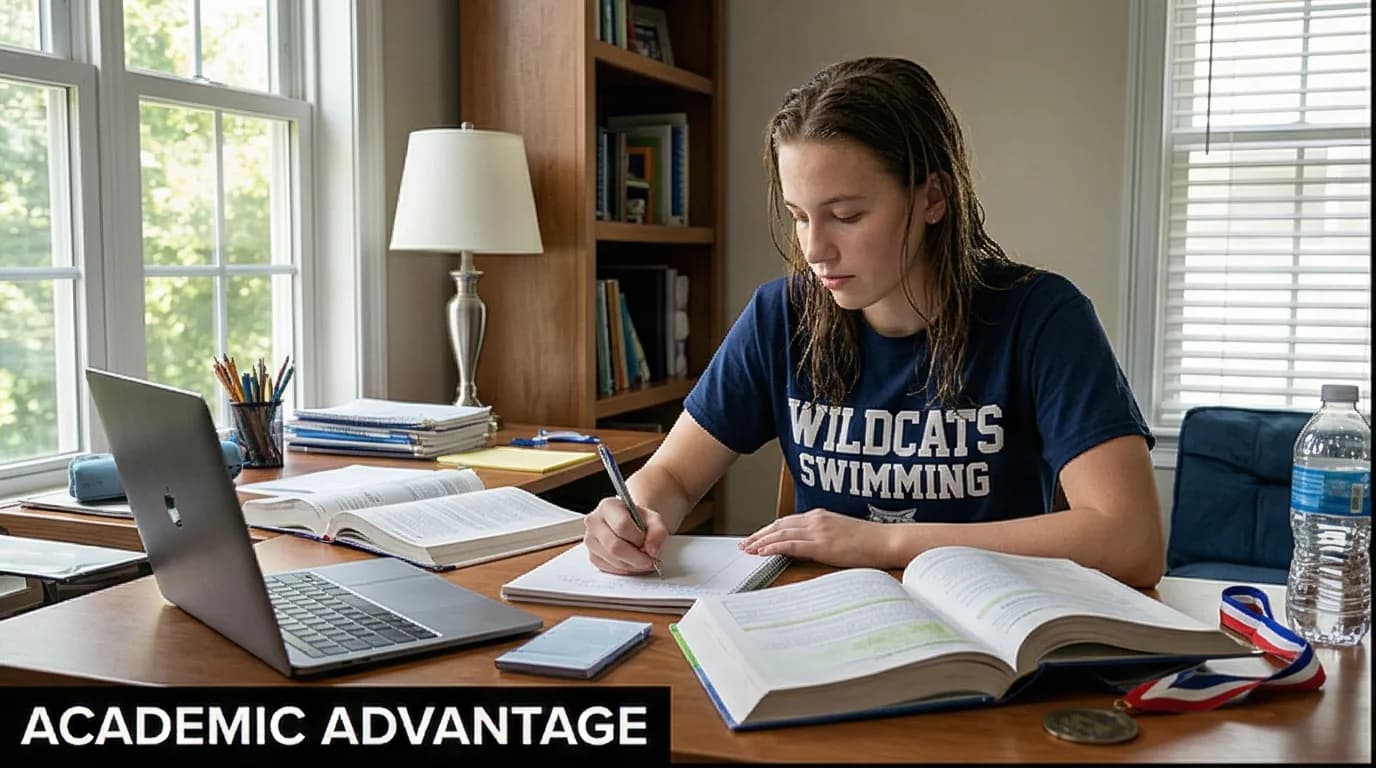
A Griffith University study of 7,000+ children found young swimmers ahead of peers on some school measures (including about 11 months in oral expression and 20 months in following directions). That is a link, not a guarantee of grades. Routine, sleep, and learning to work on a clock are the likely reasons. Do not drop the pool the first time a mark slips without talking to the teacher and the coach.
At Rafa's last parent-teacher conference, her teacher pulled me aside and said, "She's one of the most focused students in the class. She just sits down and gets it done." I almost laughed, because I know exactly where that focus comes from. It comes from the same place that makes her count laps, track intervals, and push through a set when her body is begging to stop.
If you have ever wondered whether all those hours at the pool are taking away from your child's schoolwork, the research has a reassuring answer: swimmers tend to do better in school, not worse.
A landmark study led by Prof. Robyn Jorgensen at Griffith University in Australia tracked over 7,000 children across Australia, the United States, and New Zealand. The results were striking: young swimmers were 11 months ahead in oral expression, 6 months ahead in math reasoning, and a full 20 months ahead in understanding directions compared to the general population. The advantage held across income levels and backgrounds. Something about the sport itself seems to build the kind of brain that thrives in a classroom.
Here is why.
Time Management Becomes Second Nature
Swimmers live by schedules. Morning practice at 5:30 AM, school from 8 to 3, afternoon training from 4 to 6, homework after dinner. There is no room for wasted time, and kids learn this early. By the time they reach high school, most competitive swimmers have more experience managing their hours than many adults. This forced efficiency means homework gets done, often with better focus, because there simply is not time to procrastinate.
Discipline Transfers From the Pool to the Desk
Swimming is one of the most repetitive sports in the world. Lap after lap, set after set, morning after morning. It demands a level of discipline that shapes how a young person approaches any challenge. When you have trained your body to push through the last 50 meters of a grueling set, sitting down to finish a math assignment feels manageable. The mental toughness swimmers develop is not event-specific. It shows up in every area of their lives.
Counting Laps Builds Focus
Swimming requires a surprising amount of mental engagement. Swimmers count laps, track intervals, remember stroke corrections, pace themselves, and adjust mid-set based on the clock. There is no coach standing in the lane with them. They have to hold all of this in their heads while physically exhausted. That kind of sustained attention and working memory practice is exactly what researchers call executive function, and it is one of the strongest predictors of academic success.
Early Mornings Build Structure
Nobody loves the 5 AM alarm. But there is growing evidence that consistent early rising, especially when paired with physical activity, helps regulate circadian rhythms and improve concentration during school hours. Swimmers who train in the morning often report feeling more alert in their first classes than classmates who slept later. The structure of a morning routine, wake up, eat, train, go to school, creates a rhythm that carries through the entire day.
Lower Dropout Rates Among Student-Athletes
Research from the National Federation of State High School Associations shows that US high-school student-athletes (all sports, not swimming alone) carry an average GPA of 3.01 compared to 2.59 for non-athletes, and have significantly lower dropout rates. Many swim programs also require a minimum academic standing to compete. That is a reason to stay connected to school. It is not proof that every swimmer will be an honour student.
Swimming and the Developing Brain
Physical exercise, particularly aerobic exercise like swimming, increases blood flow to the brain and promotes the growth of new neural connections. Studies have linked regular aerobic activity in children to improved memory, faster cognitive processing, and better attention spans. Swimming adds another layer because it involves bilateral coordination, breath control, and spatial awareness, all of which engage multiple brain regions simultaneously.
The Bigger Picture
None of this means every swimmer will be an honour student. Grades depend on many factors. But the evidence strongly suggests that competitive swimming gives kids tools, discipline, focus, structure, resilience, that serve them well beyond the pool. The next time someone asks whether swimming takes too much time away from school, you can tell them the research says otherwise.
Gophin does not raise marks. It puts official race times in one place so the 5 AM has a picture, not a mystery. Sign in free, no card. School is still school.
Sources
-
- Jorgensen, R. et al. (2014). Griffith University study of 7,000+ children across Australia, USA, and New Zealand. Swimmers were +11 months in oral expression, +6 months in math reasoning, +20 months in understanding directions.
-
- National Federation of State High School Associations. Student-athlete GPA (3.01 vs 2.59) and dropout rate data.