Quick answer
Swimmer's shoulder is overuse pain from millions of overhead strokes a year — often the rotator cuff getting pinched. Adolescent swimmers report it more than younger kids or elites. Early "weird" pain after a heavy set is worth a physio, not "stretch it out." This article is information, not medical advice.
Rafa was 11 the first time she said her shoulder hurt. We had just driven home from a heavy Saturday practice, two hours of long course freestyle and pull sets. She was doing that thing where she would rotate her arm in slow circles and grimace a little. "It feels weird, dad. Not bad. Just weird."
I almost said "you are fine, just stretch it out." I am very glad I did not.
Shoulder pain is the most common injury in competitive swimming. It is also one of the most ignored, especially in age group swimmers, because the early signs are easy to miss and easy to dismiss. By the time it is "real" pain, it has often already become a problem.
Here is what swimmer's shoulder actually is, why young athletes are particularly at risk, and what you can do as a parent to help prevent it.
A note before we start: This article is for information, not medical advice. If your swimmer is in pain, see a sports physician or qualified physiotherapist. Do not wait it out.
What Is Swimmer's Shoulder?

"Swimmer's shoulder" is a catch-all term for the shoulder pain that competitive swimmers develop from the repetitive overhead motion of freestyle, backstroke, and butterfly. The clinical name is most often subacromial impingement, which means the rotator cuff tendons get pinched under the bony arch at the top of the shoulder blade with each stroke. Rotator cuff strain, biceps tendinopathy, and labral irritation also fall under the same umbrella.
The mechanics are straightforward. A competitive age group swimmer can perform somewhere around 1.5 to 2.5 million stroke cycles per shoulder per year, depending on volume. Even a small technique flaw or muscle imbalance gets multiplied across that many repetitions. The shoulder is one of the most mobile joints in the human body, which makes it powerful, but also vulnerable when it is loaded the same way over and over.
Why Young Swimmers Are at Higher Risk
You might assume injuries get worse with age. With shoulders in swimming, the data points the other way. Multiple studies have found that adolescent swimmers report shoulder pain at higher rates than younger age groupers, masters, or even adult elite swimmers.
A widely cited Australian study of 90 swimmers aged 13-25 found that 91% reported some form of shoulder pain. An Italian study of 197 swimmers aged 12-20 found 51% reported shoulder pain in the prior 12 months. A US multi-site study found significant pain and disability in roughly one in five swimmers aged 12-17.
A few things drive this risk in young swimmers:
- Training volume jumps. Many age groupers go from 4-5 hours per week at age 10 to 15-20 hours per week by 13-14, often within a single season.
- Growth spurts. During puberty, bones lengthen faster than tendons and muscles can adapt, which changes joint mechanics temporarily. (More on this pattern in our growth spurt guide.)
- Underdeveloped scapular control. The small stabilizing muscles around the shoulder blade lag behind the larger pulling muscles, leading to imbalances.
- Stroke flaws under fatigue. Late-practice technique breakdown loads the shoulder in positions it was not built for.
- Specialization. Year-round swimming with no off-season has become the norm. There is no recovery window.
The takeaway is not to scare anyone away from competitive swimming. It is to take early signs seriously.
Early Warning Signs Worth Watching For
Most swimmer's shoulder cases do not start with sharp pain. They start with vague discomfort that swimmers learn to ignore. The signs to look for:
- A "weird" feeling in the front of the shoulder, especially after high-volume sets
- Discomfort during the recovery phase of freestyle (when the arm is overhead)
- A pinching or catching sensation at the top of the stroke
- Soreness that lingers more than 24 hours after a heavy practice
- Reduced range of motion when reaching overhead or behind the back
- Shoulder weakness on push-ups or pull-related dryland
- Sleep disruption from rolling onto that side
If any of these show up consistently for more than a week, that is the signal to act, not to push through.
Prevention That Actually Works
The research on shoulder injury prevention in swimmers is unusually clear. A few specific interventions show up across nearly every study and clinical guideline:
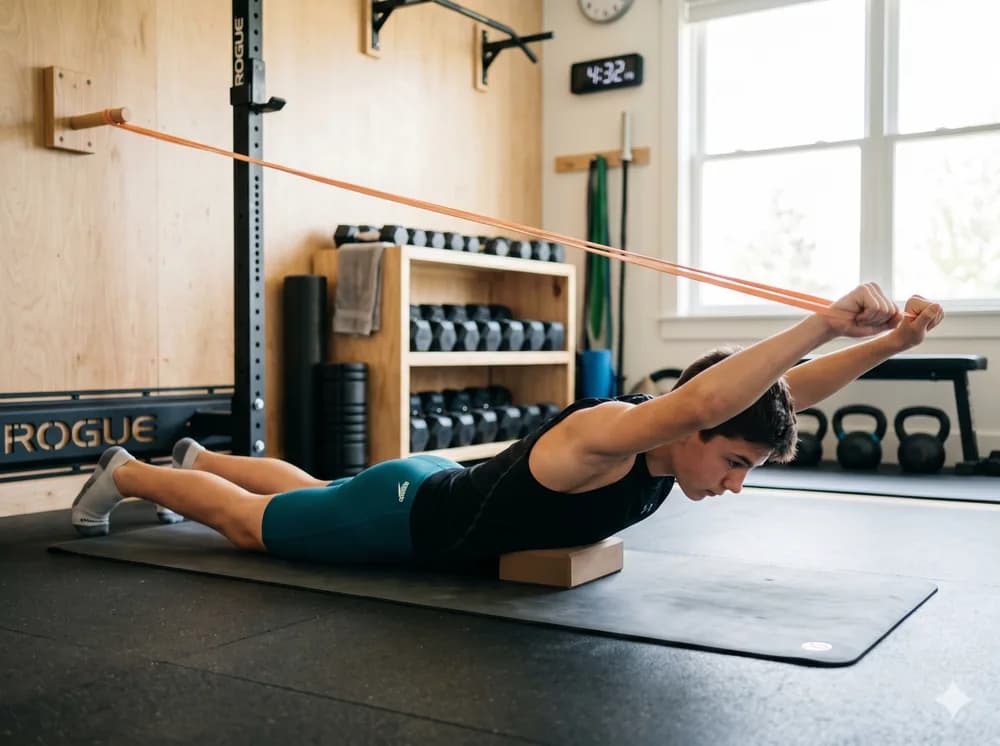
1. Dryland focused on scapular control and rotator cuff balance. This is the single most consistent finding in the literature. Exercises that target the small stabilizing muscles around the shoulder blade and the rotator cuff, not just the big pulling muscles, reduce injury rates. Common examples include scapular Y's, T's, and W's, external and internal rotations with a light resistance band, scapular push-ups, and face pulls. Two to three short dryland sessions per week is enough to produce measurable changes.
2. Technique work, not just yardage. Stroke flaws like a dropped elbow on the catch, crossing over the centerline, or aggressive thumb-first hand entry all increase shoulder load. A coach who actively corrects these issues is doing more for shoulder health than any stretch.
3. Rest days are training. The body adapts during recovery, not during work. Year-round, seven-day-a-week training without scheduled off days is one of the strongest predictors of overuse injury. At least one full rest day per week, and a real off-season block (1-2 weeks complete rest) per year, gives tendons time to remodel.
4. Land-based mobility, not just stretching the shoulder. Tight hips and a stiff thoracic spine force the shoulder to compensate. Mobility work for the upper back and hips often does more for shoulder health than direct shoulder stretching.
5. Watch the volume jumps. A swimmer who jumps from 4 to 8 practices per week mid-season is at much higher risk than one who builds gradually. Coaches and parents should be aligned on the rate of volume progression.
If your swimmer's club does not currently include dryland in the weekly schedule, that is worth a conversation with the coach. Even 15 to 20 minutes twice a week of structured mobility and shoulder-supporting exercises makes a measurable difference.
When to See a Doctor
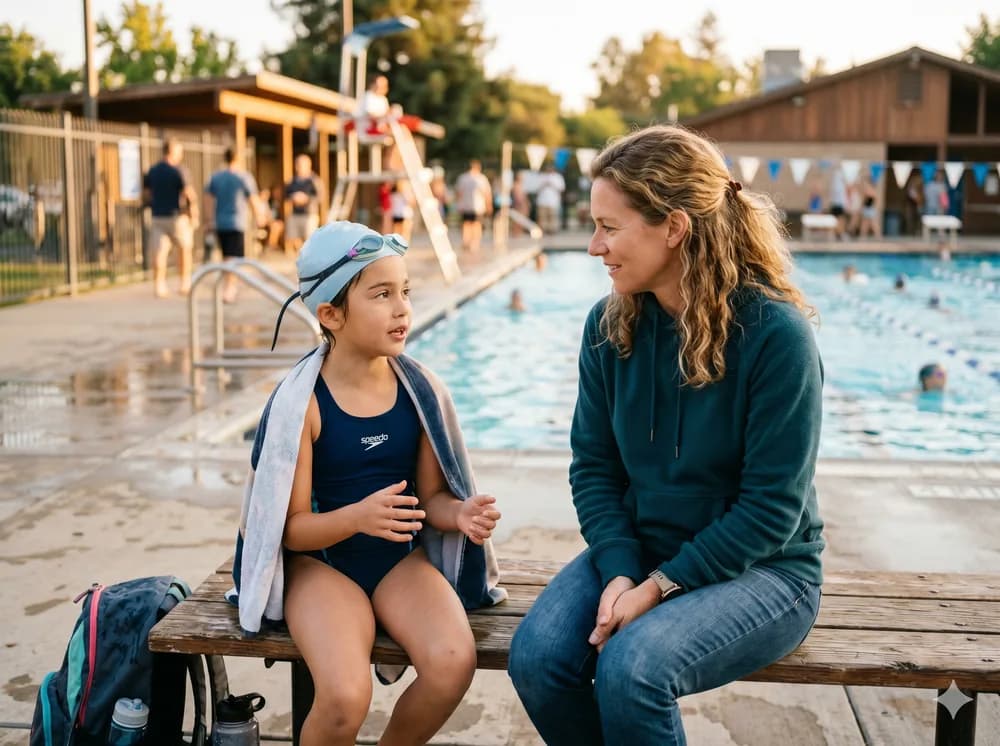
Shoulder pain that lingers, sharpens, or limits range of motion is not something to manage at home. The right call is a sports physician or sports physiotherapist who works with overhead athletes. Signs that a doctor visit is warranted:
- Pain that persists more than 7-10 days despite reduced training
- Pain that wakes the swimmer up at night
- Visible loss of range of motion compared to the other shoulder
- Weakness or "giving way" when lifting overhead
- Any sharp, sudden pain during a stroke or a fall
A physiotherapist can typically assess the issue in 30-45 minutes, identify the specific mechanism (impingement, rotator cuff, labrum, biceps), and design a corrective program. Most age group shoulder issues caught early respond well to a 4-8 week rehab block. Issues caught late often turn into months of modified training.
The Parent's Role (And It Is Not "Tough It Out")
This is the hardest part for swim parents to get right. The competitive culture of swimming rewards toughness. Swimmers who complain are sometimes seen as soft. As a result, a 12-year-old with real shoulder pain often masks it for months because they do not want to be seen as weak or be pulled from the team.
Your job as a parent is to make it safe to say "my shoulder hurts." That looks like:
- Asking how the body feels after practice without making it a big production
- Believing them the first time, not the fifth
- Working with the coach, not around them, when something does not feel right
- Modeling that rest is part of training, not the opposite of it
- Never punishing or pressuring a swimmer for taking a day off due to pain
A swimmer who learns to listen to their body at 12 will still be swimming at 22. A swimmer who learns to ignore it often is not.
For more on supporting your swimmer through the operational side of the sport (meets, recovery, the 9-hour pool deck days), see our swim meet packing checklist. And to see whether race times stall across a heavy stretch of the season, sign in to Gophin and open Compare Seasons — free, no card.
Sources
- Hill, L. et al. "Risk factors associated with shoulder pain and disability across the lifespan of competitive swimmers." Journal of Athletic Training. pubmed.ncbi.nlm.nih.gov
- McKenna, L. et al. "Shoulder Pain in Competitive Swimmers: A Multi-Site Survey Study." International Journal of Sports Physical Therapy. pmc.ncbi.nlm.nih.gov
- Feijen, S. et al. "Swim-Training Volume and Shoulder Pain Across the Life Span of the Competitive Swimmer: A Systematic Review." pmc.ncbi.nlm.nih.gov
- "Prevention and Treatment of Swimmer's Shoulder." NIH / National Library of Medicine. pmc.ncbi.nlm.nih.gov
- "Effect of Preventive Exercise Programs for Swimmer's Shoulder Injury on Rotator Cuff Torque and Balance in Competitive Swimmers: A Randomized Controlled Trial." pmc.ncbi.nlm.nih.gov
- "Shoulder Pain in Competitive Teenage Swimmers and Its Prevention." pmc.ncbi.nlm.nih.gov