Quick answer
You can tell a young swimmer is on track by comparing them to their own past times and to fixed standards, not by their ranking, which shifts every meet. A fast result at 13 is not a forecast, and a rough meet is not a ceiling. Allison Higson held a world record at 15 and finished 7th at the Olympics the same year, and still had a great career.
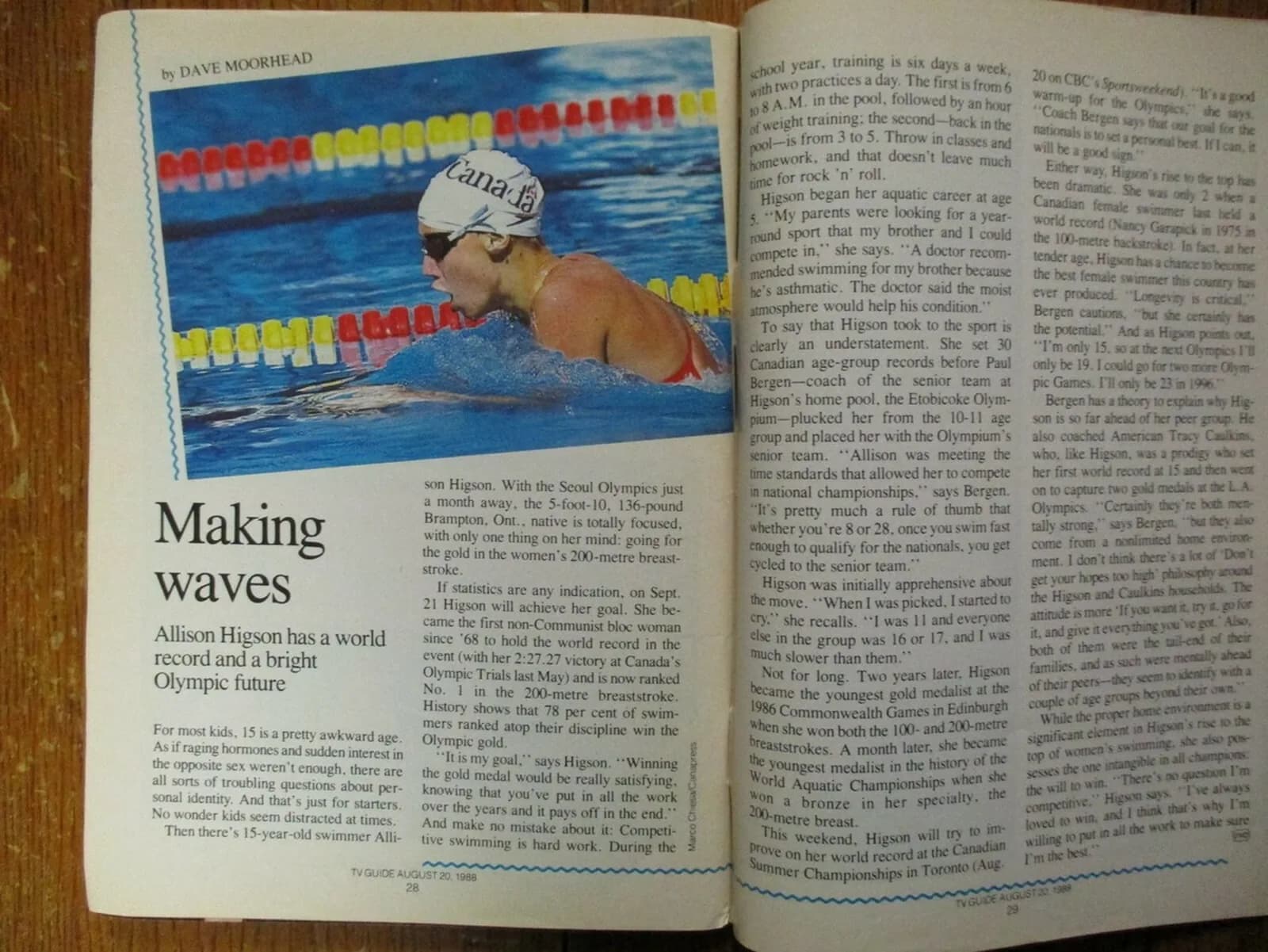
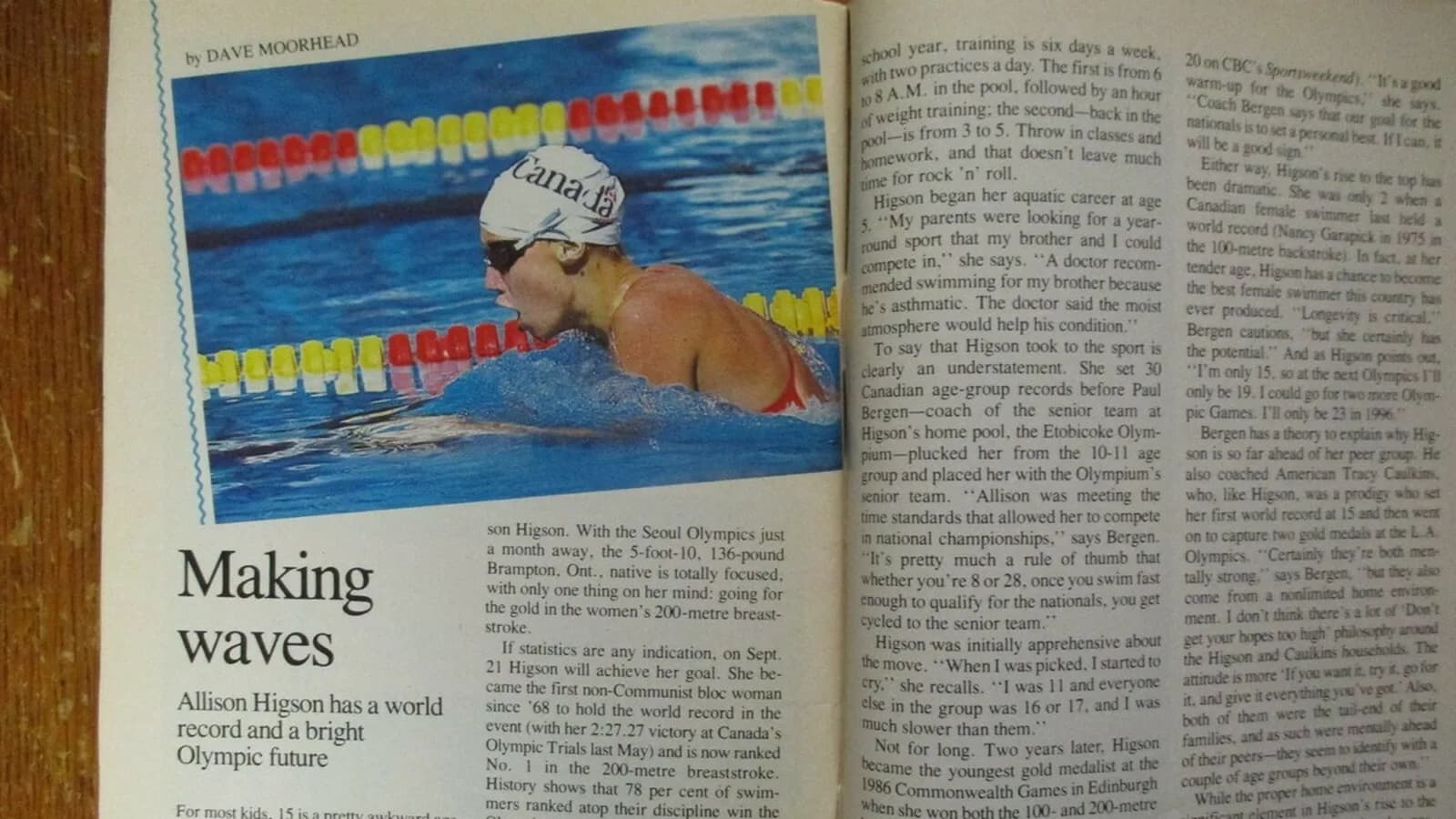
In May 1988, at the Canadian Olympic Trials in Montreal, a 15-year-old from Brampton, Ontario named Allison Higson stepped onto the deck, swam the 200 metre breaststroke, and broke the world record. Her time was 2:27.27.
She was not a surprise. Two years earlier, at 13, she had won double gold in the 100 and 200 breaststroke at the 1986 Commonwealth Games, setting Commonwealth records in both. Now, at 15, she was the fastest woman alive in her event and heading to the Seoul Olympics as a medal favourite.
Then Seoul happened. In her signature event, the 200 breaststroke, Higson finished 7th.
She had not over-trained or peaked too early. She was 15, racing women in their twenties on the biggest stage in the world, and nerves got the better of a young swimmer in a final. She still went home with an Olympic bronze in the 4x100 medley relay, as the youngest member of the team. But the individual result is the part worth sitting with, because it teaches swim parents something important about how this sport actually works.
The shape of progress is not a straight line
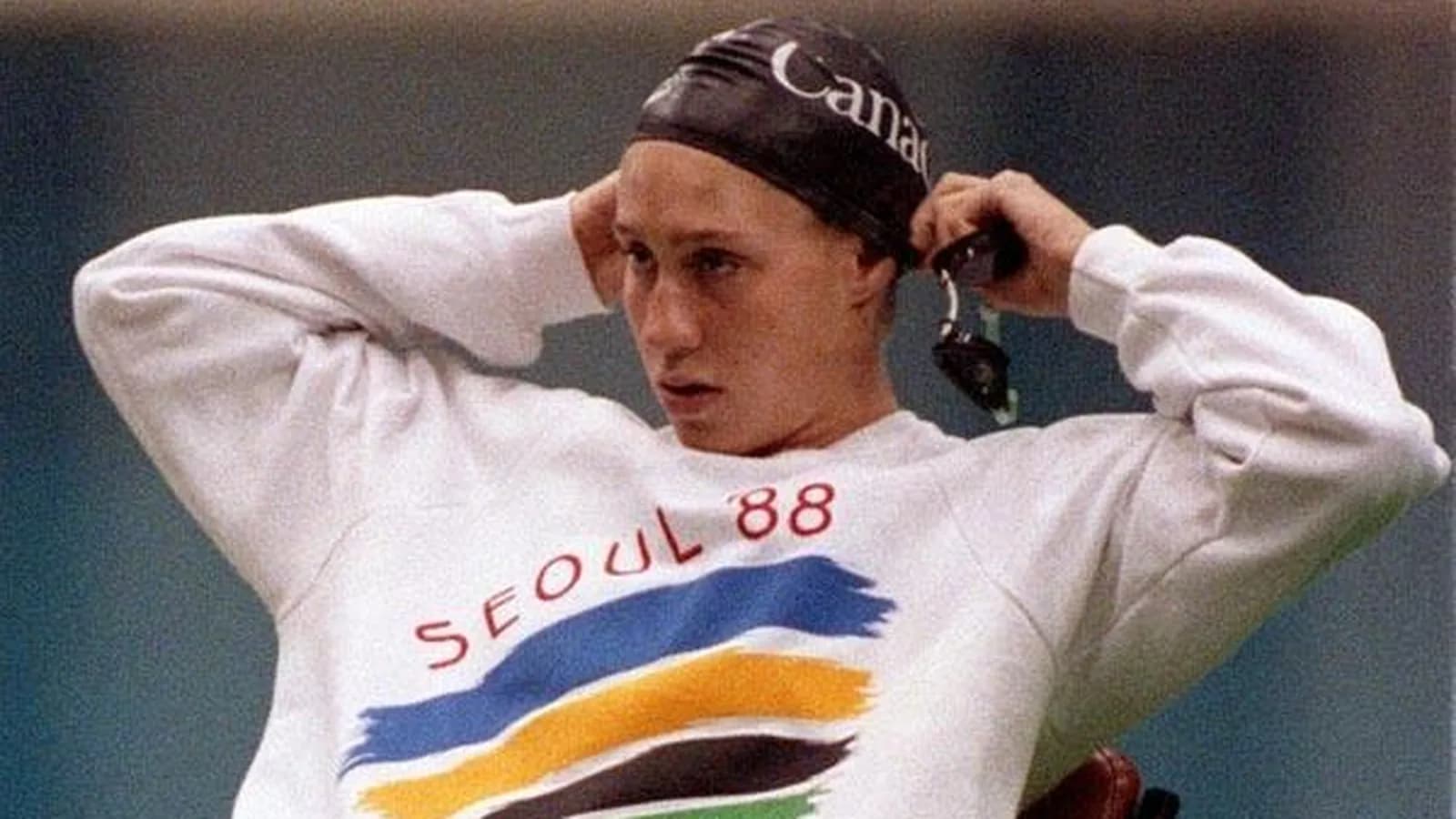
If you only watched the rankings, Higson's 1988 looks like a fall. World record in May, 7th in September. On paper, a collapse.
In reality, nothing went wrong. Swimming careers move in waves, and they move especially unpredictably through the teenage years. A swimmer who breaks a record in the spring can be a physically different person by the fall. Bodies grow, races get faster around them, and a nervous final is just a nervous final, not a verdict.
You see versions of this in your own pool every season. A swimmer who missed a cut in the spring drops three seconds in November. A former top-ten 14-year-old misses finals at 16, then circles back at 19 stronger than ever. None of that is failure. It is the normal, wavy shape of getting better. Some of it is simply growing, which we cover in Growth Spurts and Swim Performance.
The lesson is not that a fast young result means nothing. It is that a single result, fast or slow, is never a prediction.
A fast 13-year-old is not a forecast
This is the trap that catches anxious parents in both directions.
When a young swimmer posts a brilliant time, it is tempting to read it as destiny. When a young swimmer has a rough meet, it is tempting to read it as a ceiling. Higson's career says both readings are wrong. The same swimmer can hold a world record and finish 7th in the same year, and still go on to a long, accomplished career.
So if the rankings can swing this hard, and a teenage time is not a forecast, what should a parent actually watch to know whether a swimmer is on track?
The signal that actually holds steady
The steadier signal is the standards system.
Rankings are relative. They depend on who else showed up that day, and they get reshuffled every meet. Standards are fixed. A B, BB, A, AA, AAA, or AAAA time is a verified mark for a specific event and age group that does not move based on the field. Hitting the next standard is real progress no matter where the rankings sit that week. We explain the full ladder in Swimming Standards by Age, Explained, and why rankings alone mislead in Why Swim Rankings Do Not Tell the Full Story.
For a young swimmer, standards do two things rankings cannot. They give a target that is the same for everyone, and they let a swimmer measure themselves against their own past times rather than against whoever else is in the heat. That is a far healthier place for a teenager's motivation to live.
The most useful question to bring to a coach is not "will my swimmer be the next Allison Higson." It is "which standard is the next reachable one, and what gets them there." Ask that, one standard at a time, and you get to watch a young swimmer become whoever they are going to be.
The bookend, 35 years later
Here is the part that ties it together.
In January 2023, at a meet in Manitoba, a 14-year-old named Halle West swam the 100 breaststroke in 1:08.09 and broke the Canadian 13-14 age group record. The record she broke had stood since 1988. It belonged to Allison Higson.
Think about what that means for a parent watching today. The same record that a future world record holder set as a teenager was, decades later, a reachable target for another young swimmer who trained toward it. West did not need to predict her future to chase that mark. She just needed to know it existed, know how far away it was, and keep swimming toward it.
Nobody knows yet what Halle West's career will look like. She might be Canada's next Olympian, or switch focus at 17, or follow a path no one can see from here. All of those are normal swimming careers. That uncertainty is not something to fear. It is what makes the whole thing worth watching.
The healthiest way to watch your swimmer grow
Pulling it together, three habits keep parents sane and swimmers motivated through the wavy teenage years.
- Measure against their own past self first. Faster than last season is the question that matters most, and the one a swimmer can control.
- Use standards as the fixed target. The next cut is real progress regardless of the rankings that week.
- Treat rankings as context, not a verdict. They show who is in the race, not how the story ends.
Higson's 7th place did not erase her world record, and her world record did not guarantee gold. Both were just chapters. The swimmers who thrive over the long run, and the parents who enjoy the ride, are the ones who stop reading single results as the ending.
Finding the next standard in Gophin
Gophin pulls a swimmer's race results from official competition databases and lines them up against the standards for their event and age group, so you can see the next reachable cut without digging through documents. Basic standards reference is free for everyone. The full view, covering 38+ standards organisations across North America, is free for everyone too.
See where your swimmer stands against the standards
One reachable step at a time
The fastest 15-year-old in the world finished 7th at her Olympics and still had a career worth celebrating. Thirty-five years later, a 14-year-old broke her record and started a story of her own.
That is the sport. Not a straight line, not a prediction, just one reachable step at a time.
Open Gophin and find your swimmer's next standard, free
Sources
- Wikipedia. Allison Higson (born March 13, 1973, Brampton, Ontario; 1986 Commonwealth Games double breaststroke gold at 13; 1988 Canadian Olympic Trials 200m breaststroke world record 2:27.27 at 15; Seoul 1988 4x100 medley relay bronze). en.wikipedia.org/wiki/Allison_Higson
- The Canadian Encyclopedia. Allison Higson profile. thecanadianencyclopedia.ca
- Maclean's archive, September and October 1988. Coverage of Higson at the Seoul Olympics. archive.macleans.ca
- SwimSwam. "Halle West Breaks Canadian National Age Group Record in 100 Breast (13-14)," January 2023 (1:08.09, breaking Higson's 1:08.64 from 1988). swimswam.com