Quick answer
After changing swim clubs, follow the swimmer's existing profile and review their own times across the move. Verify identity using birth year, country and event history, especially if the club label changes or a duplicate profile appears. A current-club label is not proof of historical membership, and a personal group does not perform an official transfer.
A club move changes enough things without making the swimmer's progress harder to understand. There may be a new coach, a new timetable and a different competition calendar. The family still needs to answer a simple question: how do the swimmer's new races fit with the work already done?
Start with the athlete's identity and result history. Club information adds context, but it should not become a reason to discard earlier performances or create a second tracking system. This guide explains a careful way to keep the story together and recognise where official help is needed.
Find the same swimmer before comparing anything
Open My swimmers if you already follow the athlete. Check their profile and known results rather than searching only for the new club. An athlete can be recognisable from their event history even while a source's club information is catching up.
If you need to search, use the official registered name. Compare birth year and country, then inspect known meets and events. Use the club as one piece of context, not the only identifier.
Do not follow the first plausible match merely because it has the new club badge. Two records with similar names may represent different people, or an identity issue may need investigation. The getting-started guide explains the search and follow process.
Keep the existing followed profile when it is correct
A club change is not, by itself, a reason to unfollow the correct athlete or create a new identity. Start by opening Times and checking whether the familiar official history is present.
Open your followed swimmers and check the right profile
Following a profile organises what you view in Gophin. It does not submit a federation transfer, edit an official result or resolve eligibility to represent a new club. Handle those matters through the club and governing body's actual process.
If the history is split between records, do not try to repair it by inventing manual results or treating two profiles as automatically merged. Gather the relevant profile links and official result references, then ask support to investigate identity and coverage.
Separate current club from historical representation
A current-club label describes the affiliation currently shown by the system. It does not establish which club a swimmer represented at every past meet, their transfer date or whether they were eligible to score for a team at that time.
For a historical representation question, consult that meet's official result and the relevant club or federation. For a progress question, compare the swimmer's performances using their original dates, events and courses.
This distinction also matters when browsing a club roster. Today's roster should not be interpreted as the complete list of everyone who swam for that club during a previous season. Keep any claim about past membership tied to a source that actually records it.
Compare equivalent races across the move
Choose one event with results before and after the change. Match the course first: SCY, SCM or LCM. Keep the official dates and note whether the new result is a season best or a lifetime best.
A move can coincide with a new pool format or competition season. A slower-looking metres time after a yards season is not evidence that the change of clubs has harmed performance. Use course context before drawing that conclusion.
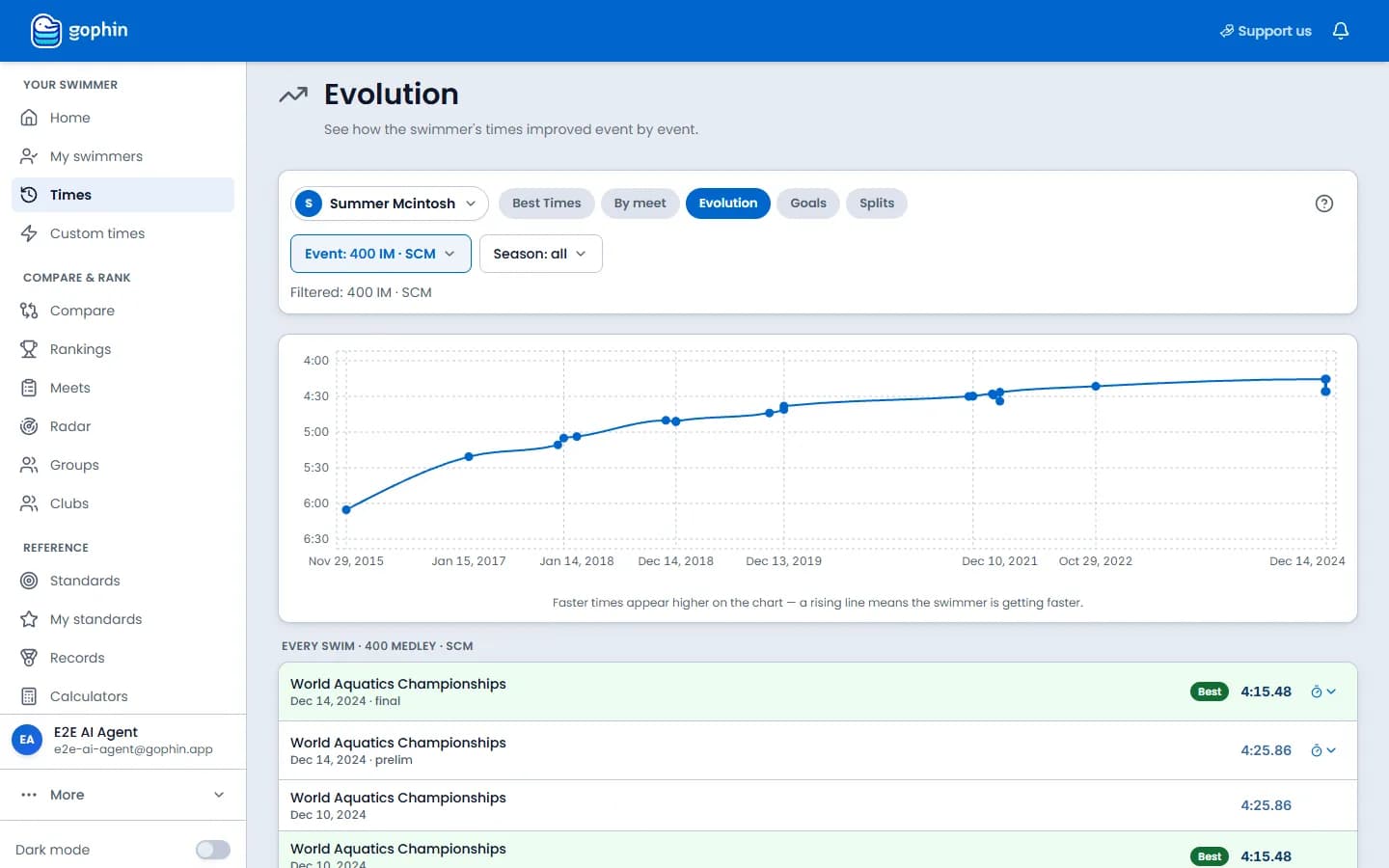
In Gophin, Times → Evolution provides the history view, while Compare → Seasons helps compare seasons for a selected event. The season comparison tutorial explains the controls. Confirm the selected swimmer and filters before interpreting the chart.
Do not use one race to grade the new club
A personal best soon after a move is encouraging, but it does not prove that the new programme caused the improvement. A slower first race does not prove the opposite. Training phase, event selection and the athlete's adjustment can all be relevant questions for the coach.
Keep observations concrete: which events were raced, what the legal results were, and how they compare with the swimmer's earlier same-course performances. Ask the new coach what review period and goals make sense.
The family can help by providing an organised history and listening to the swimmer's experience. Avoid turning every new meet into a public before-and-after verdict. The guide to supportive swim parenting keeps the broader conversation in view.
Use personal groups for organisation only
If the athlete belongs to a family or training collection in Gophin, manage that collection through the existing Groups feature. A personal group is a viewing aid, not an official club roster or transfer record.
You do not need a separate “old club swimmer” and “new club swimmer” entry to discuss the same athlete. Use result dates to frame the period you are reviewing. If identity records are genuinely separate, support should investigate rather than leaving the family to maintain a misleading combined spreadsheet.
For families following several children through different clubs, the multiple-swimmer guide explains how to organise them in one account while keeping each history distinct.
Questions families ask
Will every old result always be available immediately?
Do not assume complete or immediate coverage. Check the official source if something is missing and report the specific meet or identity issue. The missing-results guide helps prepare that request.
Can a Gophin group change official club membership?
No. Groups organise a personal view. Official membership and transfer conditions belong to the club and governing body.
Does the current club prove where an older result was achieved?
No. Use the official meet result for historical representation. Use the swimmer's own times and original course for performance comparisons.





Commentaires
Aucun commentaire pour l'instant. Les questions sur les temps, les compétitions ou l'app sont les bienvenues.