Quick answer
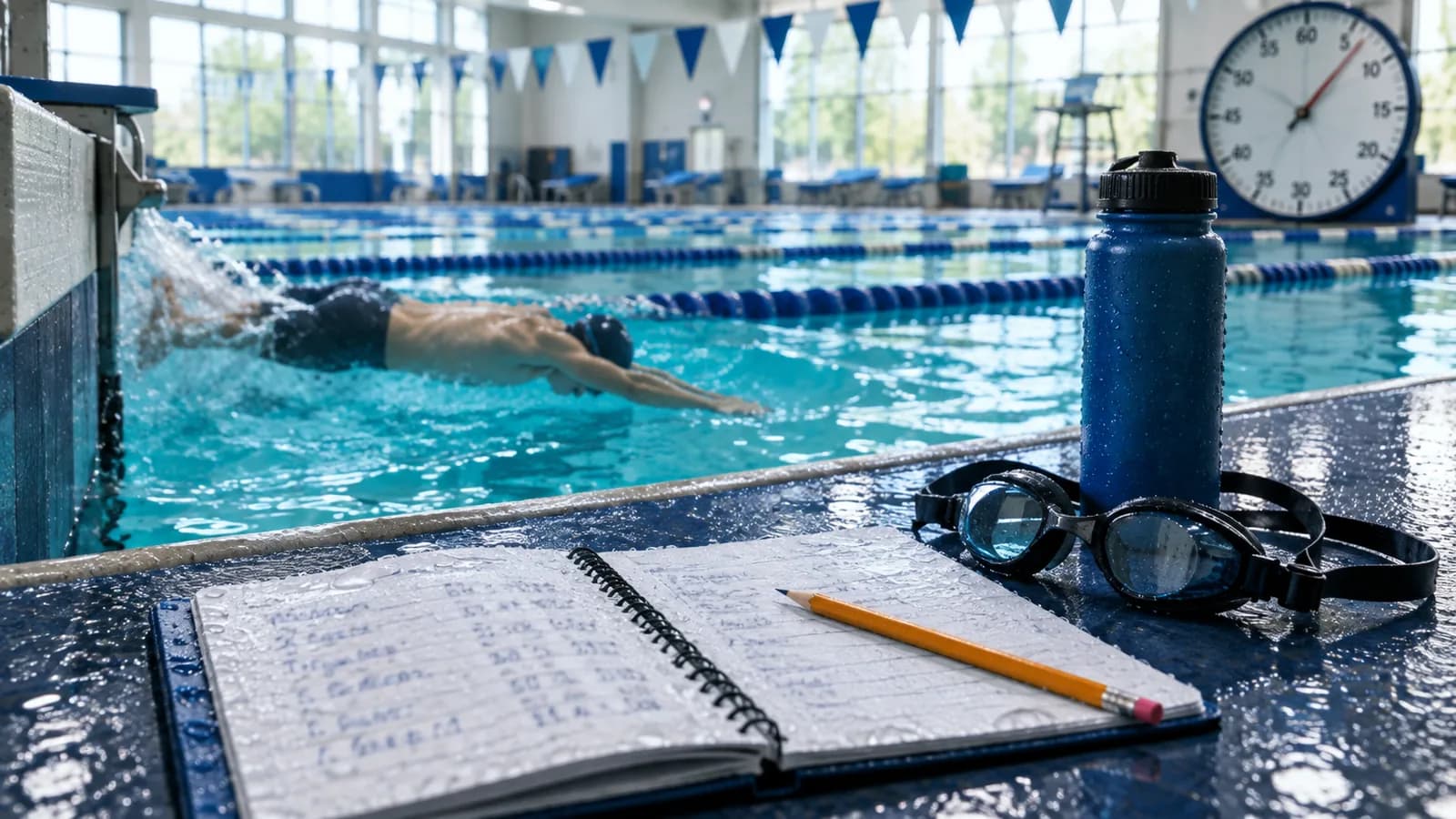
Process goals are the things you control at every practice: how you streamline off each wall, how many underwater kicks you take, whether you hold your stroke count when you are tired. Set one outcome goal for the season, measure the gap with real data, then turn that gap into two or three process goals you repeat every day. Best times follow the work; process goals are the work.
When you were 10, best times showed up almost every meet. Somewhere around 13 or 14 that changes. The drops get smaller, and some meets bring none at all.
That does not mean you stopped improving. It means the clock alone is too blunt a tool to steer by. If your only goal is "get a PB," a flat meet feels like failure, and you have nothing to do differently on Monday.
Process goals fix that. They give you something to win at every practice, and they are what eventually moves the clock.
Why "get a best time" is not enough
A best time is an outcome. It depends partly on things you do not control: the pool, your heat, how rested you are, whether you are mid-growth spurt.
Goal-setting research is clear on one point: specific, challenging goals lead to better performance than "just do your best" [2]. "Be faster" is not specific. "Hold 14 strokes per length on the last four repeats of the main set" is.
Keep both kinds of goals, and connect them so the small daily ones clearly lead to the big one.
Build a goal ladder
Think of your goals as four rungs, each one supporting the rung above.
- Dream goal (years away). Swimming at nationals, making a university team, breaking a club record. It can feel far away. Its job is to give you a direction, not a deadline.
- Season goal (this season). One or two outcomes for the meet your season is built around: a championship standard, a final, a higher place in the results.
- Short-term goals (next four to six weeks). Stepping stones. Improve one skill, hit your training targets, race one event better at the next in-season meet.
- Process goals (every practice). Small actions, fully in your control, repeated until they are automatic.
Use real data for the season goal
A season goal works best when it comes from numbers, not a guess. Two places to look:
- Last year's results for your target meet. What time made the top 8? The top 3? What won? That shows where the realistic line sits for your age group.
- The gap between your best time and the standard you are chasing. Being 0.4 seconds off in one event and 4 seconds off in another calls for very different plans.
Our standards tutorial explains how to read that gap, and the short course season goals guide helps you pick which events to prioritize.
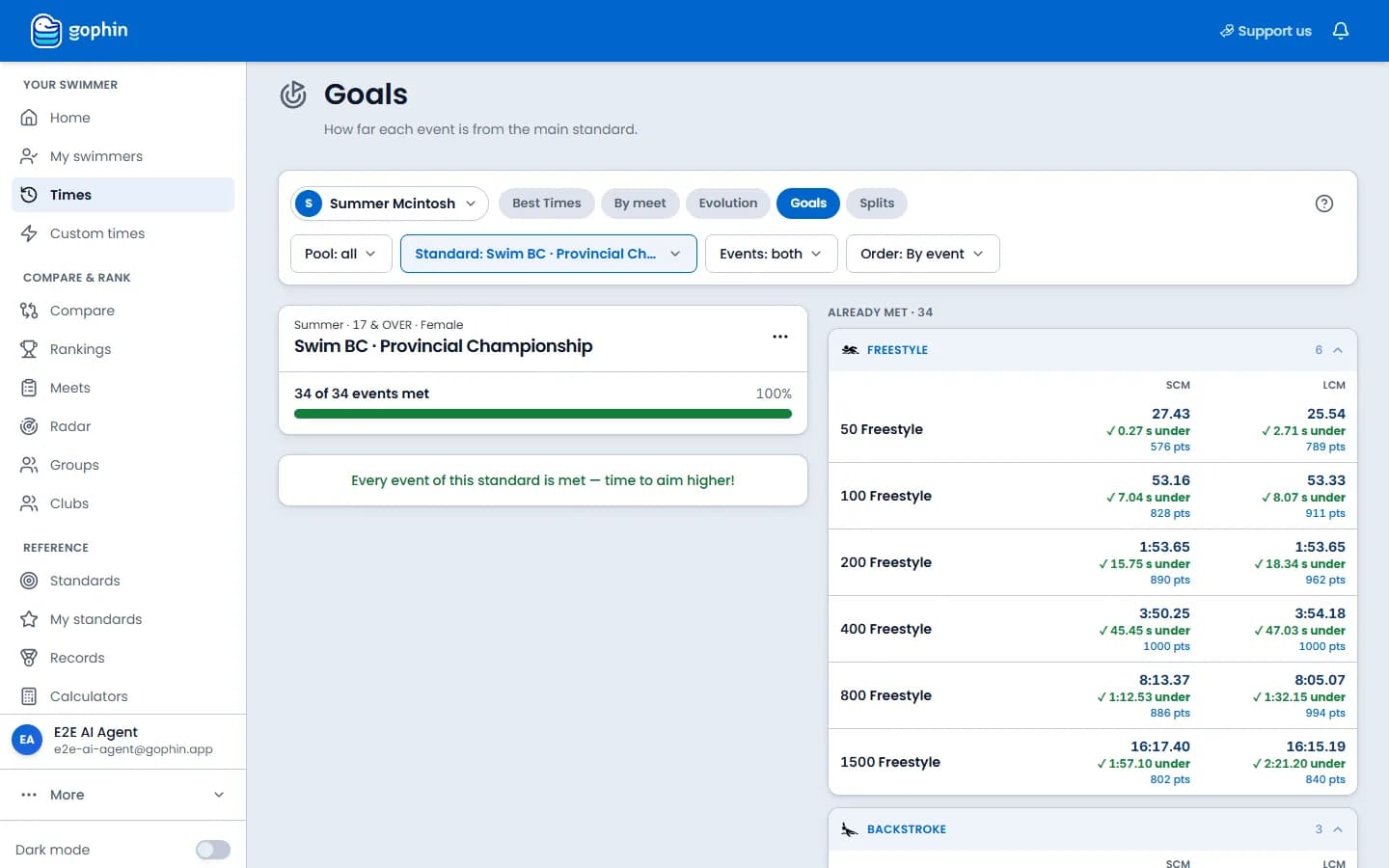
See how far each of your events is from the standard you are chasing before you write your season goal down.
What makes a good process goal
A good process goal is:
- In your control. It does not depend on who is in the next lane.
- Observable. You, a teammate or your coach can tell whether you did it.
- Repeatable. You can do it at every practice, not just on race day.
- Linked to the gap. It targets the part of the race where you lose the most time.
Some examples:
- Streamline at least 10 metres off every wall, arms locked, head down.
- Take the same number of underwater dolphin kicks off every wall, even at the end of a hard set.
- Hold your stroke count on the last repeats, when you are tired.
- Hit the target times your coach gives you on pace sets.
- Keep the breathing pattern you agreed on, especially into and out of turns.
- Finish every repeat to the wall, no glide on the last metre.
- Arrive 10 minutes early so practice starts with you ready, not rushed.
Your coach knows what you most need to work on, so check your list with them. Our guide on how to talk to your swim coach can help you start that conversation.
Turn goals into "When X, I will Y" plans
Deciding exactly when you will act on a goal makes it far more likely to happen.
Psychologists call these implementation intentions. A review of 94 studies with more than 8,000 participants found that adding a "when-then" plan to a goal had a medium-to-large effect on reaching it, compared with setting the goal alone [1].
In the pool, that sounds like:
- "When my feet leave the wall, I will hold a tight streamline before my first kick."
- "When my stroke starts to fall apart on the last 50, I will count strokes and lengthen out."
- "When I touch at the end of a repeat, I will check the clock before anything else."
The cue arrives anyway; the action is already chosen, so there is nothing to decide in the moment.
A worked example
A hypothetical 14-year-old backstroker, to show how the rungs fit together:
| Rung | Goal |
|---|---|
| Dream | Swim backstroke at nationals before finishing high school |
| Season | Reach the provincial championship standard in the 100 back |
| Short-term (next 5 weeks) | A stronger second 50 in the 100 back at the next in-season meet |
| Process 1 | Five dolphin kicks off every wall on backstroke sets |
| Process 2 | Hold stroke count on the last four repeats of the main set |
| Process 3 | Log the main set and how it felt after every practice |
Every process goal points at the same weakness: the second half of the race. The splits guide shows how to find where your own races fade.
Keep a logbook
Habits come from repeating something over weeks and months, not from one good day. A logbook tells you whether you are really repeating it.
After each practice, write down:
- The main set and your times.
- Stroke counts and underwater kicks.
- How you felt (energy, sleep, soreness) on a simple 1–5 scale.
- One thing that went well and one that needs work.
How you feel is real information. A review of athlete monitoring found that self-reported wellbeing reflected training load more sensitively and consistently than many common objective measures [3].
Once a week, read back over the entries. When you swim a best time, note what you did in the days before it: sleep, food, warm-up, mindset. That is your recipe to repeat. A short weekly check-in makes the review quicker.
Swim your own lane
It is natural to watch the swimmer next to you. But their times say nothing about whether you hit your process goals today.
Confidence before a big meet does not come from hoping. It comes from a logbook full of sets you finished and walls you streamlined off. You know you did the work because you wrote it down.
If your times stall mid-season while you are doing all this, that is often normal. Our article on why times stall mid-season explains why.
Set your outcome goal with real numbers
Gophin's Times → Goals screen shows how far each of your events is from the main standard you choose, which events you have already met, and the gap for the rest. Results load automatically from official meets, so there are no times to type. Pick a season goal that is ambitious but realistic, then aim your process goals at the gap. It is free.
Questions swimmers ask
What is a process goal in swimming?
A process goal is an action you control at practice or in a race, such as holding a tight streamline off every wall or keeping your stroke count when tired. It focuses on how you swim, not on the final time.
How many process goals should I have at once?
Two or three is plenty. A few goals you repeat at every practice beat a long list you forget by Wednesday. Check them with your coach and swap them out once they become automatic.
Should I still set time goals?
Yes. Keep one or two outcome goals for the season, based on real data such as the gap to a standard or last year's championship results. Process goals are the plan for reaching them.
Sources
- Gollwitzer, P. M., & Sheeran, P. (2006). "Implementation intentions and goal achievement: A meta-analysis of effects and processes." Advances in Experimental Social Psychology, 38, 69–119. Summary: U.S. National Cancer Institute. cancercontrol.cancer.gov
- Locke, E. A., & Latham, G. P. (2002). "Building a practically useful theory of goal setting and task motivation: A 35-year odyssey." American Psychologist, 57(9), 705–717. doi.org/10.1037/0003-066X.57.9.705
- Saw, A. E., Main, L. C., & Gastin, P. B. (2016). "Monitoring the athlete training response: subjective self-reported measures trump commonly used objective measures: a systematic review." British Journal of Sports Medicine, 50(5), 281–291. bjsm.bmj.com




Comments
No comments yet. Questions about times, meets or the app are welcome.