Quick answer
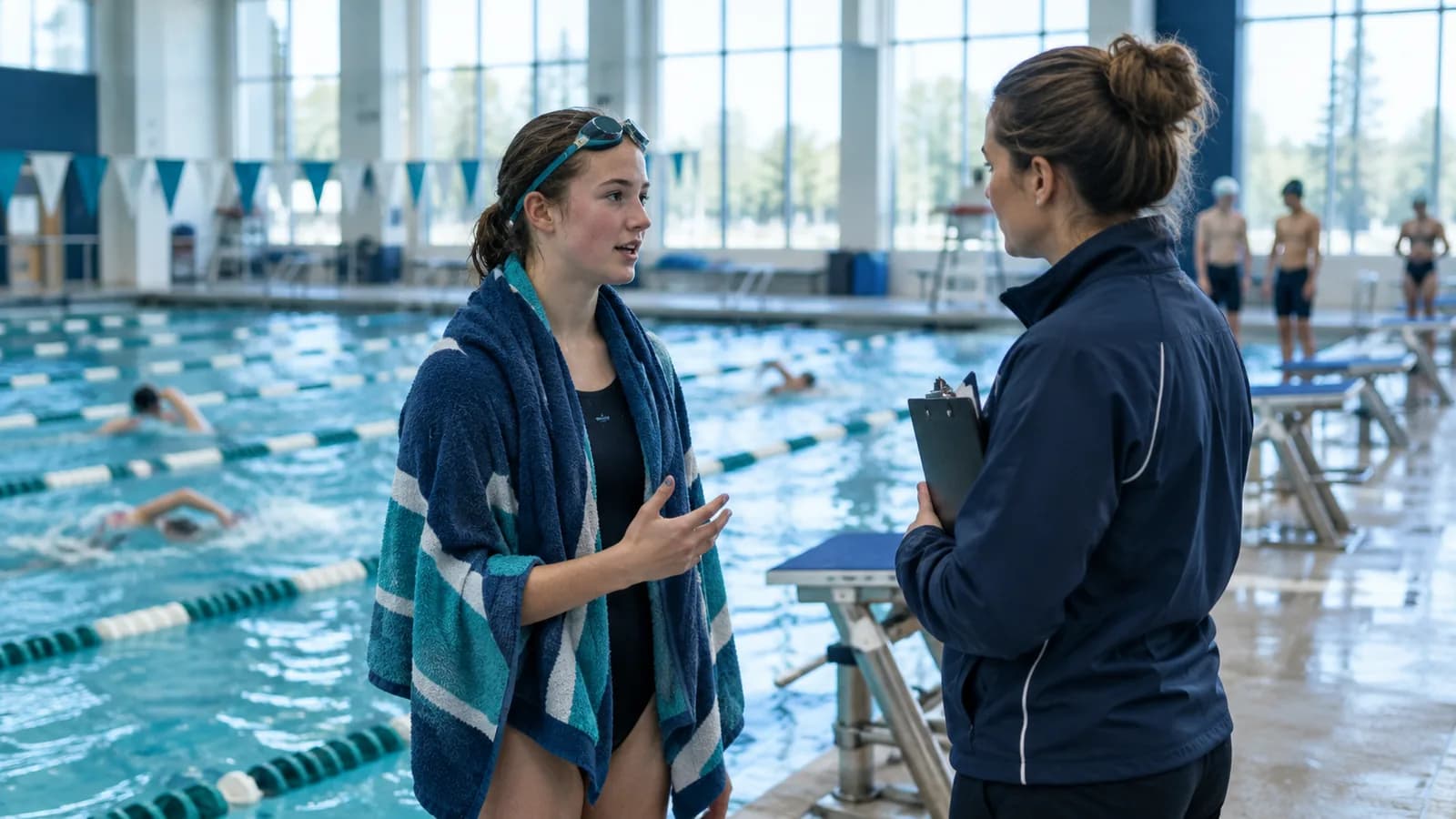
Talk to your coach yourself, before or after practice, never in the middle of a set. Bring one specific question, ideally about one specific race, like "My third 50 fades. What should I work on?" Tell them early about missed practices, pain or school stress, using the channel they prefer. If something ever feels unsafe or wrong, that is not a coach conversation: tell a parent or another adult you trust.
Walking up to your coach can feel harder than the main set. They are busy, you do not want to sound like you are complaining, and it would be so much easier to let your parent send an email.
But your coach wants to hear it from you. You are the one in the water. When you explain something in your own words, your coach learns how you think, and the feedback you get back is aimed at you.
It will feel awkward the first few times. That is normal, and it gets easier because you do it. Researchers at the UCLA Center for the Developing Adolescent describe skills like decision-making and handling emotions as things teens build through real practice and learning from what happens next [1].
Before you go: two minutes of prep
- Write two bullet points. One thing you want to say, one thing you want to ask. Your phone's notes app is fine.
- Pick a good moment. Before warm-up or after practice, when the coach is not running a set. If it needs more than a minute, ask: "Could we talk for five minutes after practice this week?"
- Bring one race, not a feeling. "How do I get faster?" gets a general answer. "My third 50 in the 200 free was much slower than the others. What should I work on?" gets a real one. Goal-setting research has found for decades that specific, challenging goals lead to better performance than a vague "do your best" [2]. Specific questions work the same way.
- Practise it once out loud. Ask a parent to play the coach.
To find that race, open your splits in Gophin and look for the 50 where your pace changed. Our guide on how to read swim splits explains what to look for.
What to say: short scripts
Use these as a starting point, in your own words.
Asking for feedback on a stroke
"Coach, I've been working on my backstroke turns. Could you watch one today and tell me the first thing to fix?"
Telling them you will miss practice
Tell them before, not after. Use the channel your coach or club prefers, such as the club email or team app, not a private text. In the U.S., adults covered by the U.S. Center for SafeSport's MAAPP rules must include a parent or another adult on texts, emails and social media messages with minor athletes [3], which is one more reason to stick to the official channel.
"Hi Coach, I'll miss Thursday's practice because of a school concert. I'll be back Saturday. Is there anything I should do on my own?"
When you were not entered in an event you wanted
"I noticed I'm not in the 200 back this weekend. Can you help me understand why, and what I'd need to show to swim it next time?"
If you disagree, say so calmly and then listen: "I'd really like to try the 200 fly. Could we talk about whether that makes sense this season?" Your coach may still say no. You will still know what they are looking for.
Coming back from pain or an injury
Say something early, while it is still small: "My right shoulder has been sore in freestyle for a week. I wanted to tell you before practice." If a doctor or physiotherapist gave you limits, bring the note. Our guide on swimmer's shoulder explains why early matters.
After a bad race
Swim down first and give it a little time. Then: "That 100 free felt flat in the second half. What did you see?" If nerves were the real problem, our article on pre-race anxiety has ideas you can try before the next meet.
When school is overwhelming
"I have three exams next week and I'm really tired. Can we talk about how to handle practice that week?" Say it before you are exhausted, not after you have missed three practices.
Asking for more or less feedback
"I like getting corrections during sets. Could you tell me more about my turns?" Or: "When I get a lot of corrections at once, I lose track. Could you give me one thing at a time?" Both are fair requests.
How to take tough feedback
Hard feedback stings. Feeling disappointed for an hour does not mean you handled it badly. What you do next is what counts:
- Listen to the end. Do not explain or defend yourself while your coach is still talking.
- Repeat back what you will do differently. "So on the third 50, I hold my stroke rate instead of just kicking harder."
- Ask one clarifying question. "Should I feel that in practice sets too, or only when racing?"
- Follow up next week. "I've been working on that. Does it look better?"
It also helps to turn the feedback into an if-then plan: "When I start the third 50, I'll hold the stroke rate my coach asked for." A meta-analysis of 94 tests with more than 8,000 participants found that if-then plans like this had a medium-to-large effect on reaching goals, compared with only setting the goal [4]. Our article on process goals shows how to build them.
Where your parent fits
Your parent can help you prepare and practise, and some things are their job, like fees and medical information. But the conversation about your swimming is yours. If you want to know what your parent is reading, it is this guide for swim parents. A weekly check-in at home is a good place to decide what to bring to practice.
When it is not a coach conversation
Everything above is about normal swimming conversations. Some things are different. If an adult messages you privately in a way that feels off, touches you or comments on your body in a way that makes you uncomfortable, humiliates you, or treats you differently because of who you are, tell a parent or another adult you trust. You will not be in trouble for telling, and you do not have to handle it alone.
- In Canada, tell your club's safe sport officer or a trusted adult, who can contact your provincial swimming association. For national-level sport, the Canadian Safe Sport Program takes reports at 1-866-971-2777 (toll free) or online, and you can stay anonymous [5].
- In the U.S., the U.S. Center for SafeSport takes reports at 833-5US-SAFE (587-7233) or online, and reports can be anonymous [6].
- If you are in danger right now, call emergency services.
Take a race to your next conversation
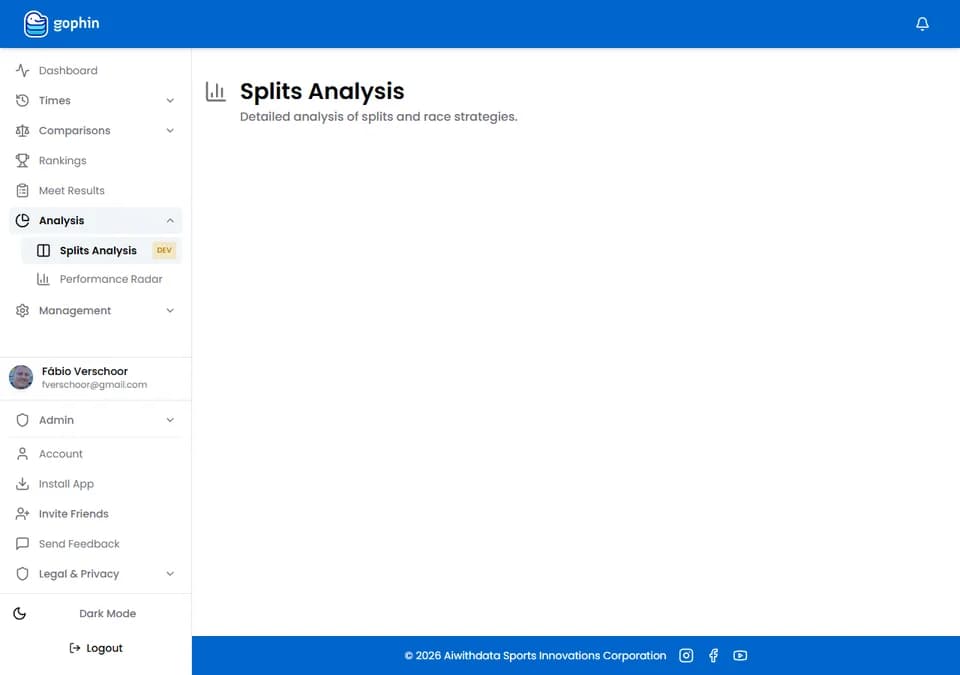
Gophin loads your official meet results automatically. Times → Splits shows how each race was swum, split by split, front half against back half. Pick the race you want to talk about, find the 50 where it changed, and bring that one question to practice. It is free.
Sign in and open Times → Splits →
Questions swimmers ask
How do I ask my swim coach for feedback?
Pick a calm moment before or after practice and ask about one specific thing: a stroke, a turn or a race. "What's the first thing I should fix in my 100 back?" works better than "How can I get faster?" Try what they say, then follow up the next week.
How do I tell my coach I'm missing practice?
Tell them before, not after, using the channel your coach or club prefers, such as the club email or team app. Say which practice, why in a few words, and when you will be back. Ask if there is anything to do on your own.
What if I disagree with my coach's event choices?
Ask to understand first: "Can you help me understand why, and what I'd need to show to swim it next time?" Stay calm, listen to the answer and accept the decision for this meet. The answer tells you what to work on.
Sources
- UCLA Center for the Developing Adolescent. "Decision Making & Emotional Regulation" and the fact sheet "Real-World Practice Helps Adolescents Learn to Make Reasoned Decisions and Manage Emotions." developingadolescent.ucla.edu
- Locke, E. A., & Latham, G. P. (2002). "Building a practically useful theory of goal setting and task motivation: A 35-year odyssey." American Psychologist, 57(9), 705–717. doi.org/10.1037/0003-066X.57.9.705
- U.S. Center for SafeSport. "MAAPP: For Parents." maapp.uscenterforsafesport.org
- Gollwitzer, P. M., & Sheeran, P. (2006). "Implementation intentions and goal achievement: A meta-analysis of effects and processes." Advances in Experimental Social Psychology, 38, 69–119. Summary: U.S. National Cancer Institute
- Swimming Canada. "Reporting maltreatment." swimming.ca/reporting-maltreatment; Sport Integrity Canada. "Report a safe sport concern" (Canadian Safe Sport Program). sportintegrity.ca/report-safe-sport
- U.S. Center for SafeSport. "Report a concern." uscenterforsafesport.org





Comments
No comments yet. Questions about times, meets or the app are welcome.