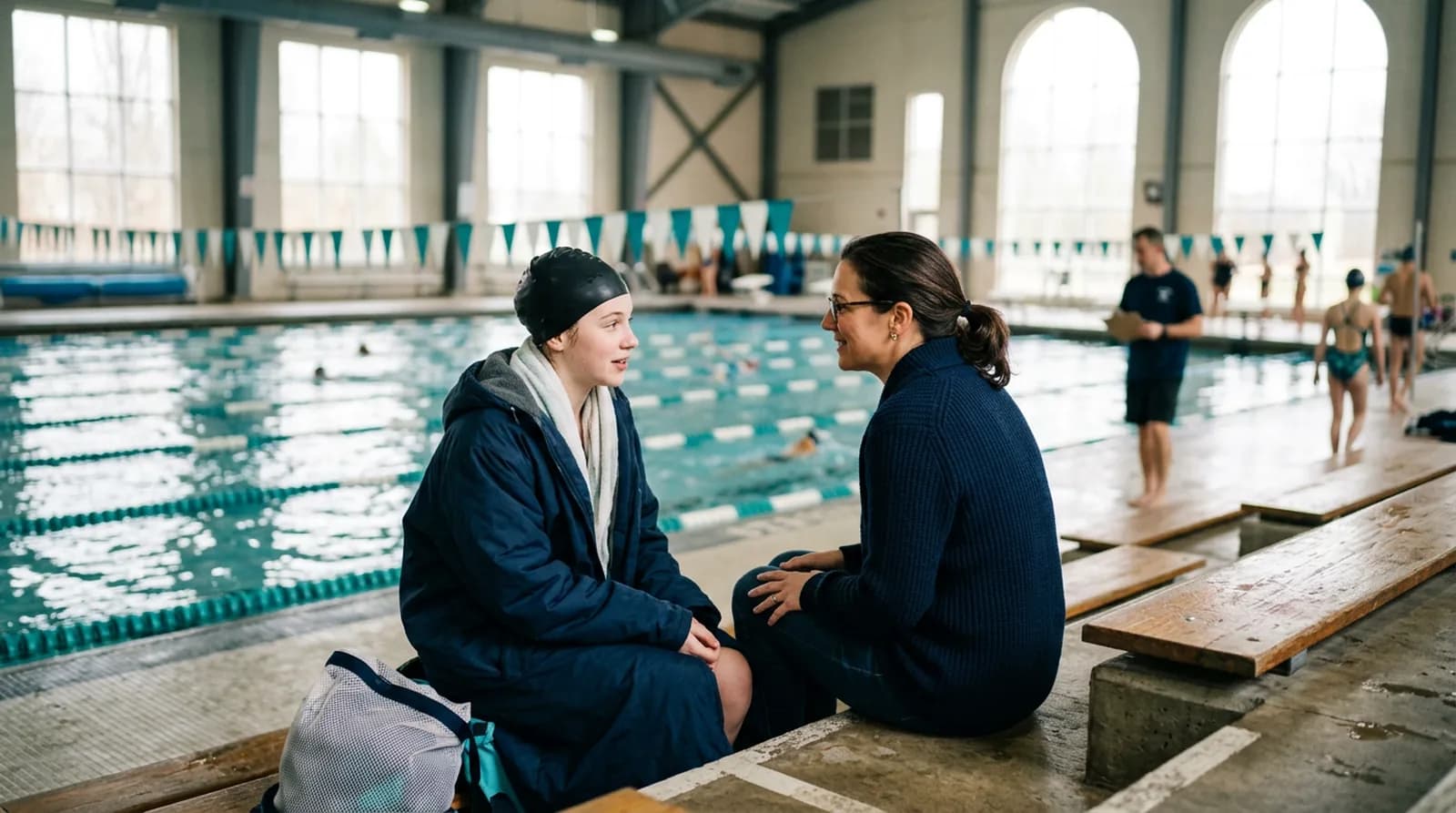
Quick answer
Most of the time, let your swimmer have the conversation and help them get ready for it at home. Step in yourself for logistics, fees, medical information, a younger child, or a teen who has already tried and is stuck. Safety is the exception: concerns about abuse, harassment, discrimination or inappropriate messages go straight to formal channels, and you never leave them for your child to handle.
The car door closes a little harder than usual. The new coach is "so unfair", the main set was "impossible", and nobody explained why your swimmer was put in the 400 IM on Saturday. You are already drafting the email.
Hold it for a day. With swimmers aged about 11 to 16, the most useful thing a parent can do is often to help their kid have the conversation. The hard part is knowing which situations belong to the swimmer, which belong to you, and which need to be reported.
Why the conversation moves to the swimmer
In older training groups, coaches start talking to the athlete, not through the parent. They expect the swimmer to ask when something is unclear, hear a correction without shutting down, say when something hurts and own a disappointing race.
None of that comes naturally at 12. These are skills, and skills need repetitions. The UCLA Center for the Developing Adolescent describes decision-making and emotional regulation as abilities teens build through real-world chances to practise and learn from the outcome. By about 16, with time to think, teens can reason about as well as adults [1]. The researchers' advice to adults: offer real opportunities, such as responsibilities and choices.
A talk with the coach is that kind of opportunity. When a parent handles something the swimmer could have handled, the swimmer loses a rep, and the coach loses a chance to coach them directly.
A new group, a new coaching style and higher expectations can make a confident swimmer feel like a beginner for a few weeks. Parents feel it too. The aim is not to remove that discomfort, but to build the skills to work through it.
What you see at home is not the whole story
Psychologist Lisa Damour explains that how a teenager acts at home can be very different from what adults see elsewhere. A teen who does well at school but is moody or cranky at home can be "the picture of perfect development" [2].
So the intensity in the car does not, on its own, tell you what happened at the pool. Brain changes in the teen years make emotions more intense [3]. Damour also describes mental health not as feeling good, but as having feelings that fit the moment, even painful ones [4]. Frustration after a hard correction fits the moment.
If your own stress is rising with theirs, read our piece on how parent stress spreads to swimmers before you reply.
How to help without taking over
When your swimmer comes home upset, try this order:
- Ask what they need. In a UNICEF parenting video, Damour suggests asking: "Do you want my help or do you just need to vent?" [3]. Often venting is enough.
- Accept the feeling without fixing it. "That sounds frustrating" is support. "Your coach is wrong" is a verdict you cannot give from the car.
- Help them reflect. What exactly did the coach say? What were they trying to fix?
- Look from the other side of the deck. The coach may have reasons your swimmer has not heard yet.
- Decide together whether there is something to say, and boil it down to one or two sentences.
- Rehearse. You play the coach.
- Show confidence. "You've got this. Tell me how it goes" says more than any email.
Our guide for swimmers on talking to their coach has short scripts to go through together. For the bigger picture, see what a supportive swim parent does.
If it is the coaching style you do not understand, start from curiosity and use the club's normal channel, such as email or a scheduled meeting, not the deck mid-practice. "Could you help me understand how the group's season is structured?" opens a better conversation than "Why is my kid doing this?" Our article on parent–coach communication policies explains what clubs usually set out.
Who handles what
| Who leads | Typical situations |
|---|---|
| The swimmer | Feedback they did not like · event choices for a meet · being asked how they will do better next time · group expectations · a tough set |
| The parent steps in or joins | Schedules and travel · fees · medical, injury or medication information · a younger child · a swimmer who has tried and is stuck |
| Formal channels, right away | Anything about safety, abuse, harassment, discrimination or inappropriate messages |
The middle row is not a failure of independence. Money and medical information are adult jobs, and a swimmer who has raised something more than once without a result deserves an adult in the room. Join them; do not replace them.
Safety is never a "let them handle it" situation
Everything above is about ordinary discomfort. Safety is different. If something involves abuse, harassment, bullying by an adult, discrimination, inappropriate messages or contact, or anything that makes your child feel unsafe, do not wait and do not leave it to your child. Act yourself.
- If a child is in immediate danger, call the police or emergency services.
- In Canada, start with your club's safe sport officer or your provincial or territorial swimming association, which handle most club-level concerns. Swimming Canada's reporting page explains where each kind of complaint goes, including its independent third party. Concerns that involve national-level sport go to the Canadian Safe Sport Program, run by Sport Integrity Canada: 1-866-971-2777 (toll free) or online, and you can stay anonymous [5].
- In the U.S., report to the U.S. Center for SafeSport at 833-5US-SAFE (587-7233) or through its online form; reports are free and can be anonymous. Suspected child abuse also goes to local authorities, first [6]. USA Swimming sends team-level and code-of-conduct concerns to the team [7].
Under the U.S. Center for SafeSport's Minor Athlete Abuse Prevention Policies (MAAPP), adults covered by the policies must include a parent or another adult on texts, emails and social media messages with minor athletes [8]. If your child is getting private one-on-one messages from an adult at the club, ask about it. In Canada, ask your club for its communication policy.
When you do need a meeting, bring the facts
Some conversations are rightly yours: your swimmer is stuck, a slump has lasted months, or you are worried about their wellbeing. One bad meet sounds like a complaint. A season of results becomes a question to look at together, so before the meeting, compare this season with last season in Gophin, event by event, in the same course. If the trigger was one race, our guide on what to say after a bad race can help the next car ride.
Bring the season, not the last meet
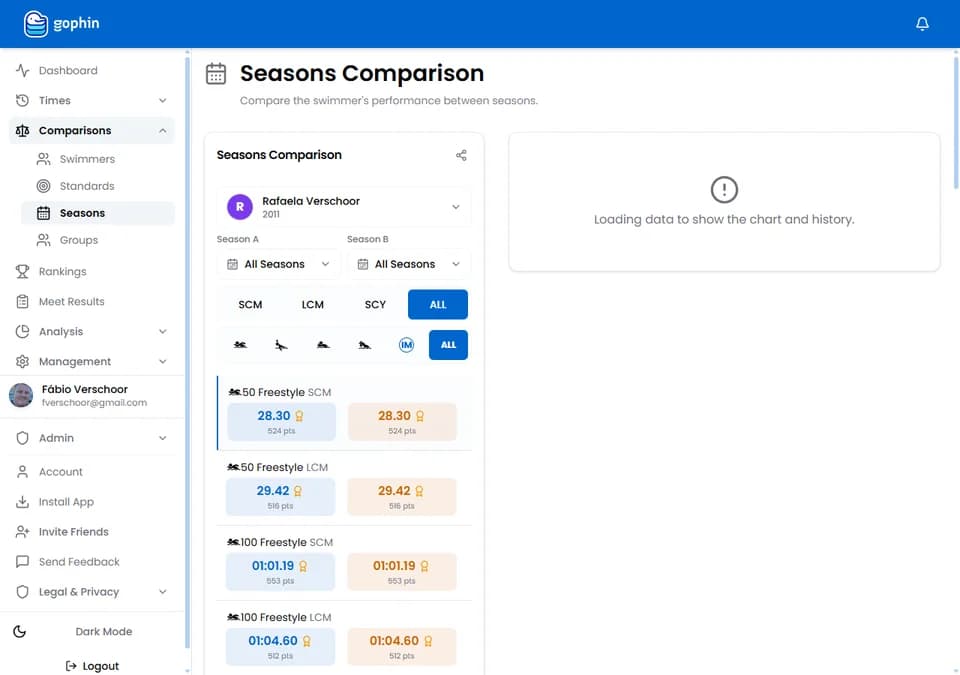
Gophin loads every official meet result automatically, so there is nothing to type. Compare → Seasons puts this season next to last season, event by event, in the same course, so "I'm worried" becomes a specific question the coach can answer. It is free.
Sign in and open Compare → Seasons →
Questions families ask
Should I talk to my child's swim coach after a bad meet?
Usually not that day. Let your swimmer cool off and ask their own question first. If the concern keeps coming back over several meets, request a meeting through the club's normal channel and bring the season's results.
My kid comes home upset after swim practice. Should I step in?
First ask whether they want help or just need to vent. Strong emotions at home are common in teens and do not, by themselves, show what happened at the pool. Step in if it involves safety or wellbeing, or if your swimmer has tried and is stuck.
When should a parent go straight to formal channels?
Right away for anything involving abuse, harassment, discrimination, inappropriate messages or a child feeling unsafe. In Canada, go to the club's safe sport officer, your provincial swimming association or, for national-level sport, the Canadian Safe Sport Program; in the U.S., the U.S. Center for SafeSport. Suspected child abuse also goes to the police or child protection.
Sources
- UCLA Center for the Developing Adolescent. "Decision Making & Emotional Regulation" and the fact sheet "Real-World Practice Helps Adolescents Learn to Make Reasoned Decisions and Manage Emotions." developingadolescent.ucla.edu
- National Association of Independent Schools. "Episode 59: Schools and the Emotional Lives of Teenagers" (with Lisa Damour). New View EDU podcast. nais.org
- UNICEF Parenting. "3 phrases to support upset teens" (video with Dr. Lisa Damour). unicef.org
- Damour, L. (2023). The Emotional Lives of Teenagers: Raising Connected, Capable, and Compassionate Adolescents. Ballantine Books. penguinrandomhouse.com
- Swimming Canada. "Reporting maltreatment." swimming.ca/reporting-maltreatment; Sport Integrity Canada. "Report a safe sport concern" (Canadian Safe Sport Program). sportintegrity.ca/report-safe-sport
- U.S. Center for SafeSport. "Report a concern." uscenterforsafesport.org
- USA Swimming. "Safe Sport for Parents." usaswimming.org
- U.S. Center for SafeSport. "MAAPP: For Parents." maapp.uscenterforsafesport.org





Comments
No comments yet. Questions about times, meets or the app are welcome.