Quick answer
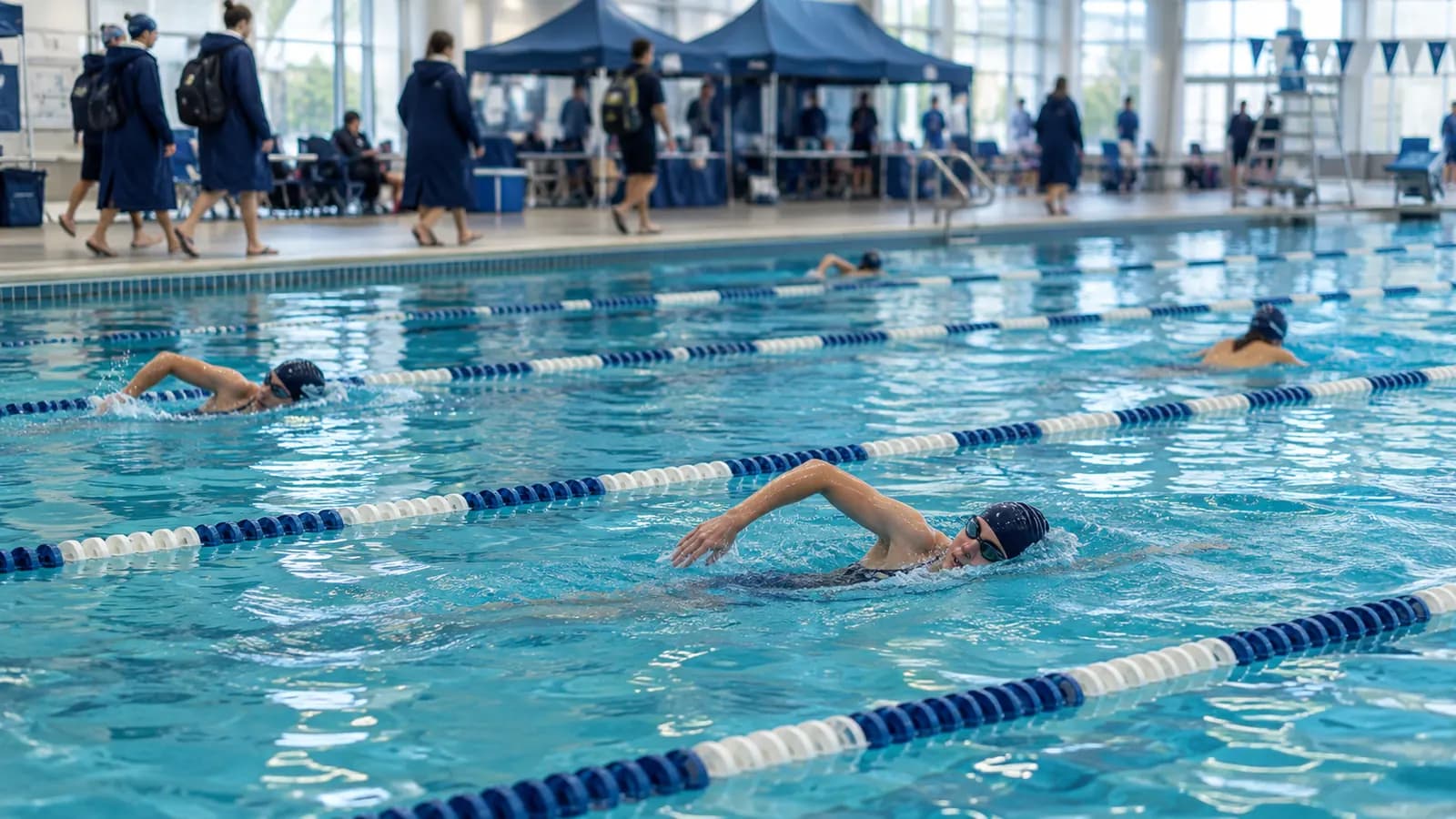
A swim-down is easy, continuous swimming right after a race. It brings your breathing and heart rate back down and clears fatigue before your next swim. Keep most of it easy, add a few short pickups in the stroke you just raced, and keep going until you actually feel recovered. How long depends on the race and on how soon you swim again, so your coach's plan comes first.
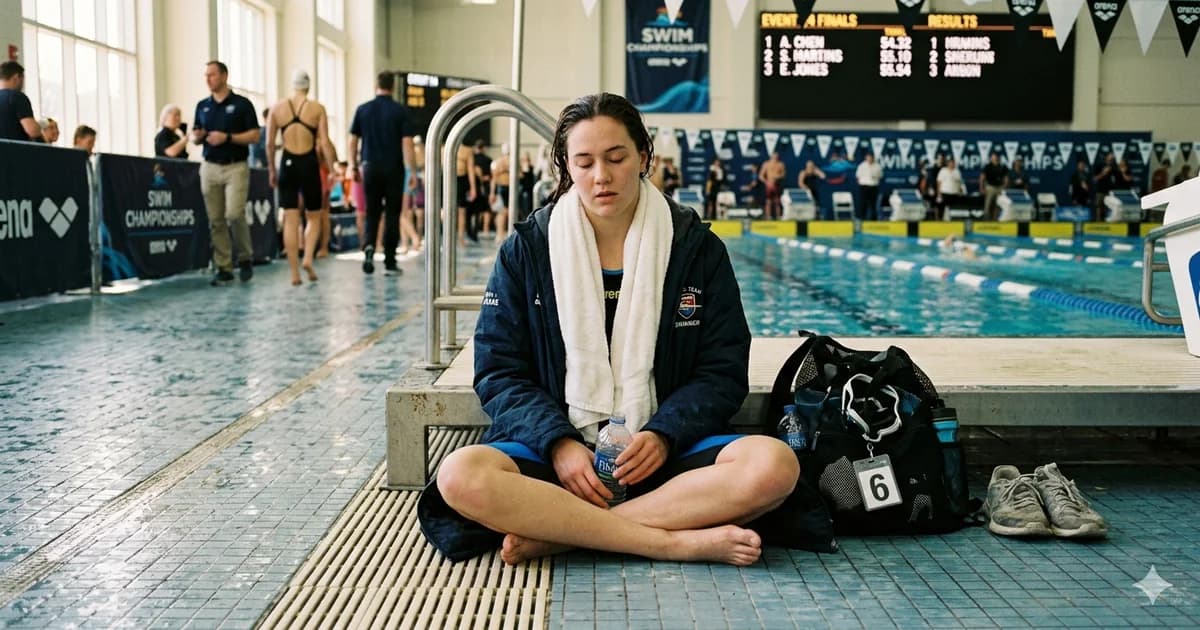
The race is over. Your legs burn, your lungs are working overtime, and the easiest thing in the world is to climb out, grab a towel and sit with your friends.
That moment shapes how your next race feels. A good swim-down is one of the few things at a meet that is completely in your control, and it only costs a few minutes. It is the other bookend to your warm-up: one gets you ready to race, the other gets you ready to race again.
Here is what a swim-down does, how long it should be, one example you can adapt with your coach, and the mental side we call repair, compare, prepare.
Why swim down after a race
A hard race pushes your body far from rest. Breathing and heart rate shoot up, and your muscles fill with the by-products of hard effort, including lactate. That is part of the heavy, tight feeling after a 200.
Easy swimming helps your body get back to normal faster than sitting still. In studies with competitive swimmers, easy active recovery (roughly 50 to 60% of 100 m race speed) cleared blood lactate faster than passive rest [1][2]. A later study found that when the recovery interval was longer, active recovery helped swimmers get back to their starting sprint performance [3].
One detail matters. Inside a sprint set with very short rest, the same line of research found that passive rest was better for the next sprint [1][2]. So a swim-down is not about moving every second of the day. It is for the gap between races, or between your last race and tomorrow, when there is time to recover properly.
A swim-down helps with three things:
- Your next race today. A final, a relay or another event later in the session.
- Tomorrow. Multi-day meets reward the swimmer who leaves the pool already recovering.
- Your head. A few calm minutes in the water give you space to let the race go, good or bad.
How long should a swim-down be?
There is no single right number. The honest answer: long enough that you feel recovered.
What changes how much you need:
- The race. A 200 or a 400 usually leaves you more tired than a 50.
- You. Two swimmers can swim the same race and need different swim-downs.
- Time to your next swim. If your next event is close, the swim-down may be shorter, and the rest of the time goes to staying warm and ready.
- Space in the pool. A packed swim-down lane sometimes means a shorter version.
Your coach knows your events, your schedule and how your body responds. If they give you a plan, that plan wins over anything in this article.
An example swim-down routine
This is an example to talk through with your coach, not a prescription. Adjust the distances to your age, your events and the time you have.
| Part | Example | Focus |
|---|---|---|
| Check-in | Take your heart rate as you start | A starting point, not a target |
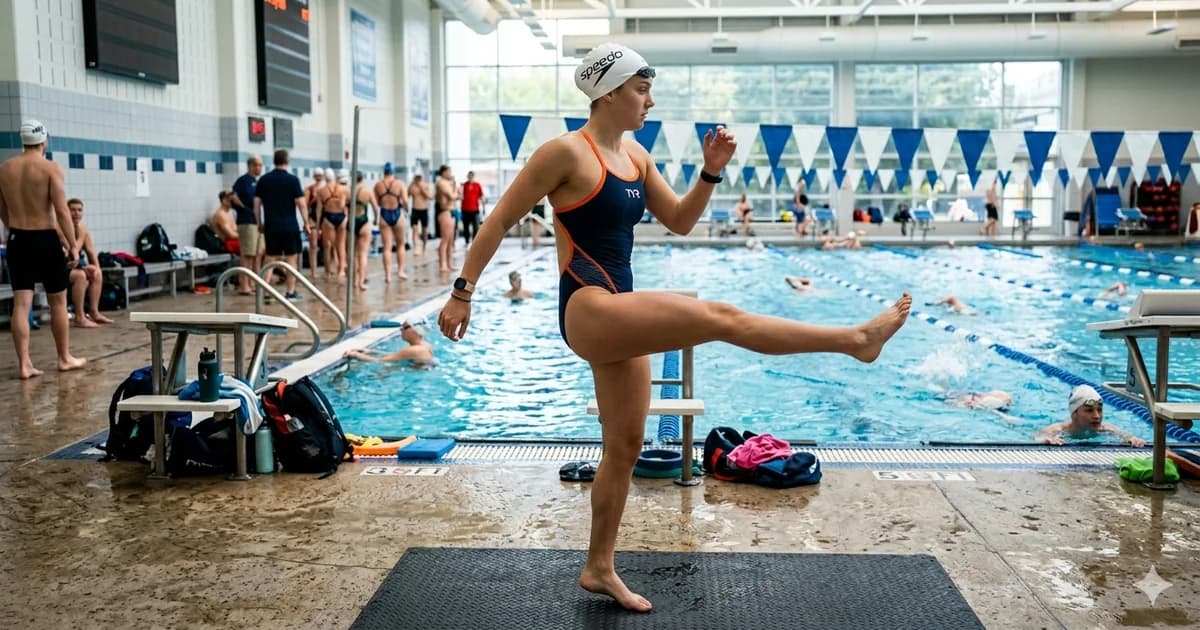
| Easy swim | 300 easy freestyle | Long, relaxed strokes and steady breathing |
| Short builds | 4 × 50, building speed within each one, in the stroke you raced | Smooth speed, never race effort |
| Easy technique | 200 easy, any stroke | Clean technique while tired |
| Check-out | Heart rate again, plus how you feel | Is it lower? Do you feel back to normal? |
Most of it is easy to moderate. The short builds remind your body what fast feels like without the strain. If you finish and still feel wrecked, ask your coach whether to keep going.
Pay attention to how you feel, not only your heart rate. A review of athlete monitoring found that athletes' own reports of how they felt reflected their training load better than many common objective measures [4]. Your sense of "I'm back" is real information.
Repair, compare, prepare: the mental swim-down
Your body is not the only thing that needs to come down after a race. Three words help with the rest.
Repair
Let the race settle in body and mind. If it went well, enjoy it. If it did not, use the easy laps to feel disappointed, then let it go. You do not have to fix anything in the water.
Compare
After the swim-down, check in with your coach. How did the race go against the plan? Did you go out the way you meant to? Did the back half hold? Splits answer that better than memory does. Once results are posted, you can look at your race split by split in Gophin. Our guide to reading swim splits shows what to look for, and why swimmers slow down in the second half explains the most common pattern.
Prepare
Turn to the next race. Pick one thing to keep and one thing to change. Then get ready: drink, stay warm and know when you need to be back behind the blocks.
Your swim-down is yours
It is tempting to get out because a teammate got out. Do not. Their race, their body and their schedule are different from yours. Two minutes of easy swimming they skipped is not a reason for you to skip yours.
Swim-downs also work best when they feel familiar. Practise them in training: after a hard set, try a version and notice how you feel at the end. Over a season you learn what brings you back, and at a meet you do it without thinking.
Before you leave the pool
After your last race of the day:
- Drink. Start replacing what you lost while racing. More in our hydration guide.
- Eat a snack with carbohydrate. Your muscles need fuel back, especially with another session tomorrow. Our guide on what to eat around a swim meet has easy ideas.
- Stretch gently. Nothing forced, just loosen what feels tight.
- Change into dry clothes. Sitting around in a wet suit leaves you cold and stiff.
After a big championship, recovery takes more than one evening. Our piece on recovery after championships covers the days that follow.
Travel meets: a short checklist
Away meets change your routine, so keep what you can the same:
- Keep your sleep routine as close to normal as possible. See how much sleep swimmers need.
- Bring your own water bottle and do not share it, especially in cold and flu season.
- Pack two bottles and more snacks than you think you need.
- Stick to familiar foods. Meet weekend is not the time to try something new.
- Keep warm between swims: parka, socks, dry clothes.
See how the race was really swum
The "compare" step works best with facts. Gophin loads official meet results on its own, with no typing of times, and Times → Splits shows each race split by split. You and your coach can see the front half next to the back half and check it against the race plan, then decide what to change before the next one. It is free.
Sign in and open Times → Splits →
Questions swimmers ask
How long should a swim-down be after a race?
Long enough that your breathing settles and you feel recovered. It depends on the race distance, how tired you are and how soon you swim again. Your coach's plan comes first. The example above is a starting point to adapt, not a rule.
Is it better to swim down or just rest between races?
Between races, easy swimming usually beats sitting still. In studies with swimmers, easy active recovery cleared lactate faster than passive rest. Inside a sprint set with very short rest, though, passive rest was better for the next sprint.
What should I do after my last race of the day?
Swim down, then drink, eat a snack with carbohydrate, stretch gently and change into dry clothes. Before you leave, check how the race went against your plan with your coach, using your splits.
Sources
- Toubekis, A. G., et al. (2005). "Influence of different rest intervals during active or passive recovery on repeated sprint swimming performance." European Journal of Applied Physiology. pubmed.ncbi.nlm.nih.gov/15778899
- Toubekis, A. G., et al. (2006). "Effect of different intensities of active recovery on sprint swimming performance." Applied Physiology, Nutrition, and Metabolism. pubmed.ncbi.nlm.nih.gov/17213885
- "Active recovery intervals restore initial performance after repeated sprints in swimming" (2018). pubmed.ncbi.nlm.nih.gov/29249177
- Saw, A. E., Main, L. C., & Gastin, P. B. (2016). "Monitoring the athlete training response: subjective self-reported measures trump commonly used objective measures: a systematic review." British Journal of Sports Medicine, 50(5), 281–291. bjsm.bmj.com/content/50/5/281





Comments
No comments yet. Questions about times, meets or the app are welcome.