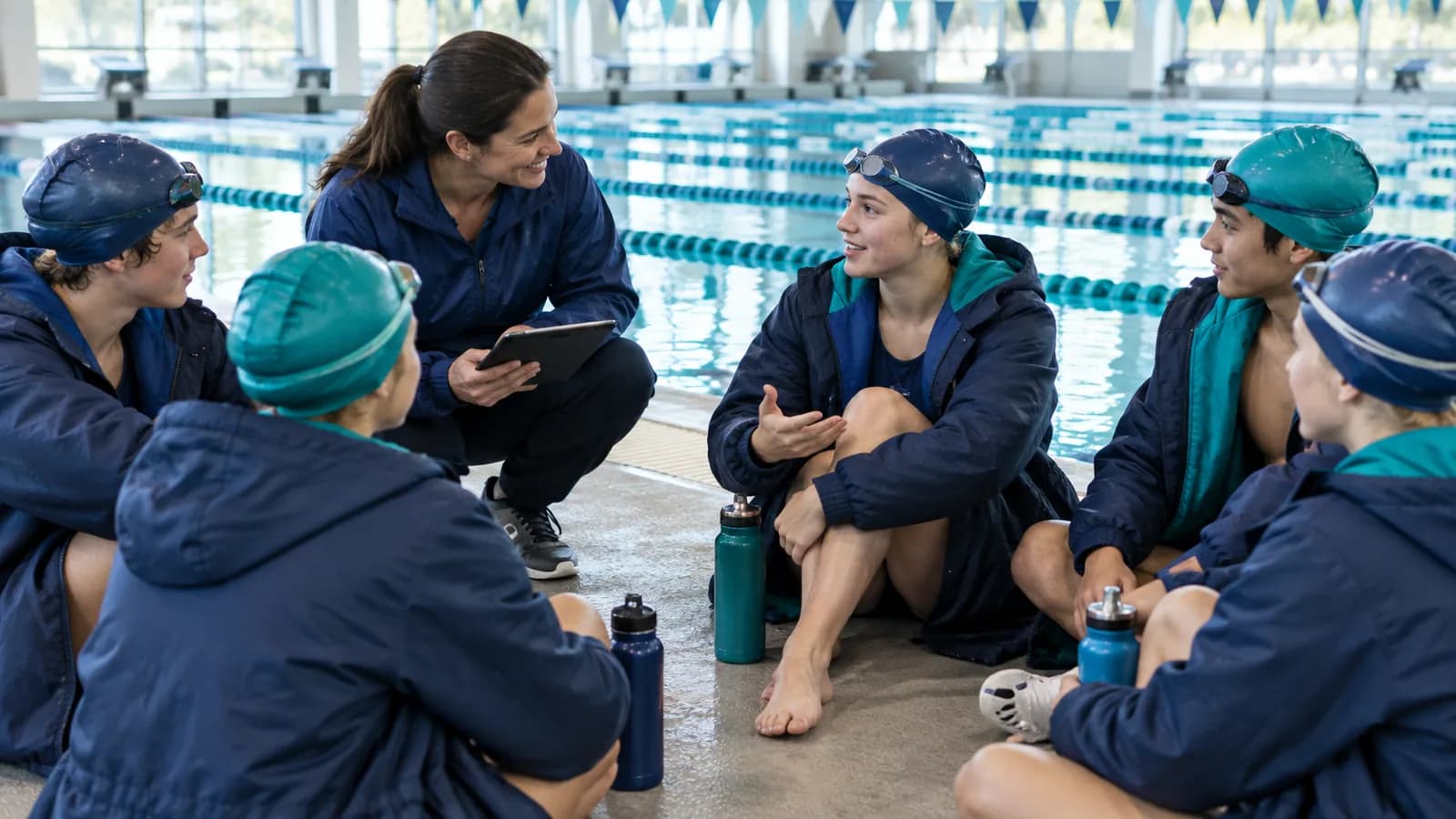
Quick answer
A weekly swimmer check-in is a short self-report, a few 1–10 ratings with one-line explanations, that the swimmer fills in and brings to a five-minute talk with the coach. Ask about sleep, aches and pain, recovery, training, meets, school, life outside the pool and mental skills. Look at trends across weeks, not single scores, and act on what you learn.
Slow times, nagging injuries and quiet dropouts rarely arrive without warning. The warning is usually there weeks earlier, in a swimmer who is sleeping less, dreading morning practice or carrying a sore shoulder they have not mentioned. Coaches see their swimmers often, but from the deck, in a group, with a set running.
A weekly check-in closes that gap. The swimmer answers the same short set of questions every week and brings them to a brief one-on-one talk. The answers give the coach a picture the stopwatch cannot, and they give the swimmer a regular, low-pressure moment to speak up.
Here is a template you can copy, why each block earns its place, which answers need action and how to keep the routine to five minutes.
Why self-report works
It can feel too simple to ask a swimmer "how was your sleep, out of 10?" The research says it is worth doing. A systematic review in the British Journal of Sports Medicine found that athletes' self-reported wellbeing reflected both short-term and longer-term training load with better sensitivity and consistency than commonly used objective measures [1]. The same review found that subjective and objective measures often did not agree, which is a good reason to keep both: the swimmer's own report next to what their race results show.
A check-in is also a skill in itself. Swimmers who learn to notice and name how their body and mind are doing are better at telling their coach what they need, a habit we cover in how to talk to your swim coach.
The check-in template
Ask the swimmer to rate each line from 1 (very poor) to 10 (excellent) where a rating fits, and to add one short sentence. Adapt the wording to the group's age.
Body and recovery
| Question | Rating | Explain in one line |
|---|---|---|
| How much sleep did you get most nights? | 1–10 | Roughly how many hours? What got in the way? |
| How does your body feel: aches, pains, injuries? | 1–10 | Where? Since when? What are you doing about it? |
| How well did you look after your body after training? | 1–10 | Stretching, mobility, rest days, anything else |
| How well did you fuel after practice and drink during it? | 1–10 | What did you eat after the hardest session? Did you bring a bottle? |
Why it matters. These are the first places a rough week shows up. Sleep is when a swimmer recovers from training, and our guide on how much sleep swimmers need explains the ranges. Fuelling and drinking are easy to fix once they are visible; see the hydration guide for swimmers.
Training
| Question | Rating | Explain in one line |
|---|---|---|
| How was your training week overall? | 1–10 | One word for it, and why |
| How did day-to-day practices feel? | 1–10 | Which day was hardest? |
| Which set did you swim well this week? | — | What made it go well? |
| What skill are you working on right now? | — | A start, a turn, a stroke detail |
| Do you want more, less or the same amount of feedback in practice? | — | Any kind of feedback that helps most? |
Why it matters. The "set you swam well" question trains swimmers to notice success, not only mistakes. The feedback question is one of the most useful on the sheet: some swimmers want a word on every repeat, others want space, and few will say so unprompted.
Meets and goals
| Question | Rating | Explain in one line |
|---|---|---|
| How did your last meet go? | 1–10 | One race you are proud of, one to learn from |
| What is your goal for this week? | — | Specific: what, when, how |
| What are your goal times for the next meet? | — | Event and time |
Why it matters. Specific, challenging goals lead to better performance than "do your best" [2]. Adding when and how ("in Tuesday's kick set, I will hold my streamline off every wall") strengthens follow-through: across 94 independent tests, plans of that if-then kind had a medium-to-large effect on reaching goals compared with setting the goal alone [3]. Steer weekly goals toward actions the swimmer controls; our piece on process goals in swimming shows how.
Mind and motivation
| Question | Rating | Explain in one line |
|---|---|---|
| How keen were you to come to practice? | 1–10 | What made it easier or harder? |
| How keen are you about the next meet? | 1–10 | Excited, nervous, flat? |
| Which mental skill did you practise? | — | Visualization, focus, relaxation, self-talk, supporting teammates |
Why it matters. Enthusiasm rarely disappears overnight. Coaches often see it fade a little at a time, which is why a steady drop deserves attention long before it shows up as missed practices.
Life outside the pool
| Question | Rating | Explain in one line |
|---|---|---|
| How heavy is your school workload this week? | 1–10 | Tests, projects, deadlines |
| How are other activities affecting your training? | 1–10 | Work, other sports, family commitments |
| What was something fun in your life this week? | — | Anything at all |
Why it matters. Swimmers do not train in isolation. A heavy exam week can explain a flat practice better than any training number. The last question keeps the check-in human.
Red flags to act on
Most weeks, the answers simply guide the coaching. Some patterns need more:
- Sleep falling and enthusiasm falling together, for two or three weeks in a row. That combination is worth a closer look against the signs of swimmer burnout.
- Pain that appears week after week, or any pain that changes how the swimmer moves. Tell the parents and suggest a health professional; our guide to swimmer's shoulder explains why early attention matters.
- School overload that keeps scoring high. Talk with the swimmer and family about adjusting the week before it turns into missed sessions.
If any answer suggests a safety or wellbeing concern, it goes beyond the check-in. Follow the club's safe sport procedure (in Canada, the provincial swimming association or, for national-level sport, the Canadian Safe Sport Program [4]; in the US, the U.S. Center for SafeSport [5]) and contact emergency services or child protection when someone may be at risk.
Making it work in five minutes
- Same day every week. Monday works well for planning; Friday for reflection. Pick one and stick to it.
- Keep the talk short. Five minutes, one or two lines discussed, not the whole sheet.
- Track trends, not single scores. A 4 on sleep once is a busy week. Three weeks of falling scores is a pattern.
- Act on what you learn. If a swimmer asks for less feedback and nothing changes, they will stop answering honestly.
- Keep answers within the coaching staff. Share with parents or health professionals when the swimmer's wellbeing calls for it, and tell the swimmer when you do.
- Respect communication rules. In the US, adults covered by MAAPP must include a parent or another adult on electronic communications with minor athletes [6], so an online check-in form should follow the same rule. Clubs elsewhere can adopt the same habit; it fits naturally in a club communication policy.
Pair what they tell you with what the results show
Over a season, the most useful view puts each swimmer's answers next to their races. The check-in tells you how the week felt. Results tell you how the races went. In Gophin, Groups puts a training group's official meet results side by side, loaded automatically, so you can see at a glance whether the swimmer whose sleep score keeps falling is also the one whose times have stalled. It is free.
Questions coaches ask
How often should swimmers do a check-in?
Weekly, on the same day. During taper or a championship week, cut it to three lines (sleep, body, enthusiasm) so it stays useful without adding pressure.
Is a check-in right for young age-group swimmers?
Yes, in a shorter form. For younger swimmers, ask three or four questions out loud, use faces or a 1–5 scale and let a parent help with logistics. Teens can handle the full sheet.
What should a coach do with one low score?
Ask about it, without rushing to fix it. One low score is a conversation. A trend across several weeks is a reason to adjust training, involve parents or suggest a health professional.
Sources
- Saw, A.E., Main, L.C. and Gastin, P.B. (2016). "Monitoring the athlete training response: subjective self-reported measures trump commonly used objective measures: a systematic review." British Journal of Sports Medicine, 50(5), 281–291. bjsm.bmj.com
- Locke, E.A. and Latham, G.P. (2002). "Building a practically useful theory of goal setting and task motivation: A 35-year odyssey." American Psychologist, 57(9), 705–717. doi.org/10.1037/0003-066X.57.9.705
- Gollwitzer, P.M. and Sheeran, P. (2006). "Implementation intentions and goal achievement: A meta-analysis of effects and processes." Advances in Experimental Social Psychology, 38, 69–119. Summary: U.S. National Cancer Institute. cancercontrol.cancer.gov
- Swimming Canada. "Reporting maltreatment." swimming.ca/reporting-maltreatment; Sport Integrity Canada. "Report a safe sport concern" (Canadian Safe Sport Program). sportintegrity.ca/report-safe-sport
- U.S. Center for SafeSport. "Report a Concern." uscenterforsafesport.org
- U.S. Center for SafeSport. "MAAPP: For Parents." maapp.uscenterforsafesport.org





Comments
No comments yet. Questions about times, meets or the app are welcome.