Quick answer
Most swimmers are not meant to drop time at every meet. Seasons are planned in blocks that end in a target meet, and the meets in between are often swum tired, on purpose, in the middle of heavy training. Best times tend to arrive after the taper at the end of a block. Compare this point of the season with the same point last season, in the same course, before deciding anything is wrong.
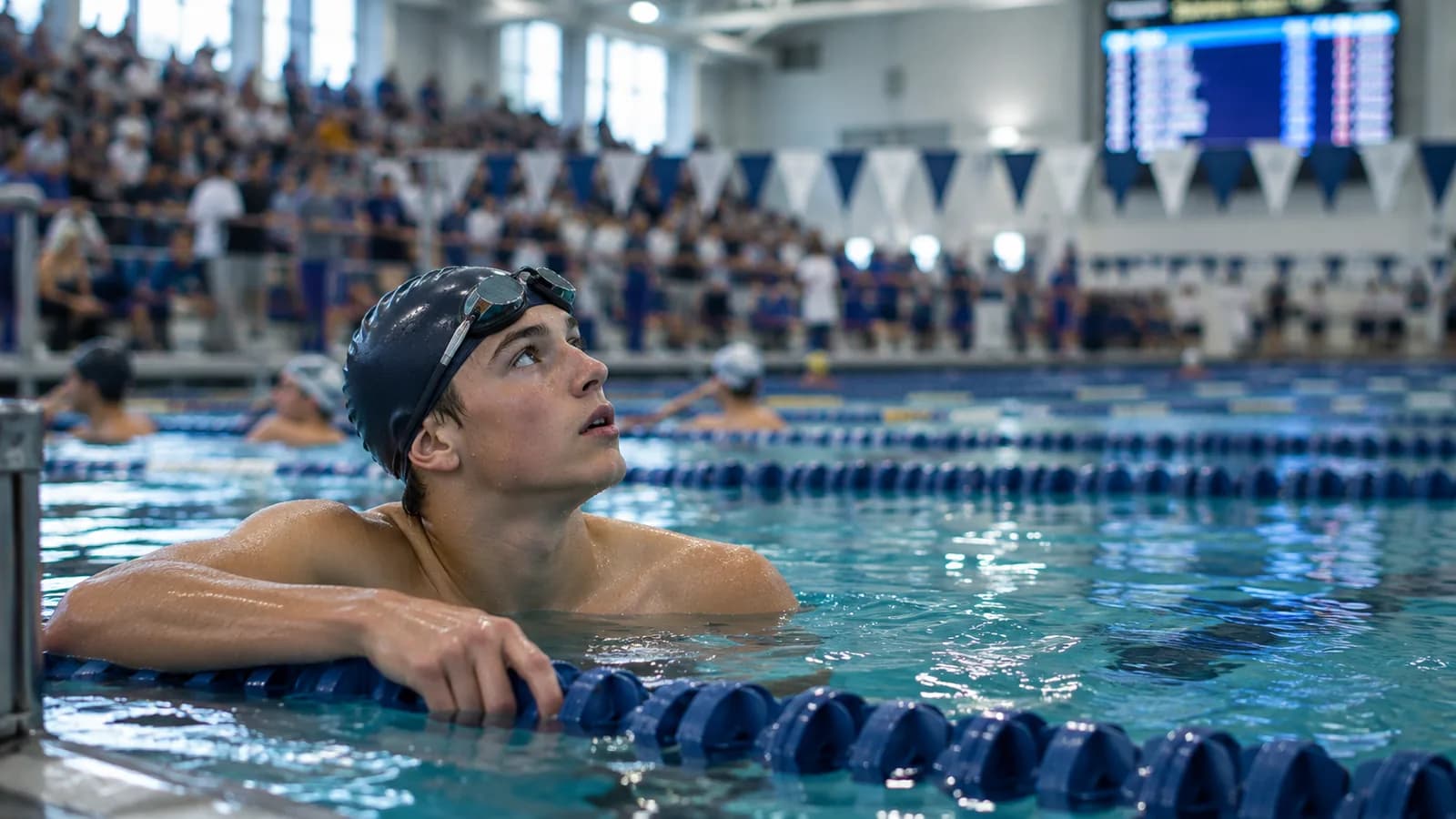
Your swimmer trained hard all fall. Then a December meet comes and goes, and the results sheet is full of times that are the same as last spring, or slower. On the drive home, everyone is quiet.
It is one of the most common worries swim parents have, and it usually has a simple answer: the meet was not designed for best times. Understanding how a season is built takes most of the sting out of it.
This guide explains why times stall mid-season, what to look at instead of the last result, and what to say (and not say) on the way home.
Seasons are built in blocks
Coaches plan a season in long blocks, often several months each, that build towards one target meet: a provincial or state championship, a sectional or a national meet. Inside each block, training moves through phases, from building fitness to sharpening speed to resting.
Meets along the way play different roles:
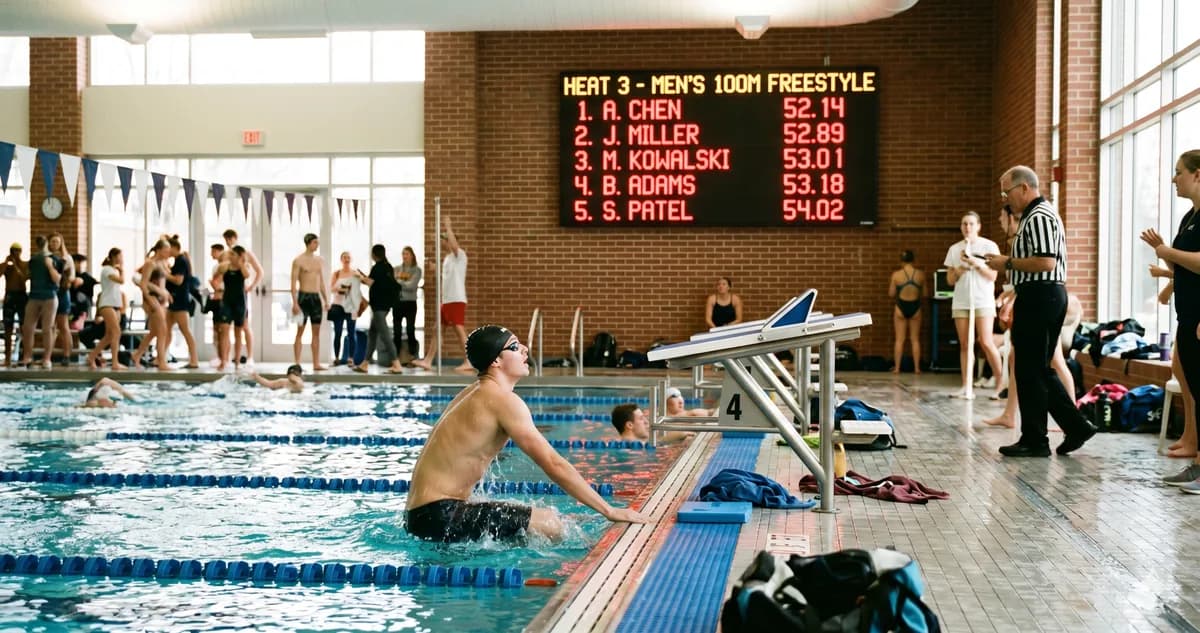
- In-season meets, swum under load. The swimmer arrives in the middle of heavy training, with no rest. This is deliberate. It is a chance to practise racing tired and to rehearse race skills: starts, turns, pacing, a new race plan.
- Partly rested meets. Some meets come with a few easier days beforehand. Times can improve, but the swimmer is not fully fresh.
- The target meet. It comes after a taper, a planned drop in training load. This is where the season's work is meant to show up.
So best times naturally cluster at the end of a block, not spread evenly across it.
How much difference a taper makes
Research on tapering is consistent. A review of taper studies found it improves competitive swim performance by about 3% [1]. In one study of Olympic swimmers, performance improved by an average of 2.18% over the final three weeks before the Games, with wide variation between swimmers [2].
To put that in perspective, here is an illustration only: 3% of a 1:05 100 free is roughly 2 seconds, and 2.18% is about 1.4 seconds. That is a large chunk of time to "hide" inside fatigue. A swimmer who looks stuck in December may be carrying exactly that much tiredness. Individual swimmers vary a lot, and age-group swimmers are not Olympians, but the idea holds: tired swimmers swim slower, by design.
Our taper guide for parents explains what happens in those final weeks.
Swimmers improve by the year, not the month
Progress in swimming is lumpy. A swimmer can go two or three months without a best time and still have a very good year. The useful unit of progress is the season, not the meet.
Researchers measure it the same way. A three-season study of talented swimmers tracked their progress with season-best times, year over year [3]. A study of more than 6,000 swimmers' careers in sprint events found that those who succeeded later often kept improving into their early twenties, while some early high performers stalled in their late teens [4]. One flat stretch says very little about the long run. See also why plateaus are normal.
Other reasons times can stall
Training load is the most common reason, but not the only one:
- Growth. A growth spurt changes levers, timing and strength-to-weight, often for months. Our guides on growth spurts and swim performance and growing taller but getting slower cover this in detail.
- Course changes. Short course yards, short course metres and long course metres are different races. A slower-looking time after a course change may not be slower at all. Compare the same course.
- Stronger competition. Around 13–14, fields get deeper and many swimmers are growing fast. Places can drop even when times hold.
- School and life. Exams, late nights and busy weeks all show up in the pool.
What to compare instead
Compare like with like:
- Season best, not only personal best. Is your swimmer faster than earlier this season? Our article on season best vs personal best explains why that is the fairer measure mid-season.
- The same point last season. December against last December, not against last year's championship.
- Championship against championship. Judge the target meet against last season's target meet.
- Splits. A swimmer can hold the same final time while swimming a much stronger second half. The splits guide shows what to look for.
What to expect at each type of meet
| Meet type | What to expect | What to look at |
|---|---|---|
| In-season, under load | Times near or slower than best; tired legs | Race skills, pacing, the process goals the swimmer worked on |
| Partly rested | Some season bests, maybe a few best times | Season best vs earlier this season, same course |
| Taper / championship | Where best times are meant to come | Comparison with last season's championship, same course |
Seeing the whole season in one place makes this easier. Put this season next to last season in Gophin and the December result stops looking like the whole story.
What parents can say and do
The ride home matters more than the result sheet.
- Skip the post-meet analysis in the car. Swimmers usually know exactly how they swam. Let the coach handle the technical debrief. Our guide on what to say after a bad race has phrases that help.
- Praise effort and process. Ask about the things your swimmer was working on, such as a better underwater, a new pacing plan or a turn, not just the time. The process goals guide explains how swimmers set these.
- Ask the coach where the target meet is. A simple "Which meet is this block building towards?" tells you when to expect fast swims, and when not to. Our guide on whether to talk to your swimmer's coach can help you frame it.
- Keep the long view out loud. "You're in the heavy part of training. The fast swims come later." Your swimmer hears your tone more than your words.
When it is worth a closer look
Mid-season stalls are normal. Some patterns deserve a conversation with the coach, and possibly a doctor: times getting clearly slower across several meets in the same course, ongoing pain, constant fatigue, frequent illness, or a swimmer who seems to have lost interest well beyond one rough meet. Our article on burnout signs explains what to watch for.
See this season next to last season
Gophin's Compare → Seasons screen puts this season next to last season, event by event, in the same course. Results load automatically from official meets, so there is nothing to type in. Use it to see whether your swimmer is on a similar track to last year, and to keep the target meet, not the last in-season meet, as the real test. It is free.
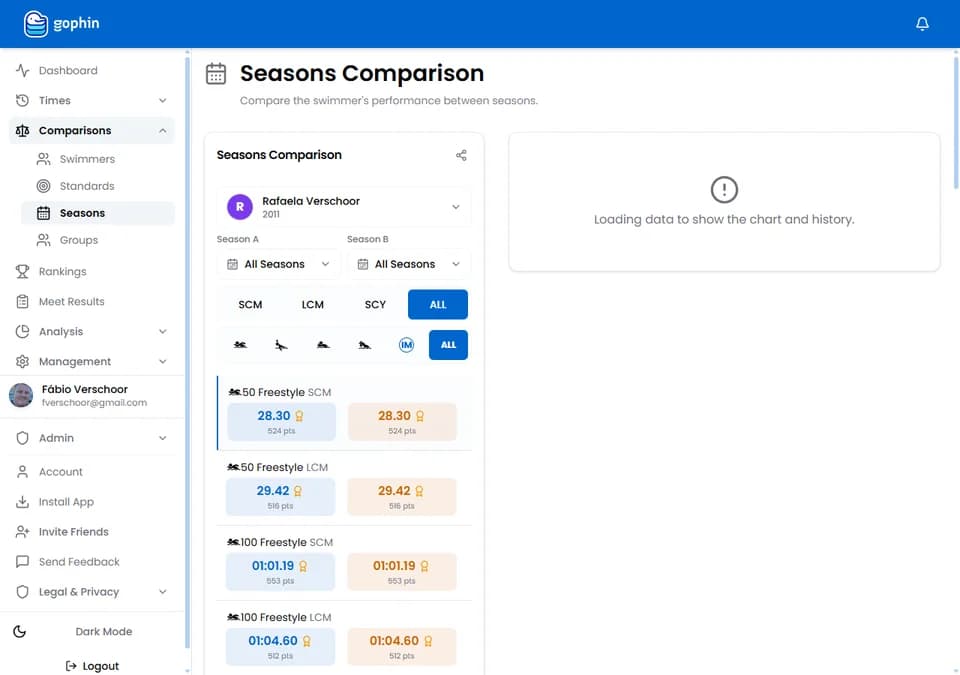
Open Compare → Seasons in Gophin
Questions families ask
Why is my swimmer slower at meets during the season?
Many in-season meets are swum in the middle of heavy training, without rest. Coaches use them to practise racing tired and to rehearse skills. Best times usually come at the target meet after a taper.
Why did my child add time at a swim meet?
Fatigue from training is the most common reason. Growth, a change of course (yards vs metres), school stress or a deeper field can also play a part. Compare with the same point last season, in the same course.
When should I expect my swimmer's best times?
Usually at the target meet at the end of a training block, after the taper. Ask the coach which meet the current block is building towards.
Sources
- Houmard, J. A., & Johns, R. A. (1994). "Effects of taper on swim performance: Practical implications." Sports Medicine, 17(4), 224–232. pubmed.ncbi.nlm.nih.gov/8009136
- Mujika, I., Padilla, S., & Pyne, D. (2002). "Swimming performance changes during the final 3 weeks of training leading to the Sydney 2000 Olympic Games." International Journal of Sports Medicine, 23(8), 582–587. doi.org/10.1055/s-2002-35526
- Post, A. K., Koning, R. H., Visscher, C., & Elferink-Gemser, M. T. (2024). "Growing up and reaching for the top: A longitudinal study on swim performance and its underlying characteristics in talented swimmers." Journal of Sports Sciences, 42(2), 132–145. pubmed.ncbi.nlm.nih.gov/38412227
- Brustio, P. R., Cardinale, M., Lupo, C., & Boccia, G. (2022). "Don't throw the baby out with the bathwater: talent in swimming sprinting events might be hidden at early age." International Journal of Sports Physiology and Performance. pubmed.ncbi.nlm.nih.gov/35894878




Comments
No comments yet. Questions about times, meets or the app are welcome.