Quick answer
Age group swim records help parents track real progress by setting a verified ceiling for what is possible at each age, against which the time standards system (B, BB, A, AA, AAA, AAAA) measures every individual swim. Records like Allison Higson's 1988 World Record at 15 and Halle West's 2023 Canadian age group record at 14 prove teenage talent is real, but the practical tool for tracking your own kid is the standards table for their exact age and event.
This guide unpacks what these teenage records actually mean for the average swim parent, the two numbers worth tracking week to week, and the question that opens the most productive conversation with a coach.
The Hook: Two Canadian Teenagers, 35 Years Apart
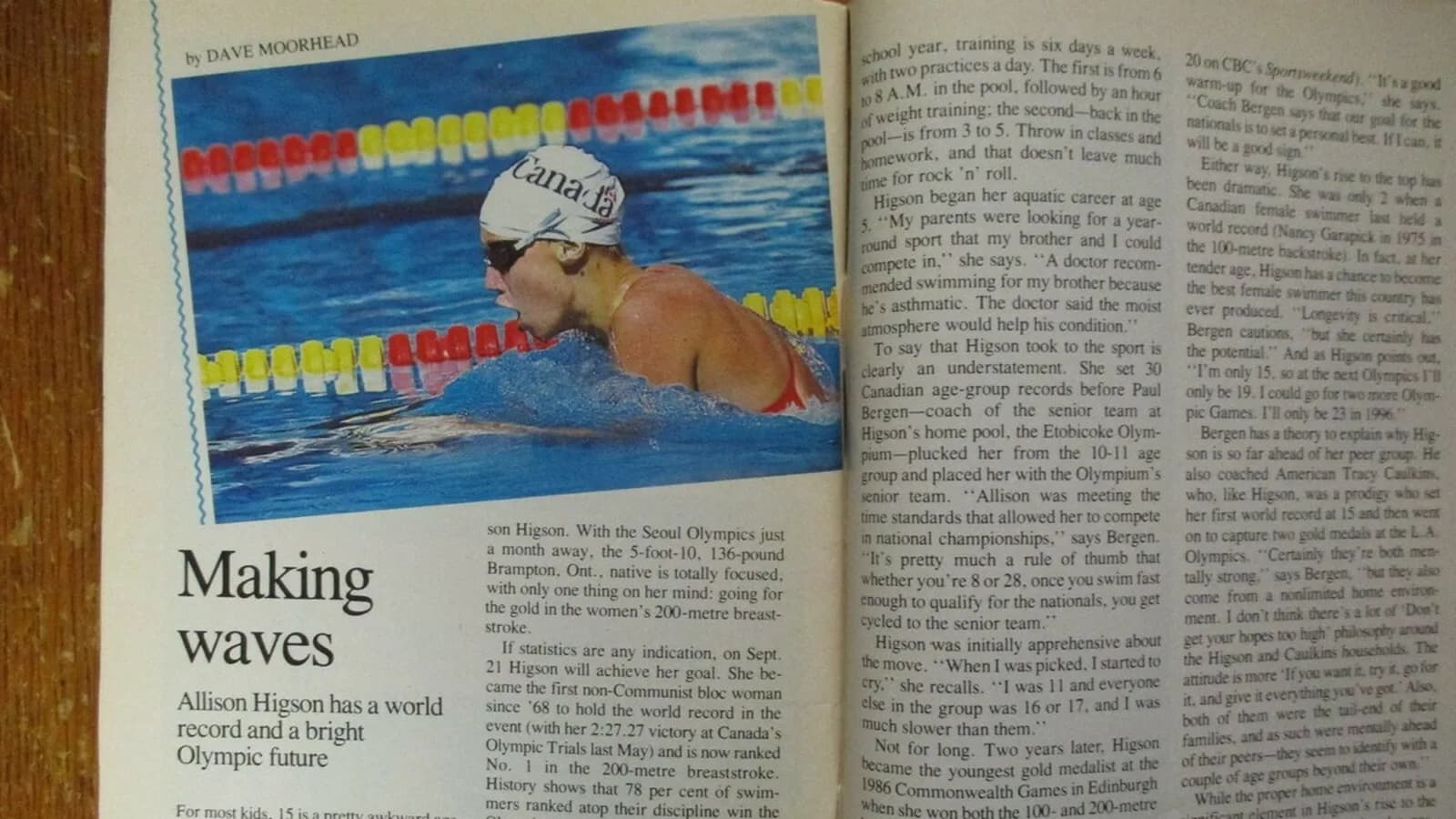
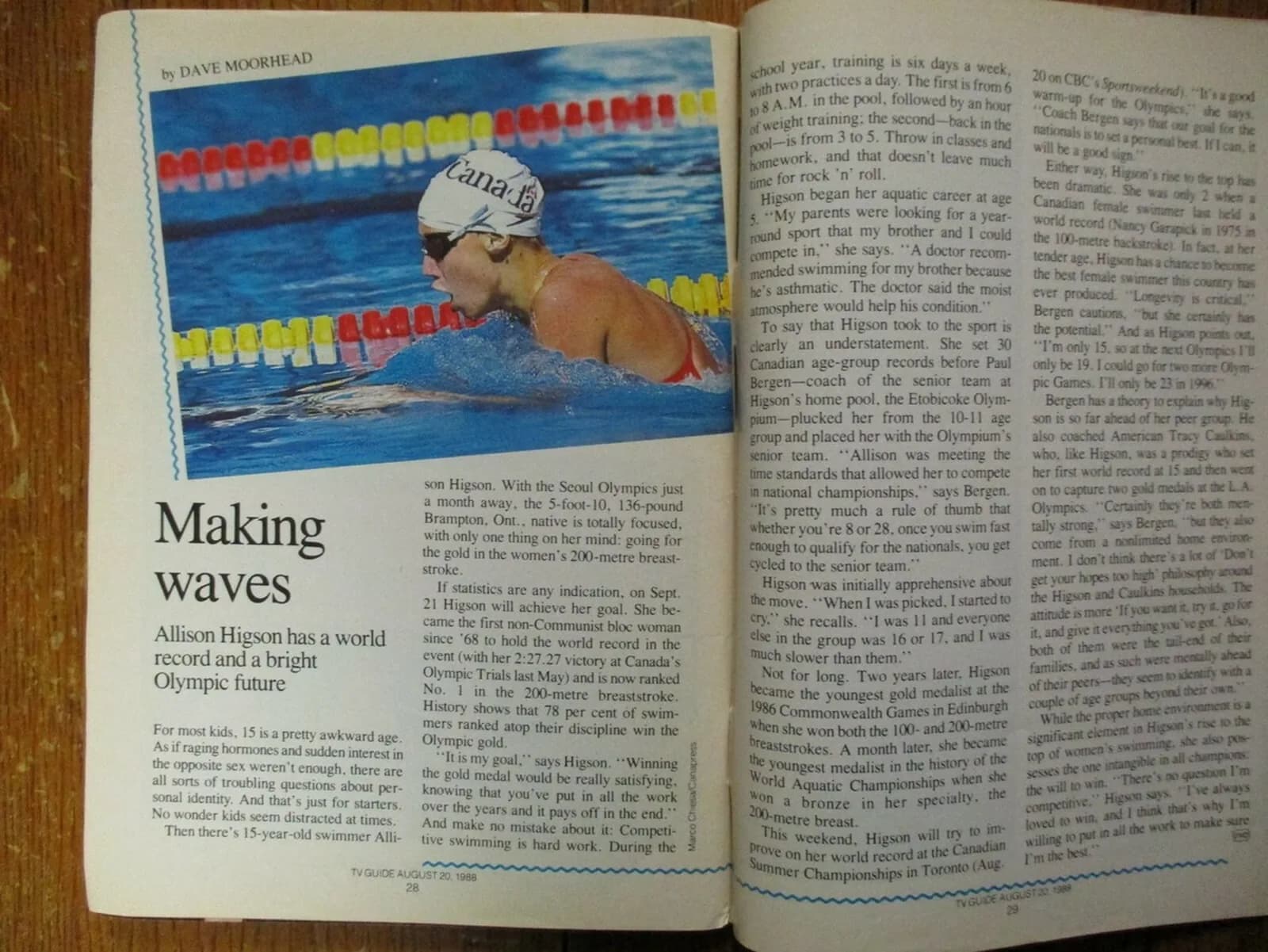
In May 1988, a 15 year old from Brampton, Ontario, named Allison Higson swam the 200 metre breaststroke in 2:27.27 at the Canadian Olympic Trials in Montreal. That time was a World Record. She was on the cover of TV Guide that summer (the article was titled "Making Waves") and she went to the Seoul Olympics in September of the same year.
In January 2023, a 14 year old from Manitoba named Halle West swam the 100 metre breaststroke in 1:08.09 short course (SCM, swum in a 25 metre pool) at the New Year's Invitational. That swim broke the Canadian 13-14 age group record that had stood from the same era as Higson's prime, and earned her 768 FINA points (FINA points are a universal scoring system that converts any swim time into a single number between 0 and 1,000 to compare performances across different events).
Different events. Different eras. Same age range. Both Canadian. Both real, verifiable, primary-source-documented talent showing up at an age when most parents are still figuring out their kid's preferred stroke.
These two stories matter because they bookend a question every swim parent eventually asks: what does normal teenage swim progress actually look like, and how do you tell the difference between a kid who is improving steadily and a kid who is plateauing?
Why Teenage Talent Surprises Everyone
Adolescent swimming progress is not a straight line. Some kids climb fast at 13. Some take off at 17. Some find their best event years after their first try at it.
The arc of a young swimmer's progress is shaped by a long list of variables: growth spurts (boys especially), training years before puberty, hand-eye-foot coordination changes, mental toughness around hard sets, sleep quality at school age, injury luck, and even simple body proportion shifts that change drag in the water. None of these arrive on a schedule.
For a deeper look at how growth specifically affects swim performance, our article Growth Spurts and Swim Performance: What Parents Should Know covers the typical patterns and what they mean for race results.
That is actually good news for parents, because it means there is room for every kind of journey. A kid who is mid-pack at 11 and AA-standard at 14 is on a perfectly normal track. A kid who set early age group records at 9 and is plateauing at 13 is also on a perfectly normal track. Both are real swimmers who can still get fast. Both need slightly different conversations with the coach and slightly different things to track.
Three Chapters of Allison Higson by 15
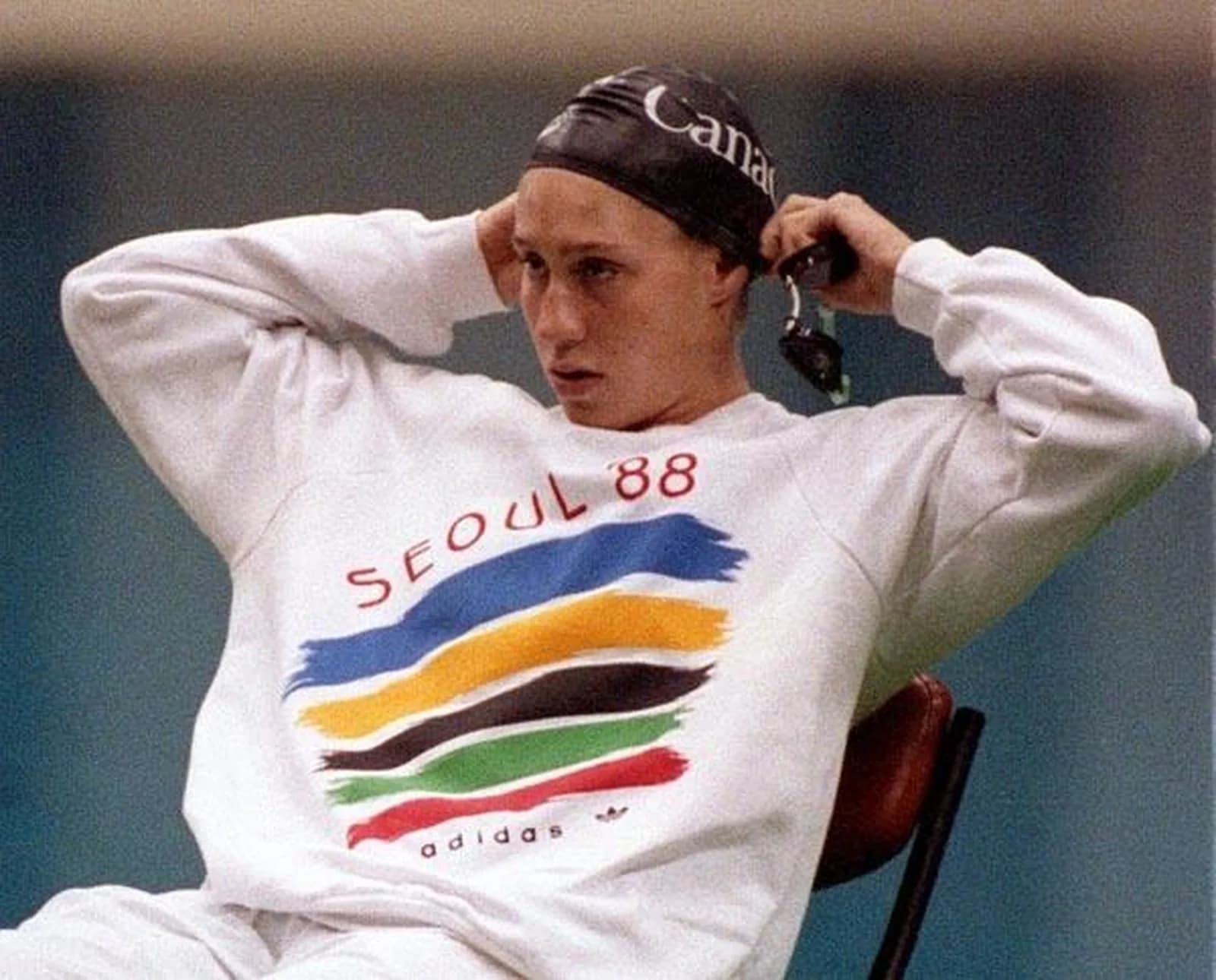
Allison Higson at Seoul 1988, age 15, primary source photograph from her Olympic Games appearance seven months after setting the World Record.
Higson's teenage career came in three big moments inside a span of two and a half years.
Edinburgh, 1986. At 13, she went to the Commonwealth Games and won gold in both the 100 and 200 metre breaststroke, becoming the youngest gold medallist in the meet's history at that time (source: Olympics.com biographical archive and the Canadian Encyclopedia). She had just learned she was going to the Games a few months earlier. Most 13 year olds had not even raced an international meet.
Montreal, May 1988. At 15, at the Canadian Olympic Trials in Montreal (long course, LCM, swum in a 50 metre pool), she swam 2:27.27 in the 200 metre breaststroke and set the World Record. The mark was ratified by FINA (now World Aquatics). She had jumped from Canadian record holder to World Record holder in a single race.
Seoul, September 1988. At the Olympics that fall, in the very same event, she finished 7th. She also won a bronze medal in the 4x100 medley relay (source: Olympics.com Allison Higson athlete profile). Seven months separated the World Record swim from the Olympic final, and the result was a 7th place finish, not gold. That is not a fall from grace. That is normal adolescent variability at the very top of the sport.
What these three chapters tell parents is that even at the highest level, teenage careers do not move in straight lines. The same swimmer, in the same event, at the same age, produced a World Record and a 7th place finish within seven months. Both were real. Both were her.
The Halle West Chapter
Halle West's record came in a very different time but tells a parallel story. In January 2023, racing for Maverick Manitoba, the 14 year old took the Canadian 13-14 age group record in the 100 metre breaststroke down to 1:08.09 short course. Her splits were 32.10 on the first 50 and 35.99 on the second, with 768 FINA points (source: SwimSwam Halle West feature coverage, Swim Canada records database).
The record she broke had stood from the same era as Higson's career. Two generations of Canadian breaststrokers, separated by 35 years, both made history at almost exactly the same age. That is the kind of pattern that emerges in age group rankings when you look at them over a long enough timeline.
The Two Numbers Every Swim Parent Tracks
Most swim parents end up tracking two different numbers about their kid: a personal best (PB) and a national age group ranking. These answer different questions and they should both be in your weekly mental model.
Personal Best (PB). Your kid's fastest verified time in a specific event, across their entire swimming career. It does not matter when it happened. If your 13 year old swam a faster 100 metre free as a 12 year old in March of last year, that older time is still their PB. PB tells you about training quality and individual progress.
For a deeper look at how PB compares to a season best and which one matters for qualifying meets, see Season Best vs Personal Best: What Actually Counts in Swimming.
National Age Group ranking. Where your kid sits relative to every other swimmer in their age group across the country in a given event. The lists are typically published by the national governing body (Swim Canada in Canada, USA Swimming in the United States) and updated continuously from official meet results. National rankings tell you about competitive position.
Both numbers matter. Watch only one and you miss the story the other tells. A swimmer can hold a steady national age group ranking while their PB keeps dropping (training is working, but their peers are improving at the same rate). A swimmer can drop their PB by three seconds and still slide down the national ranking (everyone is getting faster, your kid is keeping up).
Neither situation is bad. They are just different. And if you only watch the ranking, you might miss that your kid is improving. If you only watch the PB, you might miss that the field around them is moving.
The Standards That Bridge PB and NAG
The number that bridges PB and national rankings is the time standards system. In North America, motivational standards run from B (entry level) through BB, A, AA, AAA, and AAAA, with AAAA representing roughly the top 1-2% of swimmers in the age group nationally.
USA Swimming publishes its Motivational Standards as a single PDF, updated every four years. The 2024 to 2028 standards are the current edition (source: USA Swimming Times official documentation at usaswimming.org). Swimming Canada publishes provincial and national standards continuously through its meet management documentation (source: swimming.ca).
The standards do something neither PB alone nor national ranking alone can do: they tell you whether your kid's time is good for their exact age and event, against benchmarks that the governing body set across thousands of swimmers.
A B time in 12 and Under 100 metre freestyle for a girl is not the same as a B time in 13-14 100 metre freestyle. The standards move with the age group, because the expected speed moves with the swimmer. Hitting BB at 11 and BB at 14 in the same event is not the same achievement, the bar is significantly higher at 14.
For a complete walk-through of how the standards work and how to read them for your kid, see Swimming Standards by Age Explained, and for the official benchmarks, the USA Swimming Time Standards Guide.
Gophin tracks every official race result your kid swims and automatically shows where each time lands against the standards for their exact age and event. The basic standards reference is free for everyone. The full Compare to Standards view (with progress charts against AA, AAA, and AAAA targets across seasons) is free for everyone.
What Higson and West Have in Common
Allison Higson and Halle West are not the same swimmer in different decades. They raced different events, in different pool configurations, against different fields, with different training pathways behind them.
What they share is the simple fact that real, measurable swimming excellence is possible at 13, 14, and 15. Not common, but real. Both swimmers existed in primary-source documentation: meet results, official rankings, photographs from period publications, ratified records.
The reason this matters for the average swim parent is not that your kid is going to be the next World Record holder at 15. The vast majority of swimmers, even very talented ones, will not be. The point is that adolescent talent is real, age group benchmarks exist for a reason, and the right framing helps you cheer for the right things at the right time.
If your 11 year old is dropping seconds in BB territory and climbing the regional age group ranking, that is real progress. If your 14 year old is steady at AA level and the field is moving up around them, that is also real progress, just measured differently. Both deserve a celebration on the deck.
The Question Worth Asking Your Coach
Most parents bring the wrong question to the coach. The wrong question is some version of "will my kid be the next Halle West or the next Allison Higson?" Nobody can answer that. Not the coach. Not the parents. Not the kid. The honest answer is "almost certainly not, but neither could any specific 14 year old have predicted Halle West, and that is the point."
The right question is two parts. First: is my kid hitting the standards expected for their age in the events they swim most often? Second: what benchmark looks reachable in the next 6 to 12 months, and what does the training look like to get there?
Coaches can answer that second question in detail, because it is a coaching question, not a fortune-telling question. They know what your kid's stroke needs, what their meet schedule looks like, what their training tolerance is, what the realistic next BB or A standard is, and how to get there.
You can also help by tracking the standards system yourself between meets, so that when you sit down with the coach, you both have the same numbers in front of you. For practical guidance on tracking, see How to Track Swimming Times: A Complete Guide, and for the broader parent role across a swim season, our hub article The Supportive Swim Parent covers the full picture.
What to Do This Week
If you have read this far, here are three practical actions you can take this week as a swim parent:
- Look up your kid's most recent two race results. Note the date, event, stroke, course type (SC vs LC), and time.
- Find where those times land on the standards table for their exact age and event. B, BB, A, AA, AAA, or AAAA, or "below B" which still counts.
- Note whether the new time is a season best, a personal best, or neither. That gives you the story to celebrate (or to take to the coach with curiosity rather than concern).
If you want all of this in one place, automatically updated after every meet, start free with Gophin, no card needed.
One Last Thing
Adolescent swim talent does extraordinary things, and most of those things will not show up in a TV Guide cover article or a national record book. They will show up in B times turning into BB, in BB turning into A, in your kid walking off the pool deck with a faster time than last meet and a calm look on their face.
That is the story worth celebrating. The standards system, the ranking list, and the PB chart are how you keep track of it.
Open Gophin and see where your kid stands today, free.
Sources
- Olympics.com. Allison Higson biographical record, Seoul 1988 results and medal record. olympics.com
- The Canadian Encyclopedia. Allison Higson biography (Commonwealth Games 1986, Olympic Trials 1988, Seoul 1988). thecanadianencyclopedia.ca
- World Aquatics (formerly FINA). World Record ratification documentation, women's 200m breaststroke, 1988. worldaquatics.com
- Swim Canada. National Age Group records, 13-14 girls 100m breaststroke (Halle West 2023). swimming.ca
- SwimSwam. Halle West New Year's Invitational coverage, January 2023. swimswam.com
- USA Swimming. 2024-2028 Motivational Time Standards (B through AAAA), official PDF and Times documentation. usaswimming.org/times/time-standards
- TV Guide, August 20, 1988. Cover article "Making Waves" featuring Allison Higson at age 15 (primary period source).